
“You line up six blocks and you get through four. That is fine, until you forget which two”
Volleyball coach Dennis Boekhout, 28, on marking off what you got through: why ‘partly done’ is in there, and how the previous-session card hands your Tuesday to your fellow coach.
Six blocks on paper, sixty minutes in the hall. The warm-up overruns, serve receive asks for another fifteen minutes, and the last block is still sitting there while the net posts are being wheeled away. That is not a bad session. That is almost every session.
The problem only shows up a week later: you pull out your plan, you start at the top again, and the block that was left over last week gets left over again. Dennis Boekhout on the little circle behind every block, the counter above the programme, and the card that shows your fellow coach how your evening went.
Six blocks planned, four done. How often does that happen to you?
“Every week. I overestimate what fits into sixty minutes, and I have never met a coach who does not. You build your programme on a Sunday evening at the kitchen table, where nobody shanks a pass and nobody walks in ten minutes late.
“In the hall the warm-up overruns, serve receive asks for another quarter of an hour, and you never reach the last block. In itself that is fine. It only becomes a problem when I cannot remember next week which block it was.”
What exactly goes wrong then?
“You start at the top again. Everybody does: you open your plan, you see your warm-up sitting there, and you run the same order once more. The block that was last last week is last again this week.
“For me that was serving to zone 1. Third block, three weeks in a row, and three weeks in a row we never got to it. Written down like that it sounds stupid. At half past ten on a Tuesday evening it just feels like a session that overran.”
So what do you do after training now?
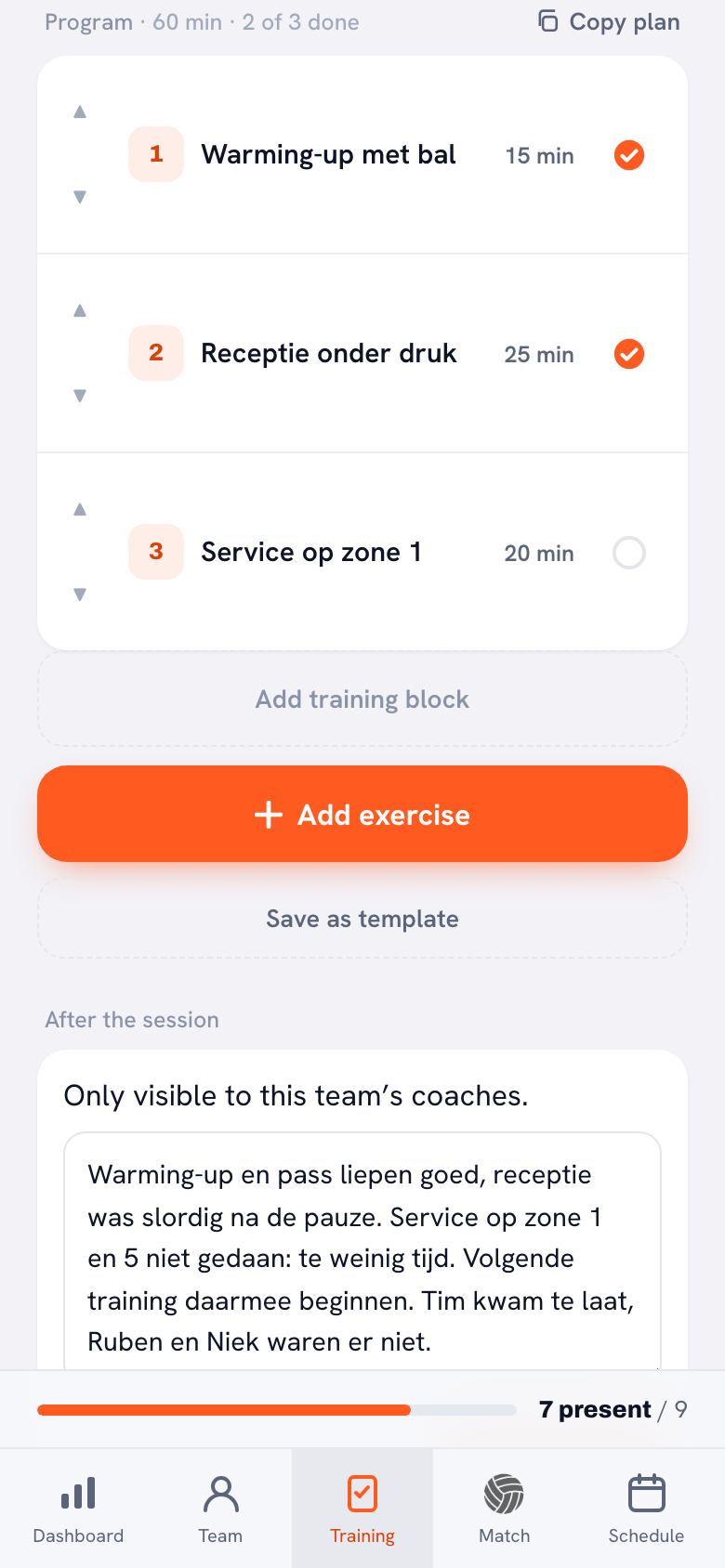
“Nothing special, and that is on purpose. Every block in the programme has a little circle beside it. You tap it and the state changes. No separate screen, no form, no Save button. The state travels along with the rest of the block.
“It had to be that way, because the moment you fill this in is the worst possible moment. Your phone is in one hand, with the other you are dragging a net away, and a parent is walking towards you. Anything that takes more than one tap simply does not get done.”
That circle has three states. Why not a plain tick box?
“Because a tick box lies. One tap and the block is done, with an orange tick. Another tap and it is partly done: a half filled circle. Another tap and it is not done, with a grey cross. Tap once more and it is empty again, for when your thumb got ahead of you.
“The middle one matters most. Most sessions end up there. You did serve receive, just not half of what you had in mind. Mark that as done and you are lying to yourself next week. Mark it as not done and you are selling your players short. Partly done is exactly what it was.”
And that counter in the header?
“At the top it says what the evening was: Program, 60 min, 2 of 3 done. One line, and it is exactly enough. You do not have to scroll past every block to see whether you have finished updating.
“It only counts the blocks you got through completely; half a block does not count, because half is not whole. And the counter only appears once you have tapped the first circle. On a session where you recorded nothing it simply says Program and the minutes, with no zero to make you feel bad.”
I notice the circle is not there on next week’s session.
“No, and I thought about that for longer than it deserves. The circle only appears on a session dated today or earlier. You do not tick off something that still has to happen.
“Otherwise you get the behaviour I see in every to-do list: on Thursday people mark Saturday’s plan as done because it looks tidy. Then you are measuring your own intentions instead of your training.”
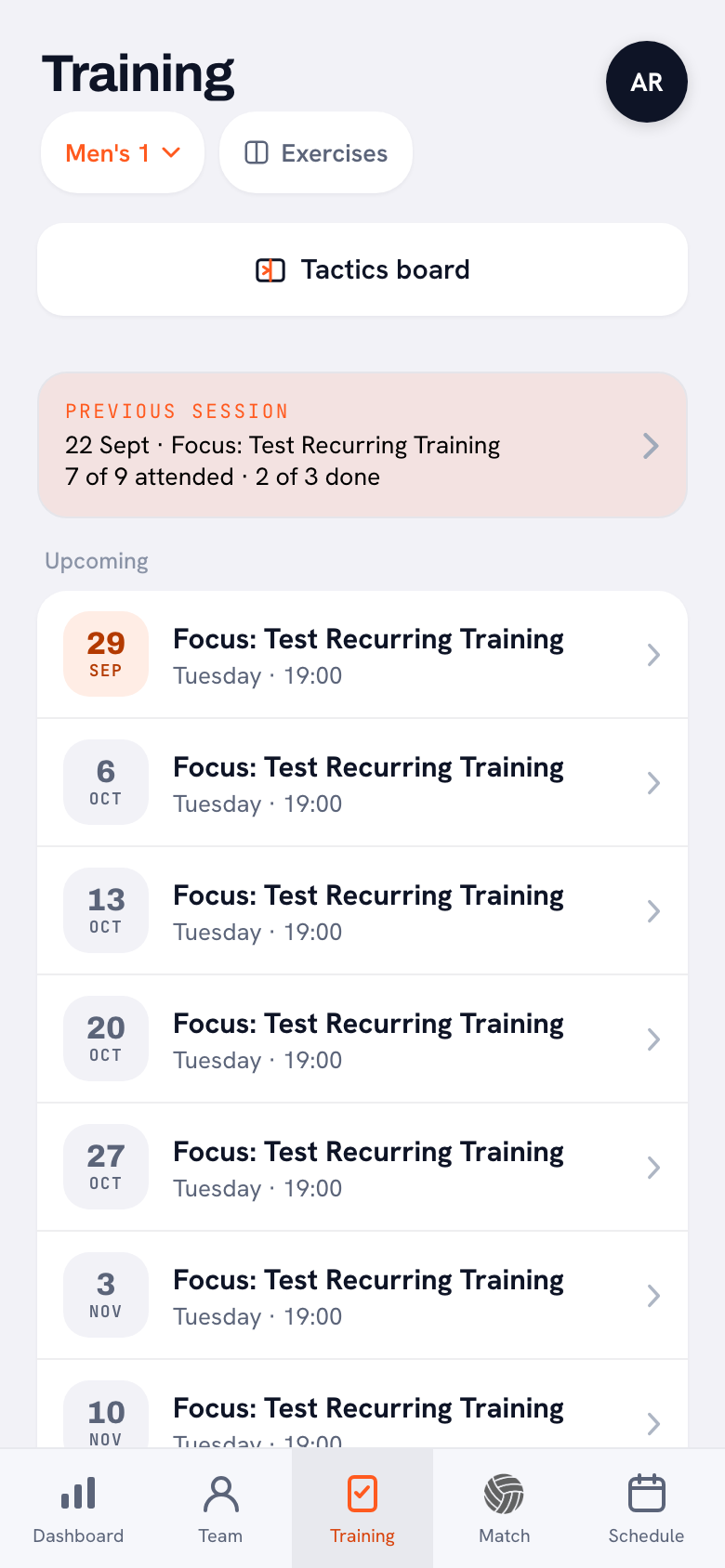
There is a card at the top of the Training tab now. What is on it?
“The previous session, and nothing more. The date, the focus you gave it, how many players were there and the done count. For me it reads: 22 September, 7 of 9 attended, 2 of 3 done.
“That card did not use to be there. The last session simply sank down the list, under the heading Past, and you had to know to go looking. Nobody does that at quarter to seven on a Tuesday evening.”
What good is that card to you if you were there yourself?
“None to me. Plenty to my fellow coach. He takes Saturday, I take Tuesday. He taps that card and he is straight into my evening: which blocks were planned, what we got through, and if I wrote something down, my report underneath it.
“That is the whole point. Not that he reads my session like a school report, but that he does not have to walk into the hall with an empty head.”
Does that replace the conversation between you?
“No, and I am not going to claim it does. A done count does not tell you the mood was rotten, that two players were bickering, or that serve receive actually fell apart on one player. That belongs in a conversation, and no little circle replaces it.
“What it saves is the first five minutes of that conversation. Those always went on what had happened. Now we start at what we are going to do about it. That is all it is, and that is already a lot.”
Is there a grade on top of this? A percentage across the season?
“No. No graph, no score, no coach of the month. That would turn something into a number that is not a number. A session where you drop two blocks because the third one finally starts to click is a good session.
“The only thing I do with it: before the next session I have a quick look at what is still open. If the last block is sitting there with a cross, that is where I start this week. That is how zone 1 finally got its turn after three weeks.” [laughs]
Know next week what got left behind
Koach records for every training block whether it was done, partly done or not done, and puts that state at the top of your Training tab. Free to try: build your programme and update it right after tonight’s session.
Try Koach free