
Beach volleyball drills by yourself: training without a partner
The short answer
Beach volleyball drills by yourself work well if you practice what you can start on your own: tossing the ball up and playing it high, setting with the net as a reference, serving at targets and footwork and jumps in the sand. Bring several balls, count what works and come back at a fixed hour every week.
Beach volleyball drills by yourself sound like a stopgap, but an hour alone on the sand gets you more ball contacts than an evening of pickup games. Here you read what you can and cannot train without a partner, an hour block by block and how to keep it up every week.
What can you train on your own on the sand?
Without a partner you train everything you can start yourself: your ball control, your serve, your footwork, your approach and jump, and the direction of your set. That is where most players have a lot to gain, because in a pickup game you only touch the ball a few times per rally.
What does not work: receiving a real serve, reading a hitter, timing your block against an attack and playing together with your partner. Do not try to imitate that. Plan those parts for the evenings you play with others, and use your hour alone for the rest.
If you have no sand but do have a wall, the drills are in volleyball wall drills; without a wall or net they are in volleyball drills at home. If you coach an indoor team on the beach, see beach volleyball drills for your indoor team; that article also covers what the sand changes about your footwork. This article is about you alone, on a beach court with a net.
What to bring
- Three to six balls. With one ball you spend half the hour chasing it. With more balls you serve or set a series and then collect them all in one go.
- Targets. Four to six cones, disc markers or towels. A towel on the sand makes a fine target, and you can see it from far away.
- Water, sunscreen and a cap. On an open court you stand in the sun and the wind for an hour.
- Something to write on. A note on your phone is enough. You are going to count, and you want to see those numbers again next week.
An hour alone on the beach court, block by block
The hour follows the same structure as a team practice: first warm up, then technique, then something with a count. How coaches build such a structure is covered in running a volleyball practice.
1. Warm-up in the sand (10 minutes)
Jog a few laps around the court, then side steps, skips, short accelerations over five meters and arm circles. Finish with ten jumps that you make a little higher each time. Do everything on the sand itself, not on the path next to it: your ankles and calves need to get used to the soft surface.
2. Self-toss and play (12 minutes)
- Keeping it up with a condition. Play the ball up with your forearms, every time above the top of the net. Series of twenty; write down your longest series. Then alternate forearm and overhead.
- Toss and move. Toss the ball diagonally away in front of you, sometimes short, sometimes far. Get under it and play it high to a towel a meter from the net. Ten balls to the left, ten to the right. On your own, this is as close as you get to a pass on the move.
- Yourself first, then the target. Play the ball high to yourself, make a quarter turn and only then play it to the towel. In beach, whoever passes is often also the one who attacks next; this drill trains the switch after the first contact.
3. Setting with the net as a reference (10 minutes)
Stand one to two meters from the net, toss the ball up for yourself and set parallel to the net to a towel near the sideline, a meter from the net. The net is your measuring stick: the highest point of the set is clearly above the top of the net and the ball lands at the towel, not past it. Goal: eight out of ten within one step of the towel. Then also set balls that you first toss far from the net, as after a poor pass.
Alternate overhead and forearm setting. Overhead play is stricter in beach than indoors. Indoors, a team's first ball may make two contacts within one action; in beach that is not allowed if you play it overhand with your fingers (FIVB beach rule 9.2.2.2), and in both a set may never be a double contact. That is why many beach players bump set. Train both, so you can choose in a match.
4. Serving at targets (15 minutes)
Put targets in the other half and serve series of ten. Serve all your balls, walk to the other side, collect them and serve back from there. That way you only collect once per series, and you serve alternately with and against the wind. Which serves work on sand and how to adjust them to the wind is covered in the beach volleyball serve.
Turn it into a game at the end. In Around the world you serve the six zones in a fixed order and only move on once you hit. On your own, count how many serves you needed to get all the way round. That number is your record.
5. Footwork and jumping (8 minutes)
- Footwork. The T-drill works just as well in the sand as indoors: forward, sideways to the left and right, backward, and staying low. Three to four rounds, with rest in between.
- Approach. In the sand most players use a shorter approach, often two steps instead of three. First do five approaches without a ball. Then toss the ball high for yourself at the net and hit it at the highest point over the net to a target.
- Block steps. Sideways along the net, two steps and a block jump, there and back.
Keep the number of jumps limited. Jumping and sprinting in loose sand asks a lot of your calves and Achilles tendons, especially in the first weeks. Stop when your landing gets sloppy. If pain persists or is severe, see your doctor, a sports physician or a physiotherapist.
6. Finishing (5 minutes)
A game against yourself: ten serves, a ball on a target is a point, an error costs a point. Try to beat last week's score. Then cool down with an easy walk or jog.
Count everything. An hour alone only becomes practice when you know what worked. After every session, write down three numbers: your longest series of keeping the ball up, your serves on a target and the number of sets that landed at the towel. After a month you see whether you are improving.
A fixed hour every week: how to keep it up
- Put it in your calendar. The same day, the same hour, just like a practice. An hour you only plan when you feel like it is gone at the first rain shower.
- One goal per week. For example the serve to the short zone, or setting after a poor toss. The rest of the hour stays the same.
- Two weeks the same, then harder. Make the target smaller, stand further from the net or use a harder toss. Change one thing at a time.
- Choose your time. In hot weather, practice in the morning or late in the afternoon, and drink before you are thirsty. If the court is taken, do the footwork and the ball control next to it and serve later.
- Combine it with playing. The hour alone is preparation; in two against two you test what it brings. One fixed evening alone and one fixed evening with others is a good split.
A drill from your coach on your phone
If you play on a team that works with Koach, your coach can give you a drill as homework. The coach chooses which players get the drill, and you then see it on your dashboard, with the drawing and the animation of each phase. That way you know exactly what the idea is when you are on the sand. How that works for a coach is in giving players homework.
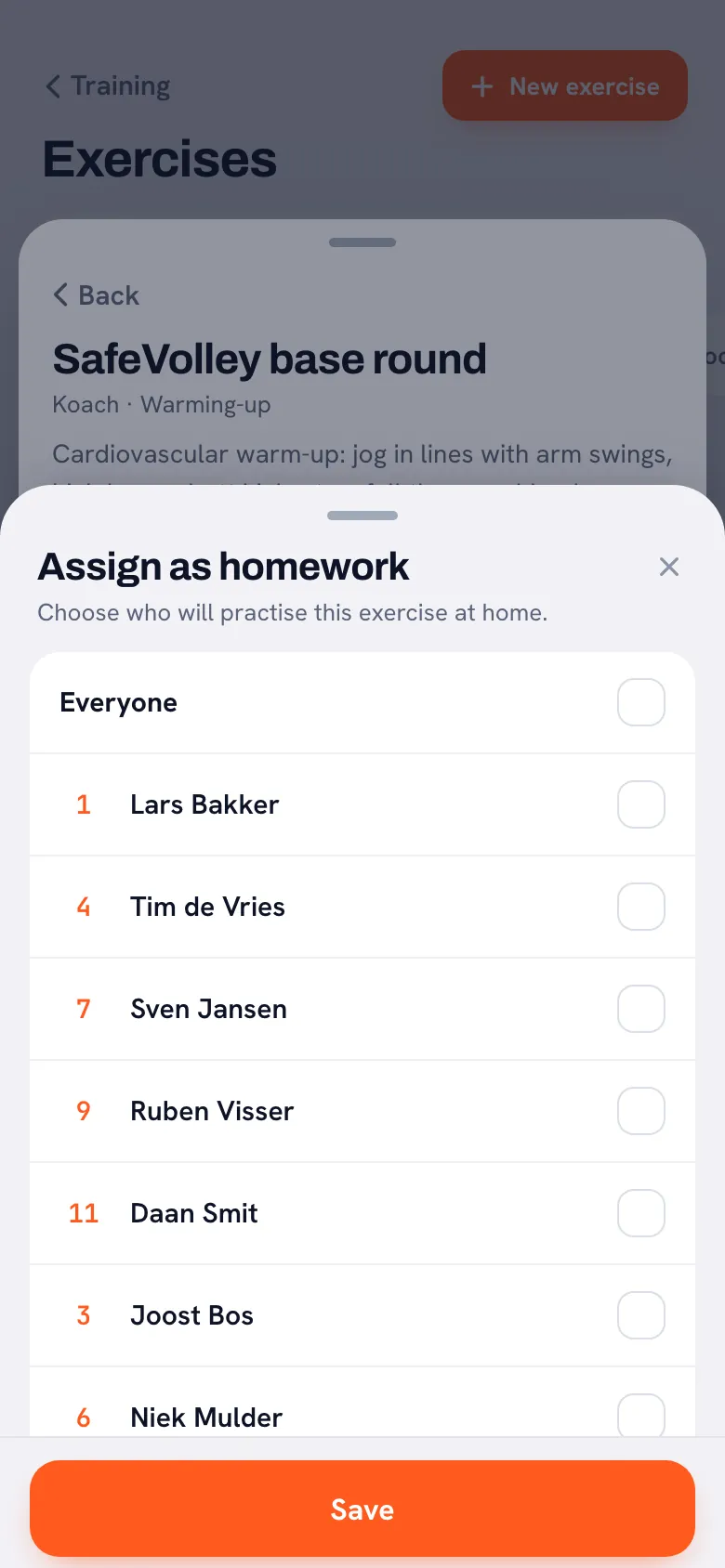
As a player you pay nothing: your account falls under the team's subscription. The drills linked in this article are on the site with their animation, no account needed. A coach first tries Koach free for 14 days; what it costs after that is on the pricing page.
14 days free, no credit card. Are you a coach? Give your players one drill for the sand this summer and ask about their record after two weeks.
Give homework in KoachFrequently asked questions
Can you practice beach volleyball by yourself?
Yes, to a large extent. Alone you train ball control, setting, serving, footwork and your approach and jump. What you cannot train without others is receiving a real serve, reading a hitter and playing together with your partner. So combine a fixed hour alone with an evening on which you play two against two.
How many balls do you need to practice alone?
Three to six. With one ball you lose a big part of the time chasing it. With more balls you serve or set a whole series and then collect them all in one go. If you serve from both sides, you collect the balls on the other side and serve straight back.
How do you practice your serve alone on the beach?
Put targets in the other half, for example towels in the corners and just behind the net, and serve series of ten. Count how many balls land on a target. Serve from both sides, so you practice with and against the wind. Finish with a game against yourself and try to beat last week's score.
Is practicing in the sand harder than indoors?
For most players it is. You sink in with every step and every takeoff, so running and jumping take more strength. Your calves and Achilles tendons in particular work hard. So build up the number of jumps gradually and stop when your landing gets sloppy. If pain persists or is severe, see your doctor, a sports physician or a physiotherapist.
Give your players a drill for the sand
14 days free, no credit card. After two weeks, ask about their record.
Get started with KoachOr read first what the volleyball coaching app does.