
Choosing drills for practice: goal first, then who shows up
The short answer
Choosing drills for practice is quickest in a fixed order: first the goal of the session, then the turnout, courts and balls, and only then variety compared with previous weeks. Pick one main drill that trains the goal and build the rest of the practice around it.
Choosing drills for practice takes longer than it needs to if you start from a list of drills instead of from what your team needs to learn. Here is an order you can use every week, and how you choose faster in Koach since version 3.1.
How do you choose drills for a practice?
Don't start with the drills, but with three questions, always in the same order. Work like that and you quickly have a plan that holds up, even after a busy day at work.
- What needs to improve tonight? Pick one main theme, ideally from what you saw in the last match or practice: passing under pressure, covering behind your own attack, serving to a fixed zone. Every drill you choose after that trains that theme or prepares the players for it.
- Who and what do you have? Count how many players are coming, how many courts and balls you have and how many minutes. A drill in groups of three only works with twelve players if you have four stations and enough balls. Otherwise eight players stand around waiting.
- What did you do the last few times? Look back at your last two or three plans. Keep what works as a routine, such as a fixed warm-up pattern, and change the form of the rest rather than the theme.
The usual progression within one session runs from simple and predictable to game-like, with a game at the end in which the theme comes back. How to split a session into blocks is in structuring a practice in blocks, and the whole line from preparation to evaluation in running a volleyball practice.
What you see, and which drill you pick
The goal usually comes from what went wrong. A few familiar situations, with the choice that often fits:
| What you see | What you pick |
|---|---|
| Players stand around waiting for a long time | A drill in pairs or groups of three at several stations at once |
| The theme works in the drill, not in the match | A game in which points only count when the theme succeeds |
| Everyone knows the drill and switches off | The same theme in a different form, or one extra rule |
| Far fewer players turn up than planned | A form on half a court, or a drill that works with six |
Choosing drills when you don't know who's coming
Turnout varies, especially in youth teams and in the weeks around holidays. So preferably choose drills that scale: a drill in groups of three works with nine players in three groups and with twelve in four. For your main drill, also think straight away about what you do with an odd number, for example one player who tosses or who rotates in after every turn.
The number of players you see in a drill's diagram is usually one group, not your whole team. So don't just check whether the number fits, but also whether you have enough space and balls for the number of groups you need.
How do you avoid doing the same thing every week?
Repetition isn't wrong: you only learn a theme by doing it often. What makes players switch off is exactly the same form, week after week. So change one thing each time: where the ball comes from, tossing or hitting, a scoring rule, a time limit or a smaller target. The theme stays, the form shifts. Why that variation works and when repeating is the better choice is in differential learning.
Choosing drills for your practice in Koach
In Koach you plan a practice on the practice screen, under Plan. + Add drill opens the Add drill sheet, with a search field and chips for the categories.
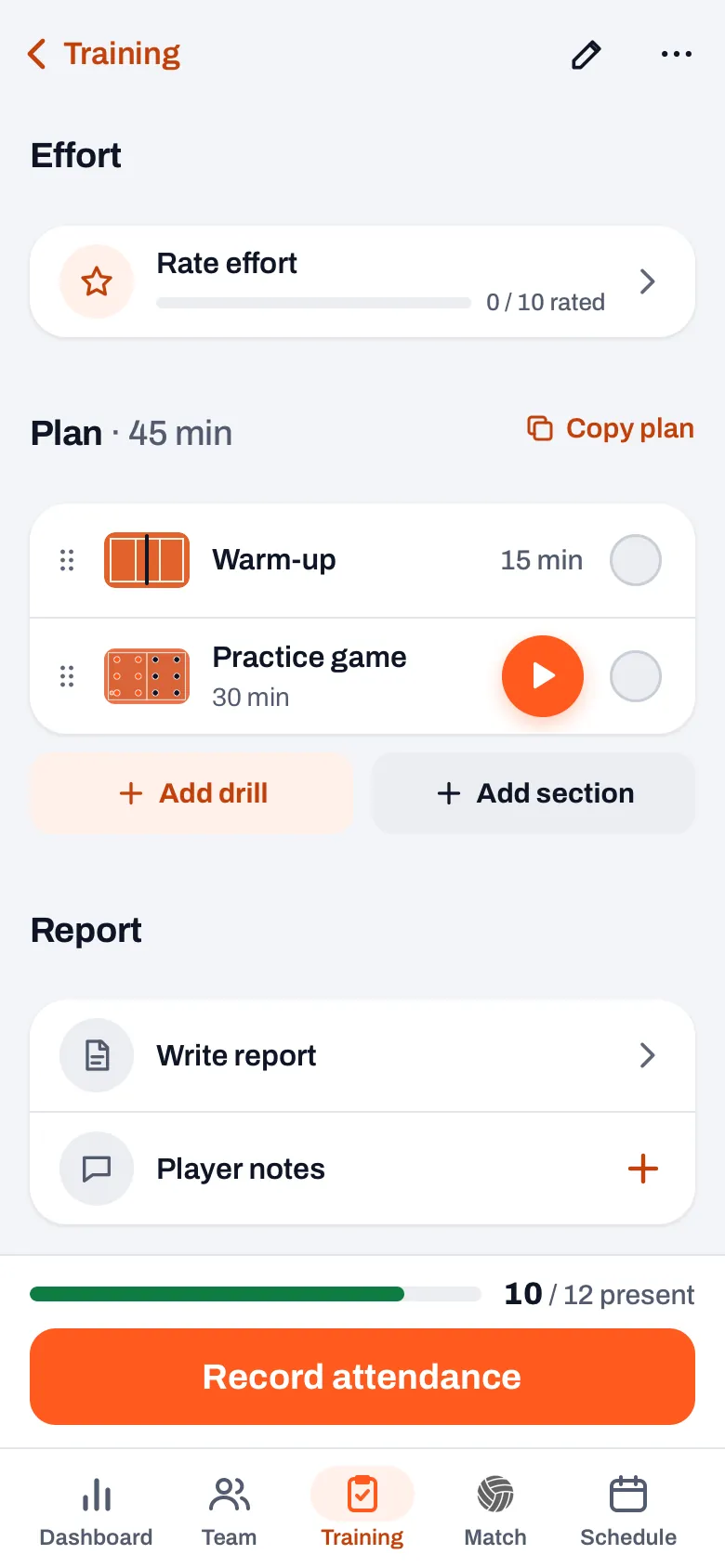
Since November 2026, from version 3.1, that sheet helps you with the three questions above:
- Recently used. At the top is a row of eight drills from your team's practices, the newest practice date first and each drill once. Practices you have already planned ahead count too. So you see at a glance what you did in recent weeks or already set up. The row only appears when you are not searching or filtering.
- Already in plan. A drill that is already in this practice gets that label. You can still pick it, for example if you want the same passing drill at the start and at the end.
- The number of players. Next to a small figure icon, each drill shows how many players are in the diagram. A drill of your own without players in the diagram has no number.
- Fits. The first chip, for example Fits 8, counts who has signed up for this practice plus your guest players. If nobody has said yes yet, Koach counts your squad without the players set to Inactive and without those who already said no, plus the guest players. Tap the chip and you only see drills with that number of players or fewer. Drills without a number simply stay in the list.
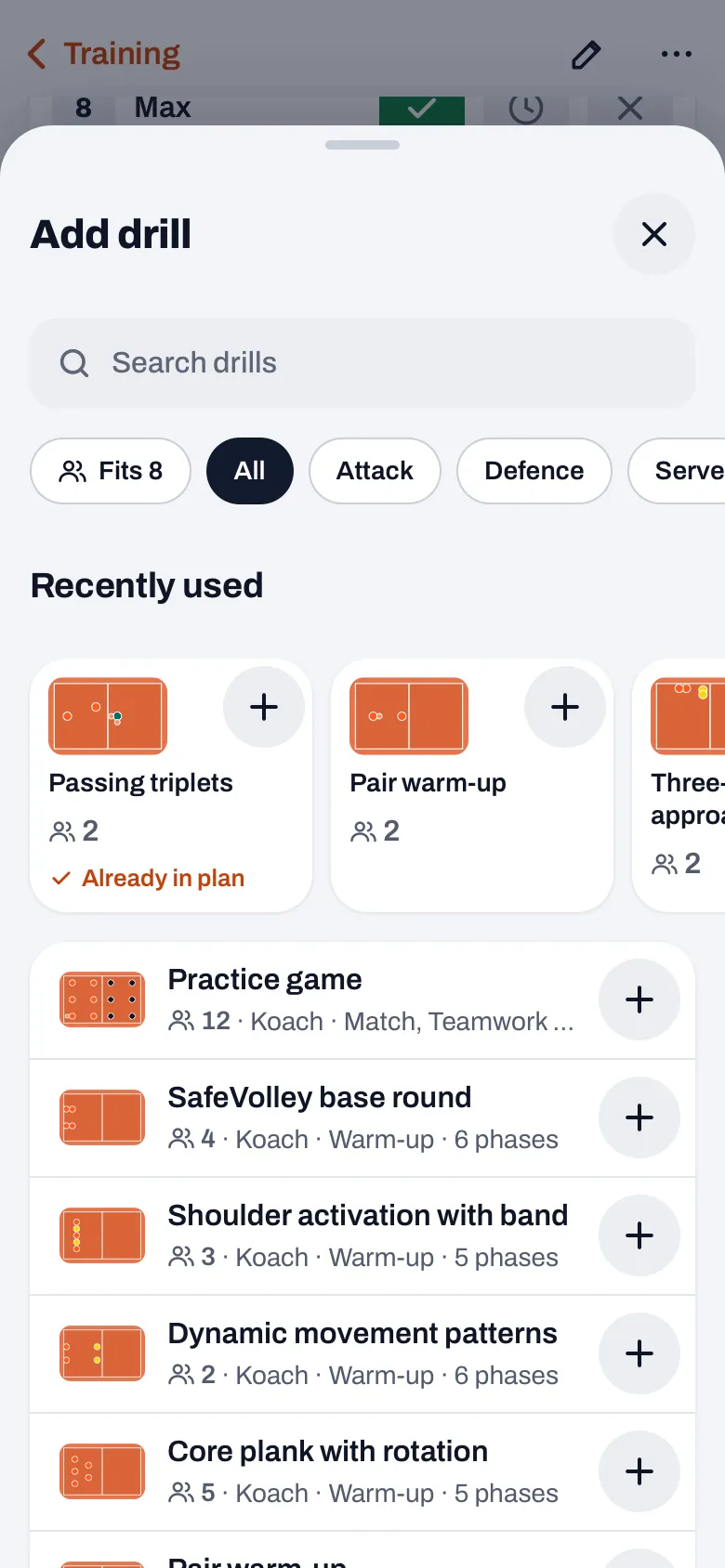
A tap on the name or the small court opens the drill, with the court and all phases. If it fits, Choose for this plan adds it to your selection and takes you back to the list. The plus button next to a drill selects it straight away. That way you pick several in a row; at the bottom it then says, for example, Add 3 drills, and they all go into your plan at once. Which drills come with the app, and how to sort them by who is there tonight in the drill overview, is in the ready-made drills in the app.
Don't see the new row and the chip? Update the app through the App Store or Google Play.
14 days free, no credit card. Put your next practice together tonight and check in the gym whether the drills fit the players in front of you.
Plan your practice in KoachWhat the picker doesn't decide for you
Koach doesn't put a practice together for you: which drill trains the theme of the session best is your call. Fits only looks at the number of players in the diagram, not at your courts, your balls or the level of your group. So a drill for four players also fits twelve if you have three stations. Use the chip mainly on nights with few players, to filter out drills you can't run anyway.
Once your plan is ready, you go through it drill by drill in the gym: that is covered in your practice plan on your phone. What Koach costs after the 14 free days is on the pricing page.
Pick your main drill first. Put the drill that trains the theme of the session hardest into your plan first, then choose a warm-up that builds towards it and a game in which the theme comes back.
Frequently asked questions
How many drills should you put in one practice?
That depends on the time and the goal. A common layout for an hour and a half is a warm-up, two or three drills around one theme and a game at the end. Fewer drills with more repetitions often achieve more than lots of short drills, because players don't need a new explanation every time.
What do you do when far fewer players show up than planned?
Keep the theme and adapt the form. A drill in groups of three runs with fewer groups, a six-versus-six game becomes three versus three on half a court. In Koach, the Fits chip shows only the drills with at most the number of players who are coming, so you quickly find a replacement.
Is it OK to run the same drill every week?
Yes, for fixed routines such as a warm-up pattern or a passing drill, repetition is actually good: players know what to do and you lose no time explaining. Do change one element regularly, such as how the ball is fed or the scoring, so players stay alert and what they learn also works in a different situation.
Why do some drills have no number of players?
The number comes from the drill's diagram: the largest number of players on court in any of its phases. A drill of your own in which you didn't draw any players therefore has no number. Such a drill also stays in the list when you switch on the Fits chip.

Plan your next practice in Koach
14 days free, no credit card. Pick drills that fit who's coming.
Get started with KoachOr read first what the volleyball coaching app does.