
End of season volleyball awards: fair categories and stats
The short answer
Give a few end of season volleyball awards that anyone can win, such as effort, attendance and most improved, next to one or two performance awards. Back every award with a number. Koach tracks those numbers for you: attendance per player, average effort, top performances and the Player of the Match votes.
End of season volleyball awards are part of every team, and so is the question that follows: why her and not him? This guide for volleyball coaches covers which award categories work, which stats make an award easy to explain, how to pick a player of the week and what a certificate looks like that you can copy as is.
End of season volleyball awards: which categories work?
Plenty of teams only hand out a top scorer award and an MVP. That rewards the same two or three players every year: the starters and the hitters. A better set of awards mixes performance with behavior, because behavior is something everyone on the roster can show, including the player who spends a lot of time on the bench. Seven volleyball award categories that work:
- Effort award. For the player who goes all out at every practice, even in the drill nobody likes. A substitute can win this one just as easily as your setter.
- Attendance award. For the player who was always there. It sounds small, but without those players there is no six on six at Tuesday practice.
- Most improved player. For the player who improved the most compared with themselves, not for the best player. On youth teams it is often the award that means the most.
- Player of the season, chosen by the team. To players, the verdict of the locker room often counts for more than the coach's.
- Skill awards. Attacking, blocking, serving and serve receive, each on its own. Including serve receive gives your libero a real shot too.
- Teammate of the year. For the player who makes others better: cheers them on, picks them up, shags the balls. There is no stat for that, and there doesn't need to be.
- A personal certificate for everyone. Especially for young players: every player gets a card naming one thing they got better at this season.
Pick four or five. Seven awards on a roster of ten makes each one worth less, and with only two they go to the same players. Funny awards for the end of season party can sit alongside them, but don't let the serious ones get lost among the jokes. Keep the awards separate from the season review with your team as well: that one is about lessons, this one is about recognition.
Why awards without stats often feel unfair
A coach remembers the last few weeks better than the first ones, and a kill better than a good pass. That is not bad intent; it is how memory works. The result: the effort award goes to whoever stood out in the final weeks, and the MVP quickly ends up with a hitter. The player who showed up on time every Tuesday all season and watched their passing improve slips through the cracks.
A number does not solve everything, but it gives you something to point to when a player or a parent asks why. Broadly, you can choose in one of three ways:
- Gut feeling. Costs nothing and works fine when the choice is obvious. When it's close, your impression is your only answer.
- A tally sheet or spreadsheet. Also free, and you decide what to track. The work is in keeping it up: checking off every practice, tallying every match and adding it all up at the end. Do that for a whole season and it gets you a long way.
- An app that tracks it while you coach. The numbers come from what you already do: taking attendance, giving stars after practice, scoring the match. At the end of the season there is nothing left to add up.
| What you want to back up | Tally sheet or spreadsheet | Koach |
|---|---|---|
| Attendance per player | Yes, if you check off every practice | Yes, from attendance at each practice |
| Effort per player | Yes, if you take notes after every practice | Yes, with stars after practice |
| Points per skill | Yes, with a tally sheet for every match | Yes, scored live or entered afterwards |
| Team vote | With a poll in the group chat | Yes, Player of the Match after every match |
| Playing time per player | Hard: you have to tally subs and rotations | Yes, for matches scored live |
| Adding it up at the end | Yourself, with formulas or by hand | Ready for you |
| Cost | Free | 14 days free, then €2.99 per month for one team |
14 days free, no credit card. Take attendance this week and give stars after practice, and the first number for your end of season awards is already there.
Start with your team in KoachWhich stat goes with which award?
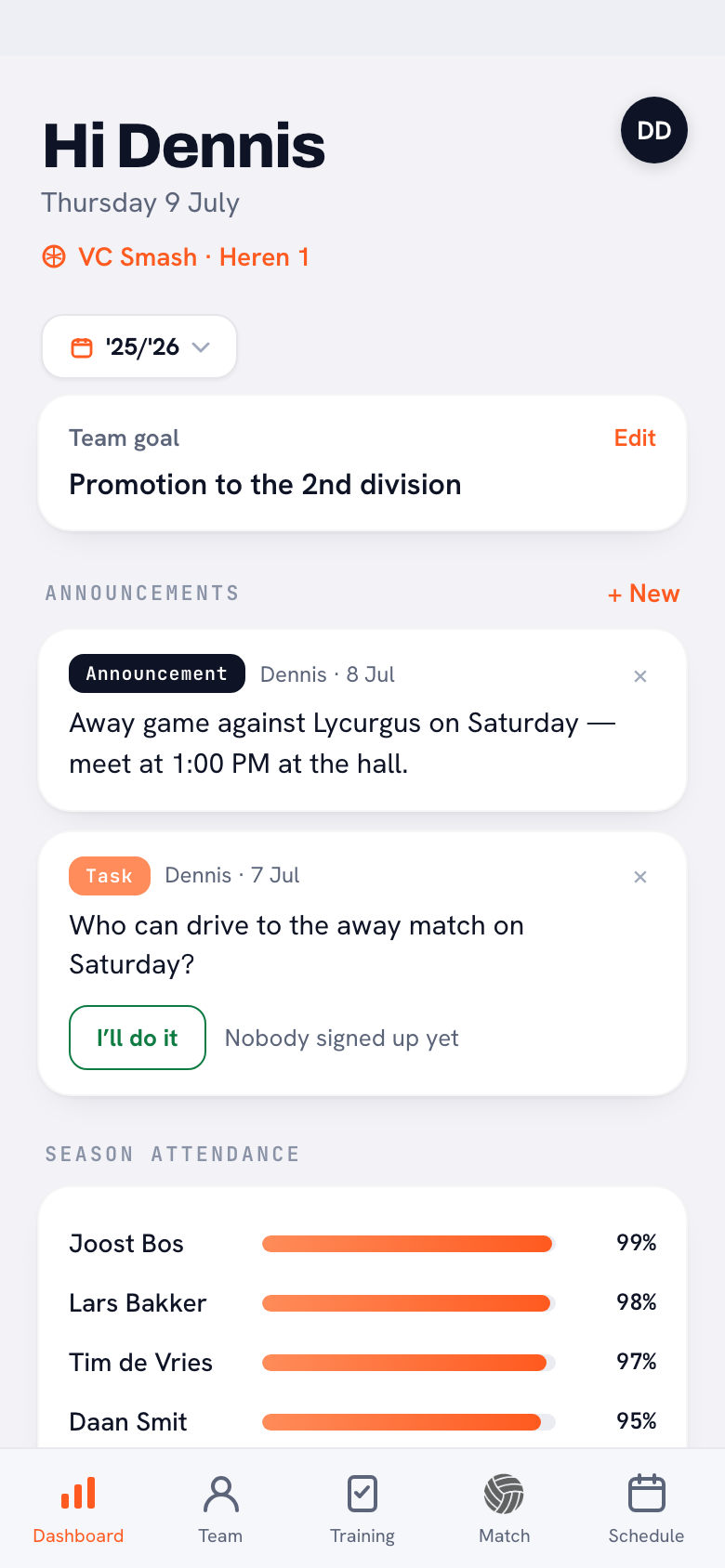
For each award, the table below shows which number you use in Koach and where to find it. Most of it is on the coach's dashboard, for the season you pick at the top; the rest is in the player profile on the Team tab.
| Award | Stat in Koach | Where to find it |
|---|---|---|
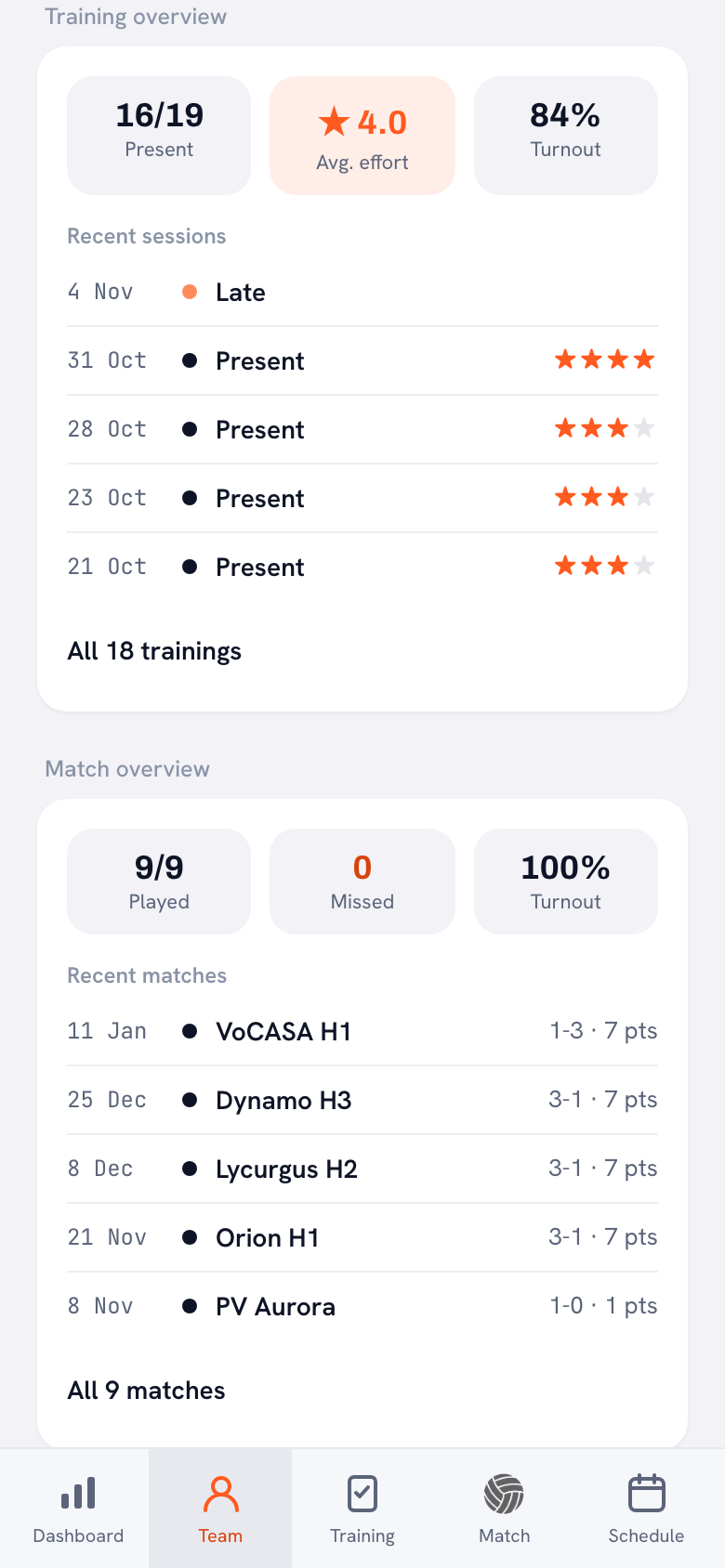
| Effort award | Avg. effort: the average of your stars after practice | Dashboard (the top three) and, per player, the Training overview |
| Attendance award | Attendance per player, practices and matches separately | Dashboard, Season attendance |
| Most improved player | Training rating as a line across the season, and the Riser badge | Player profile, under Development and Achievements |
| Player of the season | How often the team voted someone Player of the Match | Player profile, under the name |
| Attacking, blocking, serving, serve receive | The season's best per skill | Dashboard, Top performances |
| Teammate of the year | No stat | Your own judgment or a vote |
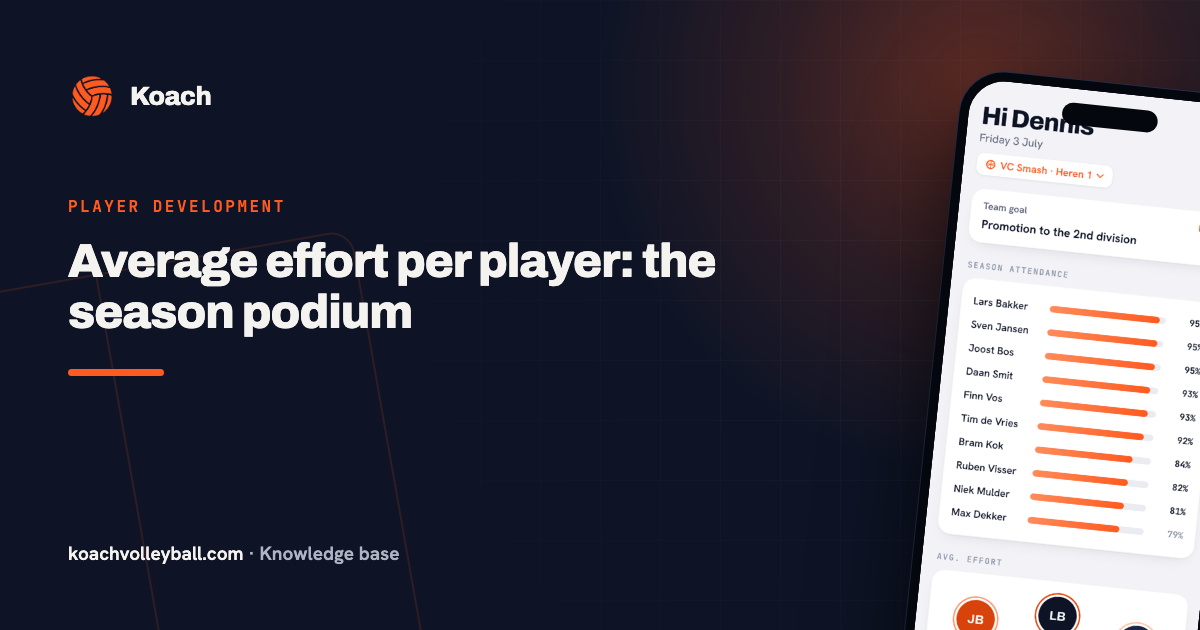
One thing to know about the effort award: Avg. effort is the average of all the stars you give after a practice, across five areas: Technique, Game awareness, Coachability, Work ethic and Effort. So it measures more than effort alone. Say so when you present the award, and the award matches the number. Players don't see their own stars; that judgment stays with you, and you decide what you share. The dashboard shows the top three as a podium, with the best player in the middle.
Use playing time as a check, not as an award. Under Playing time this season on the dashboard, the players with the least time on court are at the top, measured in rallies played. If all your winners sit at the bottom of that list, with the most playing time, you are mostly rewarding the players you already chose to play.
Most improved player: how to choose fairly
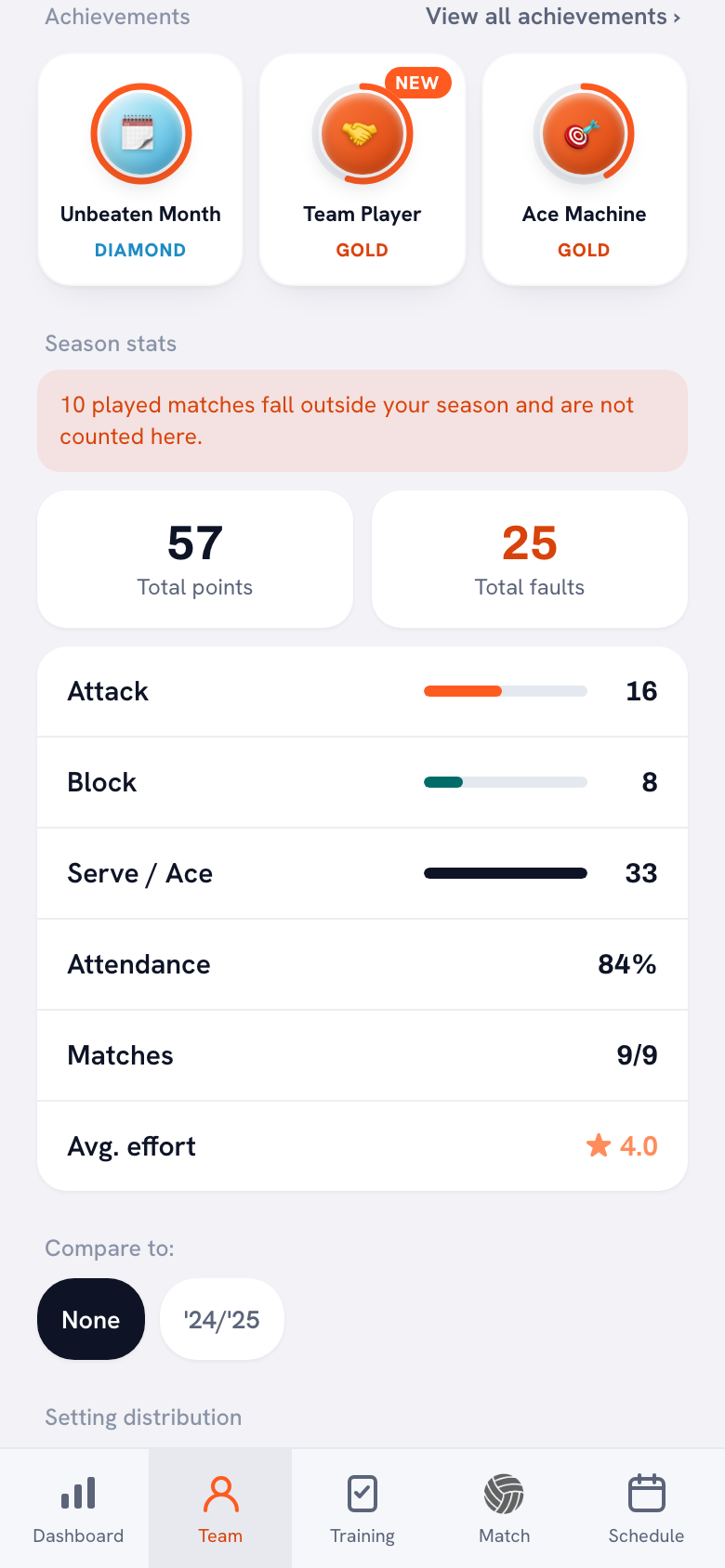
Growth is the hardest award to give, because you compare a player with themselves rather than with the rest. In the player profile, under Development, you'll find the Training rating as a line across the season, next to points per match. If that line clearly rises, you have your candidate. If you completed a previous season in Koach, use Compare to: under Season stats to put this season next to that one. Under Season-over-season growth you then see points and attendance for each season. How to track development more broadly than with numbers alone is covered in tracking player development in volleyball.
On top of that, players earn badges all season, from Bronze to Diamond, for attendance, effort and performance, among other things. For this award the Riser badge is the most useful: a player earns it when their effort rises over the season. Only you can see it: it is based on your stars, and those stay hidden from the player. A badge is not an award from the coach, but it is a good hook: it shows where a player crossed a threshold, and you can mention that when you hand out the award. Which badges exist and when players earn them is in all badges in Koach, and how to use them to motivate is in achievements and badges.
Player of the week or month: how to pick one
A player of the week keeps the season alive between the end of season awards. The risk is the same as with the final awards: without solid ground it turns into the top scorer every week. Three approaches that work better:
- Let the team decide. After every match, your players vote for their Player of the Match in Koach; you don't vote. The winner is your player of the week. How the vote works is explained in Player of the Match: let your team vote.
- Rotate the criterion. Effort at practice one week, serve receive in the match the next, then the player who took on a new role. For a match, Player performance shows each player's points from attacks, blocks and serves, plus their errors; for a practice, the stars from that session.
- Player of the month based on form. On the player profile, under Performance over time, you'll find Form (last 3): points per match over the last three matches, set against the player's average. Put that next to that month's attendance and stars, and you choose on more than one good night.
On youth teams, coaches often make sure everyone gets a turn during the season. That is a perfectly good choice, but then say that this is how it works: kids see through a rotating award dressed up as merit faster than you think.
A volleyball award certificate template you can copy
You make a certificate in a word processor or a design tool; Koach doesn't make them. What makes a certificate stronger is the number behind the award. That turns it into more than a compliment. Copy this structure:
- Header: the team name and the season, for example [team name], [season].
- Award: the name of the award, such as Effort Award or Most Improved Player.
- Presented to: the player's first and last name.
- Because: one sentence in plain words plus the number. For example: Present at 16 of 19 practices, and never gave up in the last drill.
- For next season: one thing the player can build on. That way the certificate ends with a beginning.
- Signature: the coach's name and the date of the ceremony.
Want something ready-made as well? From the player profile in Koach you can share the season card of every player who played a match this season: an image with their rating, season stats, number of badges and best moment, laid out by the app itself. At the end of season party it is a fun extra, but no replacement for the personal certificate: the card shows match stats and a rating that compares players with each other, not where someone grew.
What Koach doesn't do, and what it costs
Koach has no separate screen for season awards and doesn't pick winners for you. The app doesn't make certificates and doesn't export a PDF. What it does: keep the numbers you record along the way. Those numbers are only as good as what you enter. You only get attendance if you take attendance, Avg. effort only if you give stars, points for matches you score live or fill in afterwards, and playing time only for matches scored live. For the post-match vote your players need their own account, and the Player of the Match counter on the profile counts all of the team's matches, not just this season. Want everything in a spreadsheet? Export season (CSV) on the dashboard gives you, per player, attendance, Avg. effort and points from attacks, blocks and serves, among other things.
If you only start at the end of the season, you'll have few numbers for this year. Stats from matches you kept on paper can still go in with Enter the result manually and Enter stats afterwards, but you can't simply rebuild the attendance and stars of the past months. Then these become next season's awards.
You can try Koach free for 14 days, with no credit card and every feature included. After that you choose Coach for €2.99 per month (one team, two coaches) or Club for €9.99 per month (unlimited teams); with a yearly plan you pay €2.49 or €8.33 per month. In the App Store and on Google Play you see the price in your own currency. Players and parents use the app for free, so voting costs your players nothing. The prices are on the pricing page.
Announce the awards at the start of the season. When players know that attendance and effort count, an award becomes a goal instead of a surprise, and the result at the end of season party is no longer up for debate.
Frequently asked questions
Should every player on a youth volleyball team get an award?
It depends on the age group and on what you want to reward. With young players, up to around age twelve, a personal certificate for everyone works well, naming one thing that player got better at this season. Alongside that you can give a few awards based on behavior, such as attendance and effort, because anyone can win them. Skill awards fit older youth and adult teams better.
How do I keep the same players from winning every award?
Mix performance awards with awards for behavior, such as attendance and effort, because a substitute can win those too. Give the performance awards per skill, so your libero has a shot through serve receive, and let the team choose a player of the season. You can also agree that nobody gets more than one award. Finally, check playing time: if every award goes to the players who played the most, you are mainly rewarding your own lineups.
Who should pick the award winners, the coach or the team?
Both can, for different awards. Attendance and effort are the coach's call, backed by a number you can show. A player of the season or teammate of the year is better left to the team, because that verdict carries weight with players. In Koach, players vote for the Player of the Match after every match, and the player profile shows how often someone was chosen.
How much does Koach cost if I want to track stats for awards?
You can try Koach free for 14 days, with no credit card and every feature. After that, Coach costs €2.99 per month for one team with two coaches, and Club costs €9.99 per month for unlimited teams. With a yearly plan you pay €2.49 or €8.33 per month. Players and parents use the app for free, so your players vote for the Player of the Match at no cost.
Can I still back up awards with Koach if I start late in the season?
Partly. Stats from matches you kept on paper can be added afterwards with Enter the result manually and Enter stats afterwards. You can't simply rebuild the attendance and post-practice stars of the past months. So for this season you can back up the performance awards better than the attendance and effort awards. Start at the beginning of next season, and every number is ready when the season ends.

Base your season awards on real numbers
14 days free, no credit card. After one week, attendance and effort per player are already in.
Get started with KoachOr read first what the volleyball coaching app does.