
History of volleyball: from mintonette to rally point scoring
The short answer
The history of volleyball starts in 1895, when William G. Morgan of the YMCA in Holyoke, Massachusetts, invented a game called mintonette. In 1896 it was renamed volley ball. The FIVB followed in 1947, the Olympic debut in Tokyo in 1964, and the libero and rally point scoring arrived in the late 1990s.
The history of volleyball begins in 1895 in a YMCA gym in the United States, with a game for older members who found basketball too strenuous. These are the dates that matter, checked against the FIVB, the Volleyball Hall of Fame and the Olympic database Olympedia, plus the two rules from the 1990s that shape every match you play today.
1895: mintonette in Holyoke
William G. Morgan (1870 to 1942) became director of physical education at the YMCA in Holyoke, Massachusetts, in the summer of 1895. He had studied at the YMCA training school in Springfield, the school where James Naismith invented basketball in 1891. Basketball worked well for the young members, but Morgan also had older members, and for them that game was too strenuous. He looked for a competitive game with less physical contact and built it from his own training methods and from what he saw working in the gym. Tennis was ruled out: it needed too much equipment.
What remained was a net between two teams. Morgan hung it at about 1.98 meters (6 feet 6 inches), just above the head of an average man. A basketball and its inner bladder did not work, so he had Spalding make a ball of its own: leather around a rubber bladder. He called the game mintonette. There was no maximum number of players, and a team could touch the ball as often as it liked before sending it over the net.
1896: from mintonette to volley ball
In 1896 Morgan demonstrated the game at a conference at the YMCA school in Springfield, the school now called Springfield College. Professor Alfred T. Halstead suggested replacing mintonette with volley ball, after the volley: playing the ball back before it touches the ground. Morgan and the conference adopted the name. In July 1896 a short report with the rules appeared in the magazine Physical Education, and in 1897 the rules were printed in the first official handbook of the Athletic League of the YMCAs of North America. Only in 1952 did the US volleyball association decide to write the name as one word: volleyball.
How the game spread around the world
The YMCA took the game wherever it went. In 1900 Canada became the first country outside the United States to adopt it. Franklin H. Brown brought it to Japan in 1908 and Elwood S. Brown to the Philippines in 1910; in 1913 volleyball was on the program of the first Far Eastern Games in Manila. In Asia people played for a long time under Brown's rules, with sixteen players per team, so more people could take part at once. In 1916 the YMCA persuaded the NCAA, the US college sports association, to publish the rules.
Meanwhile the game became tighter. In 1918 the number of players per team went to six, and in 1922 the number of contacts per team was fixed at three. Until the early 1930s volleyball was mainly recreation; after that, many countries started playing national championships.
1947 to 1996: a world federation, world titles and the Olympics
In 1947 fourteen national federations founded the Fédération Internationale de Volleyball, the FIVB, in Paris. Frenchman Paul Libaud became its first president and held the post for 37 years, until 1984. In that time the FIVB grew from fourteen to more than one hundred and fifty members. The first men's world championship followed in 1949, the first women's in 1952.
In 1964 volleyball was on the Olympic program for the first time, in Tokyo, with one tournament for men and one for women. The Soviet Union won the men's event, Japan the women's. Beach volleyball was added in 1996, in Atlanta. At the 1998 world championship in Japan the FIVB brought in the ball with yellow, blue and white panels. According to its own history page, the FIVB now has 220 affiliated national federations.
The rules that made today's game
| Year | Rule | What it changed |
|---|---|---|
| 1895 | No maximum number of players or contacts | A recreational game for the YMCA gym |
| 1918 | Six players per team | Six against six, as today |
| 1922 | No more than three contacts per team | The three-contact build-up, as today |
| 1996 or 1998 | The libero | A defensive specialist in a different-colored jersey |
| 1998 | Rally point scoring: a point on every rally, sets to 25 | Every error costs a point |
The FIVB sets the rules for each Olympic cycle. The current edition is the Official Volleyball Rules 2025-2028; what changed in it is covered in the new volleyball rules, and all of today's rules are in volleyball rules at a glance.
Why the libero and rally point scoring came in
The two rules you notice every week are the youngest. The FIVB itself is not consistent about the year of the libero: its basic rules page says it introduced the libero in 1998, its page about the game says 1996. It does describe the role clearly. The libero takes a large share of serve receive and is the hub of the back-row defense. The libero plays only as a back-row player, may not serve or block, may not attack a ball that is entirely above the top of the net, and wears a jersey that differs from the rest of the team. Today a team may have two. For coaches that means there is a starting spot for a player who does not need to be tall, as long as they can pass and dig. How that works in your team is in the libero rules.
Rally point scoring was ratified at the FIVB World Congress in October 1998. Before that, a team could only win a point on its own serve, and sets went to 15. If the receiving team won the rally, it only got the serve back, so a set could go on for a long time. The FIVB wanted a scoring system that was easier to follow, with faster and more exciting matches. Now every rally produces a point and sets go to 25, with a deciding set to 15 and always a two-point margin.
What that means for your coaching:
- A service error costs a point. In the past you only lost the serve; now the opponent gets the point. That is why coaches track service errors carefully these days; exactly how scoring works is explained in scoring in volleyball.
- The side-out is the foundation of every set. A team that does not win its own receive point gives a point away straight away. The side-out percentage per rotation shows in which rotation you are leaking points.
- Every run shows up on the scoreboard at once. Four points in a row for the opponent means four points behind, even if you were the team serving. That is the moment for a timeout, not when the set is nearly over.
Let your team play the old scoring once. Play a set to 15 in which only the serving team can score. Within ten minutes players feel how much a side-out is worth, and why a service error costs more now than it did in 1990.
Libero and rally scoring in your own matches
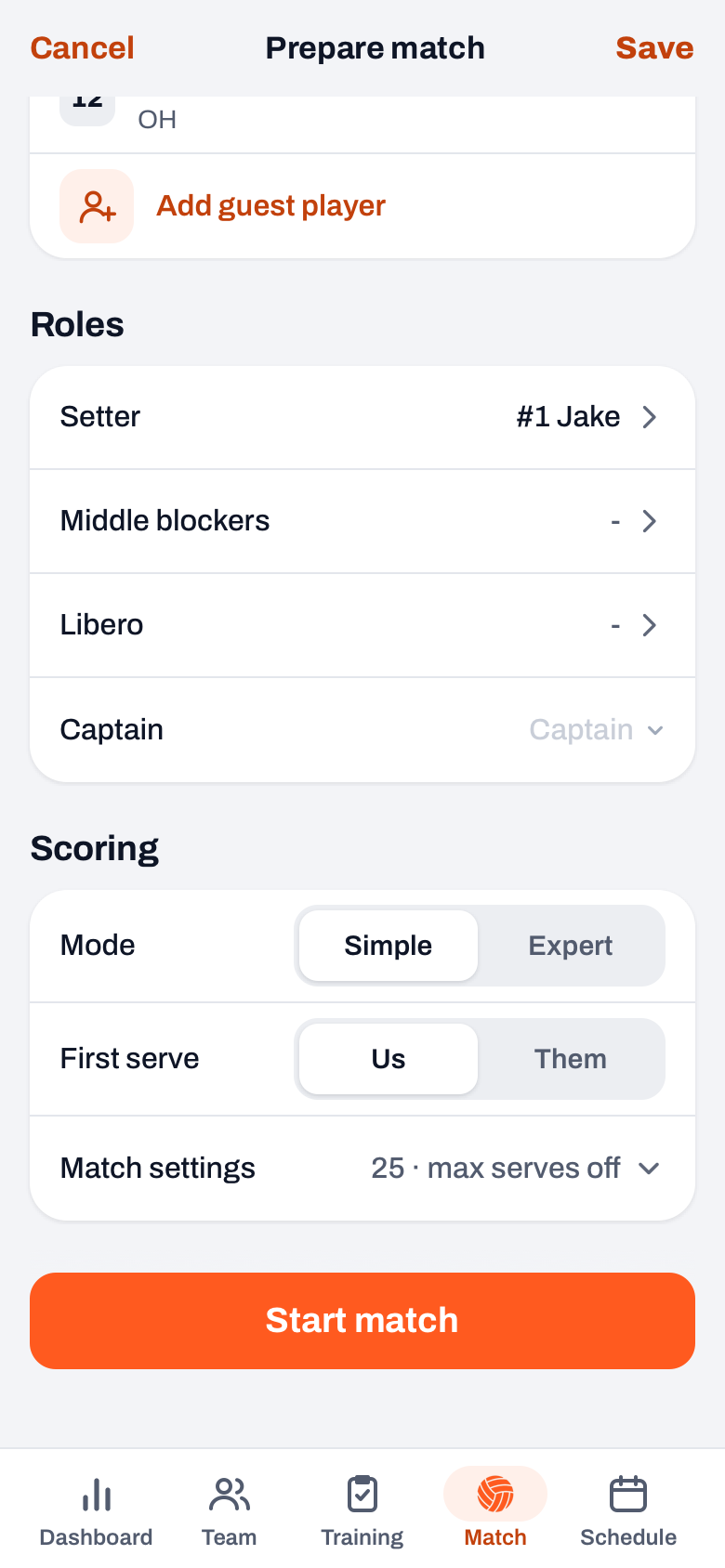
Anyone who tracks a match works with both. In Koach every rally counts as a point and each set goes to 25 by default, the fifth to 15. When you prepare the match, you pick your middle blockers and your libero under Roles. At the start the libero comes in for a back-row middle blocker on its own, and with Swap libero automatically (on by default) the libero swaps with the middles for the whole match. Afterwards you see how often you won the side-out in each rotation. If you are new to the game, read how to play volleyball first.
What Koach costs after the 14 free days is on the pricing page.
14 days free, no credit card. Set up your libero and your middles and track every rally on Saturday.
Try Koach at your next matchSources: FIVB, history of volleyball; FIVB, basic rules and FIVB, the game (libero and rally point scoring); Volleyball Hall of Fame, William G. Morgan and Paul Libaud; Olympedia, Tokyo 1964 results for men and women. Accessed on 1 November 2026.
Frequently asked questions
Who invented volleyball?
William G. Morgan, director of physical education at the YMCA in Holyoke, Massachusetts, invented the game in 1895. He wanted a game for older members who found basketball too strenuous, and he called it mintonette. In 1985 Morgan became the first inductee into the Volleyball Hall of Fame in Holyoke.
Why is volleyball called volleyball?
At a YMCA conference in Springfield in 1896, Professor Alfred T. Halstead suggested replacing the name mintonette with volley ball. To volley is to play the ball back before it touches the ground, and that is what the game is about. Since 1952 the US federation has written it as one word.
When did volleyball become an Olympic sport?
At the 1964 Games in Tokyo, with one tournament for men and one for women. The Soviet Union won the men's event and Japan the women's. Beach volleyball has been on the Olympic program since the 1996 Games in Atlanta.
When did rally point scoring start in volleyball?
The FIVB ratified rally point scoring at its World Congress in October 1998. Before that, a team could only score on its own serve and sets went to 15. Now every rally produces a point and sets go to 25, with a deciding set to 15.



Track your next match rally by rally
14 days free, no credit card. After one match you see your side-out per rotation.
Get started with KoachOr read first what the volleyball coaching app does.