
How to play volleyball: the game explained for beginners
The short answer
How to play volleyball: two teams of six players face each other across a net. You try to get the ball to the floor on the other team's court, and your team may touch it at most three times to do that, without catching or throwing. Every rally scores a point, and a set goes to 25 points.
How to play volleyball if you have never done it? Here is the game in plain words: what the goal is, how a rally unfolds, how you win points and sets, why players keep changing places and which five skills you learn first. For new players and for anyone sitting in the stands.
The goal of volleyball
Two teams of six players each stand on one side of a net, on a court of 18 by 9 meters. The net hangs at 2.43 meters for men and 2.24 meters for women, and lower for youth players. The goal is simple: make the ball land on the floor in the opponent's court, and stop it from landing in your own. If the other team cannot do that, or makes a fault, your team gets the point.
Three rules make volleyball volleyball:
- At most three hits. Your team may play the ball no more than three times before it has to go over the net. A touch at the block does not count toward those three (rule 9.1).
- Not twice in a row. The same player may not play the ball two times in a row. The exception is the block: a player who blocks may also play the next ball (rule 9.1.1).
- No catching or throwing. You play the ball away cleanly. It may touch any part of your body, including your foot, but it may not come to rest (rule 9.2).
How a rally unfolds
A rally is everything from the serve until the ball is dead. A typical rally looks like this:
- Serve. The player in right back serves from behind the end line. They toss the ball and hit it with one hand or arm over the net, within eight seconds of the whistle (rule 12.4). The ball may touch the net, as long as it goes over.
- Pass. The other team plays the serve with the first contact, usually with a forearm pass: arms straight and together, the ball on the forearms. The goal is a high, soft ball to the setter. This first contact is also called the serve receive.
- Set. The setter plays the second ball, usually overhand with the fingers, high along the net to an attacker.
- Attack. The attacker jumps and hits the ball over the net with one hand, hard or placed. This is also called a spike.
- Block. On the other side, one or more players jump at the net with their hands above the top of the net to stop the attack. Only front-row players may block (rule 14.1.1).
- Defense. If the ball gets past the block, a defender tries to keep it in play. If that works, the build-up starts again on that side: pass, set, attack.
The ball goes back and forth like this until it hits the floor, goes out or someone makes a fault. A ball on the line is in (rule 8.3). A ball that touches the antenna or crosses the net outside the antennas is out (rule 8.4).
Points, sets and the match
- Every rally is a point, also for the team that did not serve. If the receiving team wins the rally, it gets the serve as well as the point (rule 6.1.3).
- A set goes to 25 points, with a lead of at least two points. At 24-24 you play on to 26-24, 27-25 and so on (rule 6.2).
- The first team to win three sets wins the match. At 2-2 a fifth set follows, played to 15 points, also with a two-point lead (rule 6.3).
- Timeouts and substitutions. Each team may request two timeouts of 30 seconds and make six substitutions per set (rule 15).
There is no clock: a match lasts until one team has won three sets. A 3-0 is therefore much shorter than a five-set match. Some leagues and tournaments count differently, for example with a fixed number of sets or shorter sets; that is then in the rules of that competition. All the official rules at a glance are in volleyball rules at a glance; the full text is in the FIVB Official Volleyball Rules 2025-2028.
Rotation: why players keep changing places
The six players stand in two rows of three: three in front at the net and three at the back. The positions are numbered 1 to 6, and the player in position 1, right back, serves. At the moment of the serve the receiving team must be in the correct order; the serving team may then stand anywhere in its own court (rule 7.4). As soon as the serve is hit, everyone may move wherever they like.
When your team wins back the serve, everyone moves one position clockwise: the player in position 2 moves to position 1 and serves (rule 7.6). That way everyone gets a turn to serve, and everyone spends time in the front row and time in the back row. A back-row player may attack, but only when taking off from behind the three-meter line, or when the ball is not entirely above the top of the net (rule 13.2). How the order works exactly is in rotation order in volleyball.
The five skills you learn first
| Skill | How | When |
|---|---|---|
| Forearm pass | Arms straight and together, ball on the forearms, power from the legs | Receiving the serve, low balls, defense |
| Overhand pass | Hands above the forehead, push the ball away quickly with the fingers | The second ball to an attacker, high balls |
| Serve | Underhand (easier) or overhand: toss and hit with one hand | The start of every rally |
| Attack | Approach, jump, arm swing and hitting the ball at the highest point | Usually the third ball |
| Block | Jumping at the net with the hands above the top of the net | Against the opponent's attack |
As a beginner you learn the first three first: without a pass, a set and a serve that gets over the net, there is no rally. How to build up each skill is in learning volleyball technique.
What do you do as a player on the court?
In a team everyone has a fixed job, regardless of the spot where rotation puts them. The five roles:
- Setter: plays the second ball and chooses which attacker gets it.
- Outside hitter: receives the serve and attacks mainly from the left.
- Middle blocker: blocks a lot and attacks quickly in the middle of the net.
- Opposite: lines up opposite the setter and attacks mainly from the right.
- Libero: the defender in the contrasting jersey, who only plays in the back row. Why that player wears a different color is in why the libero wears a different color.
With beginners everyone often still plays everything; fixed roles only come once the basics are in place. What each role asks for is in volleyball positions explained.
Call the ball. Say "mine" or "got it" out loud before you play it. Most balls that drop among beginners fall between two players who both thought the other would take it. One word solves that.
How to start playing volleyball
Six against six with three touches is hard as long as you cannot control the ball yet. So start small: two against two or three against three on a smaller court, with a lower net if needed. You touch the ball much more often, and that is how you learn. In beginner sessions the ball may sometimes still be caught for a moment, as a step toward real play.
Places to start are a club with practices and a league, a recreational group on a regular evening, and beach or grass volleyball in summer. Indoors you play in sports shoes with non-marking rubber soles, and knee pads come in handy as soon as you start defending. If you are an adult and want to know what to expect in the first months, read starting volleyball as an adult.
Volleyball on a team with Koach
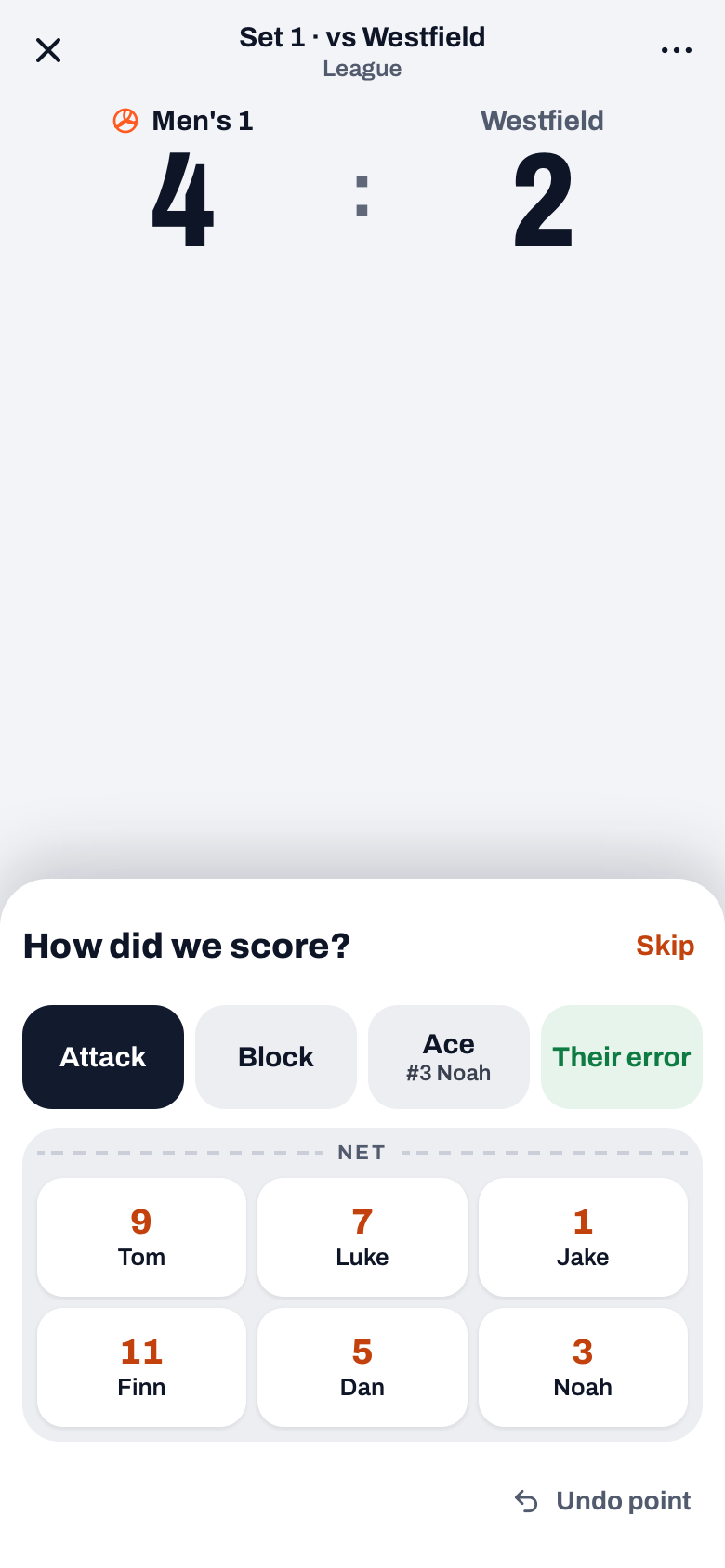
If your coach uses Koach, you pay nothing as a player: your player account is covered by the team's subscription. You see practices and matches in the schedule, let the coach know whether you are coming, and after a match you see your own stats. Those stats are created during the match: the coach or a scorer can tap after every point how it was won. For a point for your team, they choose from attack, block, ace (a serve that scores directly) or an error by the other team. Those are exactly the four ways a team scores in volleyball.
Are you coaching a beginners' team yourself? What Koach costs after the 14 free days is on the pricing page.
14 days free, no credit card. Put your team in Koach and see after the first match how you scored your points.
Try Koach with your teamFrequently asked questions
How many players are on the court in volleyball?
Each team has six players on the court: three in front at the net and three at the back. A team may list up to twelve players on the scoresheet, up to fourteen in official FIVB competitions for seniors, with at most two liberos among them. In beach volleyball you play two against two, and children often play with fewer players on a smaller court.
Can you play the ball with your foot in volleyball?
Yes. Under the official rules the ball may touch any part of your body, including your foot. It just may not be caught or thrown, and the same player may not touch it twice in a row. In practice you play almost everything with your arms and hands, because you can aim the ball much better that way.
How long does a volleyball match last?
There is no clock: a match lasts until one team has won three sets. A set goes to 25 points with a two-point lead, and at 2-2 a fifth set to 15 follows. A match that ends 3-0 is therefore a lot shorter than a five-set match. Tournaments often play shorter formats.
What is the difference between indoor volleyball and beach volleyball?
In beach volleyball you play two against two on sand, on a court of 16 by 8 meters, without substitutes and without fixed positions. A set goes to 21 points (a possible third set to 15), and a touch at the block does count as one of the three hits there. Indoors you play six against six on 18 by 9 meters, with sets to 25.


Put your beginners' team in Koach
14 days free, no credit card. After the first match you see how you scored.
Get started with KoachOr read first what the volleyball coaching app does.