How to correct a player without yelling: better feedback
There are three kinds of coach on the sideline: the one who says nothing, the one who encourages and the one who shouts. The third thinks he is coaching. In reality a player being shouted at almost never gets information he can use — mainly he gets the message that it went wrong again.
Why shouting louder doesn't work
There are three reasons, and all three are practical. One: there is no information in it. "Come on!", "what are you doing?" and "concentrate!" describe no action the player can carry out. Two: it arrives too late. A correction that lands while the next ball is already on its way makes the player miss that one too. Three: it shifts attention. A player addressed in front of the whole team thinks about how he comes across instead of about his task — exactly the shift that does the most damage under pressure, as described in mental training.
Volume is also a resource that runs out. A coach who spends the whole session at ten has nothing left for the moment it is really needed. Someone who normally speaks calmly only has to raise his voice once to silence a hall.
One thing at a time, in action words
Good feedback is short, concrete and about what the player has to do. Compare: "your passing is bad" with "hands ready earlier". The first is a judgement, the second is an instruction. Use two rules alongside it. Rule one: at most one focus point per player per drill. Two corrections at once produces zero improvements. Rule two: use the wanted behaviour, not a prohibition. "Don't swing your arms" makes the player think about swinging arms; "arms still, legs move" gives him something to do.
Work with a fixed, small vocabulary per skill as well — the same three or four cues all season. For passing, for example, "set early", "platform still" and "angle to the setter". If you use different words every week for the same movement, the player first has to translate before he can correct.
The four moments when feedback lands
- Straight after the action, three words. Just the cue, during the drill. Nothing more fits between two balls.
- At the change of drill, one sentence per player. A calm moment, the player is standing still, and you can briefly demonstrate.
- Individually after practice, two minutes. This is where everything sensitive or longer than one sentence belongs. Away from the group, without an audience.
- Later in the week, with numbers or video. For patterns a single session doesn't show — a recurring type of error or a position where it keeps going wrong.
What stands out about these four: none of them is shouting during a rally. That moment simply doesn't exist as a learning moment.
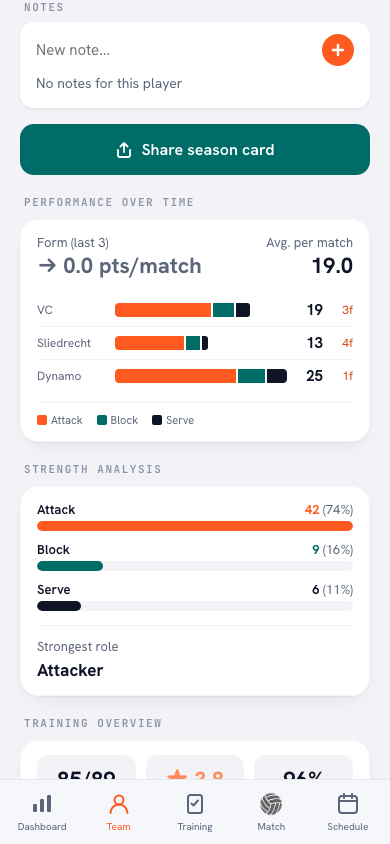
That fourth category is exactly where most coaches leave things lying. Write one concrete point per player in your Koach notes after practice, so your next feedback moment starts with something specific instead of a general impression. After a month you also see patterns that are invisible in the hall: the player who only makes errors under serving pressure, or the one who gets the same point every session without anything changing. How to keep those notes usable is in keeping player notes.
From not like that to like this: the wording
- Describe, don't judge. "You weren't there yet when the ball came" instead of "you're lazy".
- Ask before you tell. "What did you feel on that ball?" often produces within five seconds the answer you were going to give — and then it belongs to the player.
- Link it to a consequence. "If your platform tilts, the ball goes right and the setter has to run." Players correct better when they understand the effect.
- Finish with the next task. Feedback ends with what happens now, not with what went wrong.
- Name what is going well too, just as specifically. "Good" isn't feedback; "you were set this time before he hit it" is.
If you do raise your voice
It happens: a dangerous situation, a player putting a teammate down, or simply an evening when it all gets too much. What matters is what happens afterwards. Come back to it briefly — "I reacted too sharply, that could have been calmer, but the point stands" — and make clear that the correction was about the behaviour and not the person. Coaches who can do that lose nothing in authority; they gain it. And watch your pattern: if you notice that you get louder mainly with the same player, that is not coincidence but a signal about the relationship. Then have a conversation outside the hall, for example in the form of an evaluation conversation, instead of continuing to correct harder.
A test for yourself: have someone tally for a whole session how many of your remarks contain a concrete action. Come out under half and you are mainly coaching on outcomes — and a player can't do anything with that during practice.
Frequently asked questions
How many instructions can a player process per practice?
In practice one technical focus point at a time, and at most two or three per session in total. More produces players thinking about everything at once and executing worse than they would with no instruction at all.
Should I always give criticism in private?
Technical corrections are fine in the group, as long as they are about the action. Anything about effort, attitude or behaviour you give privately — public criticism there almost always produces defensiveness instead of change.
Does the sandwich method (compliment, criticism, compliment) work?
With young players it can help, but experienced players see through it and start waiting for the but. Being concrete is more effective: name what went well as specifically as what needs to improve, and keep the two apart.