How to Find Your Weakest Rotation in Volleyball
Almost every team has one rotation where it consistently leaks on the scoreboard. Coaches sense it, but usually point at the wrong one. With two numbers per rotation you know exactly where the leak is inside two matches.
Six rotations are six different teams
The moment you rotate, almost everything changes: who is in the front row and can therefore attack, who passes, who blocks and where your setter is coming from. A team that wins 55 percent of its own serve-receive rallies on average can be at 70 percent in one rotation and 35 in another. So the average tells you nothing — the distribution does.
Name your rotations consistently or you will be talking past each other. The common convention: the rotation is named after the player at P1, so after whoever is serving. In a 5-1, 'rotation 1' is then the alignment with your setter at P1 and three hitters in the front row. From there you count on: rotation 2 is the alignment after your P1 player has rotated and the next player serves.
What to measure: two numbers per rotation
There are exactly two questions per rotation, and both are easy to tally:
- Side-out: of the rallies in which the opponent served, what percentage did you win? This is by far the most important number; what it means is in side-out percentage. At club level a healthy average sits around 50 to 60 percent. Anything under 40 in a single rotation is a leak.
- Points won on your own serve: of the rallies in which you served, what percentage did you win? A normal average here is lower, around 35 to 45 percent. A rotation that consistently sits below that is killing your serving runs.
You do not need software to start. A sheet of paper with six columns and a tally mark in the right column for every rally, with a plus or a minus, is enough. Important: note which rotation each rally was in, not just who scored.
How to tally it in a single match
- Before the set, write down your six rotations in order, with the server's name next to each.
- Put a mark in the column of the rotation you were in for every rally, with a + if you won the point and a − if you lost it.
- Add one letter when the cause was obvious: A for an ace against, E for an attack error, B for a blocked ball, S for your own service error.
- Afterwards, count the pluses and minuses per rotation, separately for serve receive and serve.
One match gives you a suspicion, three matches give you a conclusion. Six rotations across three matches produce roughly fifteen to twenty-five rallies per rotation — enough to take a fifteen-point gap seriously, too little to hold a meeting about five points.
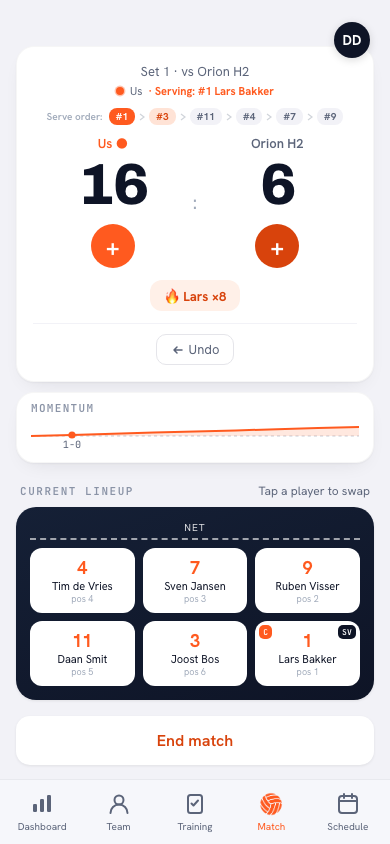
Score live and you can stop tallying altogether: because Koach records the score progression and who was serving, you can trace a run of lost points back to the rotation it happened in.
The four causes behind a leaking rotation
Once you have the rotation, the real work starts: why does it leak? In practice it is almost always one of these four.
- Serve receive. Two weak passers are standing next to each other in this alignment, or your best passer is in the spot no ball goes to. Recognisable from aces against and attacks that consistently start out of system.
- Too few attacking options. Classic in a 5-1: the rotations with your setter in the front row only have two front-row hitters. Put your weakest hitter in there too and the opponent knows exactly where to put the block.
- The block. Your shortest front-row player is standing where their best hitter attacks. If you see a lot of points against the same opponent in the same alignment, this is it.
- The serve. For the number on your own serve, the cause is often simply the server: a player who misses twice a set costs you two rallies you never started.
Five repairs
- Shift the serve receive in that rotation. You do not have to play the same formation in all six alignments. Give your best passer a bigger zone in the weak one, or drop from four passers to three.
- Give the offense a second option. Two front-row hitters become three the moment you let a back-row player attack. One agreed back-row attack per rotation keeps the block honest.
- Substitute with intent. A blocker on for the three rotations where their star hits, or a serving specialist for that one turn: a substitution does not have to be an emergency measure.
- Shift your starting lineup. The cheapest intervention there is. Start one position further along and the weak rotation moves to a different moment in the set — away from the opening points, for instance, where you can least afford it. The trade-offs are in choosing your starting lineup.
- Train the alignment, not the skill. Put the whole team in the weak rotation in a game format and play ten rallies out of it. Repeat that for three weeks. Nothing improves a rotation faster than playing it more often.
Look at your strongest rotation too
The mirror image is nearly always forgotten: which alignment does your team actually win in? You want that rotation on the court as often as possible at the start of the set and on the big points, and you control it with the same dial — your starting lineup. Coaches who re-read their score progression regularly find that sets are not given away in the weakest rotation, but simply not closed out in the strongest.
Change one thing at a time. If you shift the serve receive, make a substitution and rotate the starting lineup all at once, you will not know afterwards what worked. Apply one repair, measure for two matches, and only then move on.
Frequently asked questions
How many matches do I need to find my weakest rotation?
One match gives a suspicion, three give a conclusion. You want at least fifteen rallies per rotation before you start intervening on the basis of the numbers.
What side-out percentage is too low for a rotation?
At club level a healthy average sits between 50 and 60 percent. If one rotation consistently drops below 40 percent, it is demonstrably leaking points and worth acting on.
Can I play a different serve-receive formation per rotation?
Yes, and it is one of the most effective repairs there is. Keep it to one deviation though: no team remembers six different formations, but every team remembers one exception in the weakest alignment.
Does adjusting the starting lineup help?
Often yes, and it costs nothing. Shifting by one position moves your weak rotation to a different moment in the set, while your strongest rotation ends up at the start.