
How to land properly in volleyball to protect your knees
A volleyball player jumps dozens of times a session and easily a few thousand times a season. Every jump ends in a landing, and every landing is a moment where things can go wrong. That makes landing technique the cheapest injury prevention there is: no equipment, no extra practice time, no specialist.
Why the landing matters so much
On take-off you drive the movement yourself; on landing the body has to absorb forces several times body weight in a fraction of a second. If that happens with a controlled, bending movement, muscles and tendons share the load. If it happens with straight legs or with knees collapsing inward, most of the impact goes into joints and tendon attachments. In volleyball there is the context on top of that: you land near other people's feet, often backwards or off balance, and usually without looking.
The two classic consequences are well known: rolled ankles — usually landing on a teammate's or opponent's foot under the block — and overload of the patellar tendon. Neither can be fully prevented, but the odds can clearly be reduced. The broader story is in injury prevention in volleyball.
What a good landing looks like
- On two feet. Two legs share the load; landing on one concentrates it. In play it isn't always possible, but it is what you train.
- Forefoot to whole foot. Ball of the foot first, then the heel — that works like a shock absorber. Landing flat-footed is a hard landing.
- Knees bent and over the toes. Rule of thumb: the knee points the same way as the foot. Knees collapsing inward are the clearest risk signal.
- Hips back. The movement comes from the hip, not just the knee — as if you are sitting down on a low chair.
- Quiet. A good landing makes little noise. That is immediately the handiest cue for a whole group: I don't want to hear you.
Four drills that fit in any warm-up
- Drop and stick. Step off a low bench or box, land and hold completely still for three counts. Anyone wobbling has to land lower and wider. Two sets of six.
- Jump and freeze. Vertical jump with arm swing, land and freeze immediately. Then the same with a half turn in the air, because in play you rarely land square.
- Landing with a disturbance. A teammate gives a light push against the shoulder on landing. Trains exactly what happens at the block: coming down while something unexpected happens.
- Block movement with landing. Two sideways steps along the net, block, land on two feet inside your own half, move back immediately. Combines technique from blocking with the landing where it goes wrong.
Together that takes four to six minutes. Important: do it at the start, while players are fresh. Training landings on tired legs mainly teaches bad landings.
The mistakes you see most
Knees inward. By far the most common, and even more so in young players and after growth spurts. Filming with a phone from the front works better here than a hundred instructions: players see it themselves in two seconds. Landing straight-legged. Often in players who want to be ready again quickly; then the jump comes at the expense of the damping. Stepping through under the net. Not a technical but a tactical fault, and the main cause of ankle injuries. Make it a hard rule in every drill. Landing on the heel. Usually on backwards movement; you fix it by training footwork rather than the landing itself. And watch especially in the last quarter of the session: the more tired players get, the sloppier the landings, and that is exactly when you see what has really been learned.
From theme to habit
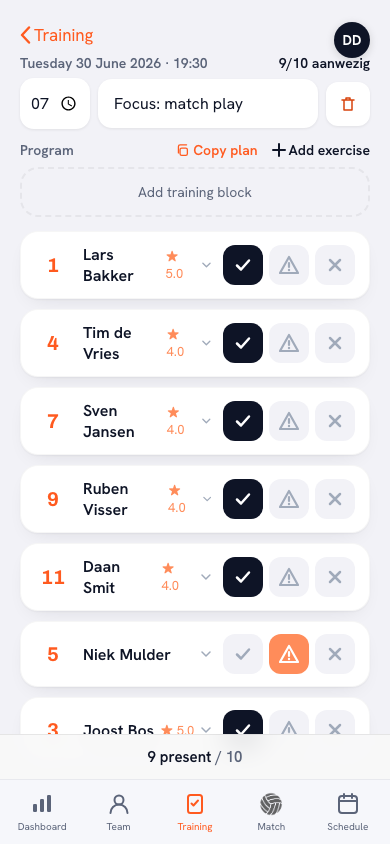
Landing technique isn't a lesson you give once; it is a habit you maintain. The practical trick is not to plan it as a separate topic but as a fixed part of the warm-up — comparable to shoulder activation. Put a short landing block in your warm-up template in Koach so it is in every session, instead of only after someone gets hurt. After that, correct during the rest of the session with a single word (quiet, or knees), because during game play you want a reminder and not a technical explanation. After six weeks or so you literally hear the difference in the hall.
Important: these are general prevention principles, not treatment advice. Persistent pain, recurring knee or ankle complaints and acute injuries belong with a (sports) physiotherapist or doctor, who also decides when a player may jump fully again.
Frequently asked questions
From what age can you train landing technique?
From the moment children jump, so effectively from mini volleyball onwards. Keep it playful — land like a statue, come down as quietly as you can — and keep the volume low. A good landing is most valuable precisely during the growth phase.
How much time does a landing block take per practice?
Four to six minutes in the warm-up is enough, as long as you do it every session. Consistency over months works better than one extensive technique evening that never comes back.
Does landing technique help against jumper's knee?
It is one of the factors. A damped landing lowers the peak load on the patellar tendon, but the main cause of tendon complaints remains a jump load built up too quickly. Technique and dosage belong together.


