
Torn meniscus in volleyball: causes, signs and return to play
The short answer
A torn meniscus in volleyball often happens when twisting or braking on a bent knee, sometimes together with an ACL injury. Signs are a knee that gets more swollen and stiffer in the days after, keeps catching, locks or gives way. Always have it checked; a knee that is locked, the same day.
A torn meniscus in volleyball rarely happens with much drama. A player twists on a bent knee, feels something, and often just plays on. Only in the days after does the knee swell or keep catching. Here you read what the meniscus does, which signs need a doctor and what the return to jumping involves.
What does the meniscus do in your knee?
Every knee has two menisci: wedge-shaped pieces of tough cartilage between the thighbone and the shinbone, one on the inside and one on the outside. The American Academy of Orthopaedic Surgeons (AAOS) calls them shock absorbers: they transfer weight from one bone to the other and are important for the stability of the knee. In volleyball they take a beating with every landing and every stop.
The meniscus can tear in two ways. In athletes it often happens at one moment, through a twist or an impact. In older players a second kind comes in: according to the AAOS the meniscus gets weaker with age, and then a small, awkward twist can be enough. So with recreational and masters players, "I wasn't really doing anything special" is no reason not to have it checked.
How a meniscus tears in volleyball
The patient information of the US National Library of Medicine (MedlinePlus) lists causes including twisting or overbending the knee, suddenly stopping and changing direction while running, landing after a jump or turning around, kneeling, and squatting deeply to lift something heavy. The AAOS adds that a meniscus tear often occurs together with other knee injuries, such as a torn anterior cruciate ligament (ACL).
On the court, these are for example moments like these (examples, not a researched list):
- a defender who brakes hard for a ball and turns in the same movement;
- a blocker who turns away right after landing to go after the next ball while their foot is still planted;
- a player who drops low to reach a low ball and twists their knee as they do.
That is different from pain that builds up slowly from a lot of jumping. If the pain sits just below the kneecap and gets worse with jumping and landing, read knee pain and jumper's knee. If the player felt a pop, the knee gave way and it swelled within a few hours, also think of the ACL: see an ACL injury in volleyball.
Playing on proves nothing
The tricky thing about a meniscus tear is that it often does not seem too bad in the moment. According to the AAOS, you may feel a pop, most people can still walk on the knee, and many athletes even keep playing with a tear. The stiffness and swelling then increase gradually, over two to three days. A player who "still played fine" on Saturday can have a swollen knee on Monday that no longer bends properly.
For you as a coach that means: after a clear moment, a twist with pain or a knee that felt strange for a second, take the player off the court, even if they say they are fine. Whether they can still walk later that day says little about what is going on inside the knee.
Ask again the next day. Send the player, or with young players the parents, a short message the next day: has the knee got more swollen, does it keep catching, does it give way or does it no longer bend all the way? If the answer is yes, they first see a doctor or physiotherapist before they practice again.
The signs: when a knee needs a doctor
You do not make a diagnosis; a doctor does that with an examination and, if needed, an MRI, because a meniscus does not show up on a regular X-ray (AAOS). What you can do is recognize the signs the AAOS and MedlinePlus list:
- joint pain that gets worse with pressure, and difficulty squatting;
- swelling and stiffness that increase in the days after the moment;
- a knee that keeps catching or locks;
- a knee that gives way or feels unstable;
- not being able to fully bend or straighten the knee.
With one or more of these signs, the player goes to a family doctor, sports physician or physiotherapist, and does not practice until someone has looked at it. Some signs cannot wait. The UK's National Health Service (NHS) says to get medical advice right away if the knee locks, gives way or clicks painfully, if you cannot move the knee or stand on it, or if it is very painful, badly swollen or has changed shape.
A locked knee, one the player can no longer straighten, is such a moment: make sure the player sees a doctor the same day. MedlinePlus explicitly names a knee that locks and will not straighten as a reason to get in touch. Do not force anything: do not shake the knee loose or push it straight, do not let anyone else do that either, and support the leg in the position that hurts least. What else you do in the gym until help arrives is in volleyball first aid.
What happens next: exercise therapy or surgery
According to the AAOS, how a meniscus tear is treated depends on age, symptoms, activity level, and the type of tear, its size and its location. The outer part of the meniscus has a good blood supply; a tear there can sometimes heal on its own or be stitched. The inner part has little blood supply; if a tear there causes symptoms that do not go away, the damaged piece is often trimmed away in keyhole surgery (arthroscopy).
So there are roughly three routes: recovery without surgery, with exercise therapy; surgery in which the meniscus is stitched; or surgery in which part of it is removed. Which route it will be, the doctor and the player decide together. This article gives no treatment advice; it only helps you understand why two players with "something with the meniscus" come back so differently.
Back to jumping: expect weeks to months
For recovery after removing part of the meniscus, the AAOS gives about 3 to 6 weeks, and after stitching the meniscus about 3 to 6 months. MedlinePlus speaks in general of a few weeks to a few months. That difference is large, and it is the reason you do not fix a date in your head in advance.
According to the AAOS, rehab starts with moving the knee, and strength is then added gradually, with a physiotherapist. Jumping, landing and turning at full speed are the heaviest load on the knee in volleyball, so they only come back when the person treating the player approves. Three things you can do:
- Ask which step is allowed now. For example passing and setting in place, but no blocking or attacking yet. Adapt the drills to that instead of putting the player on the sideline.
- Watch the knee after practice. If it gets more swollen, more painful or more unstable again, the player reports it to the person treating them; MedlinePlus lists that as a reason to get in touch.
- Build up jumps gradually. How much a volleyball player jumps, and so what a return means, is in how often does a volleyball player jump. You practice a soft landing on two feet with learning to land safely.
Whether a brace makes sense in the first period is up to the person treating the player; MedlinePlus mentions a brace as possible support. If symptoms persist or come back after the return, go back to the family doctor, sports physician or physiotherapist. If you are new to coaching, starting as a volleyball coach covers what to arrange from the start.
In Koach: who is injured and what was agreed
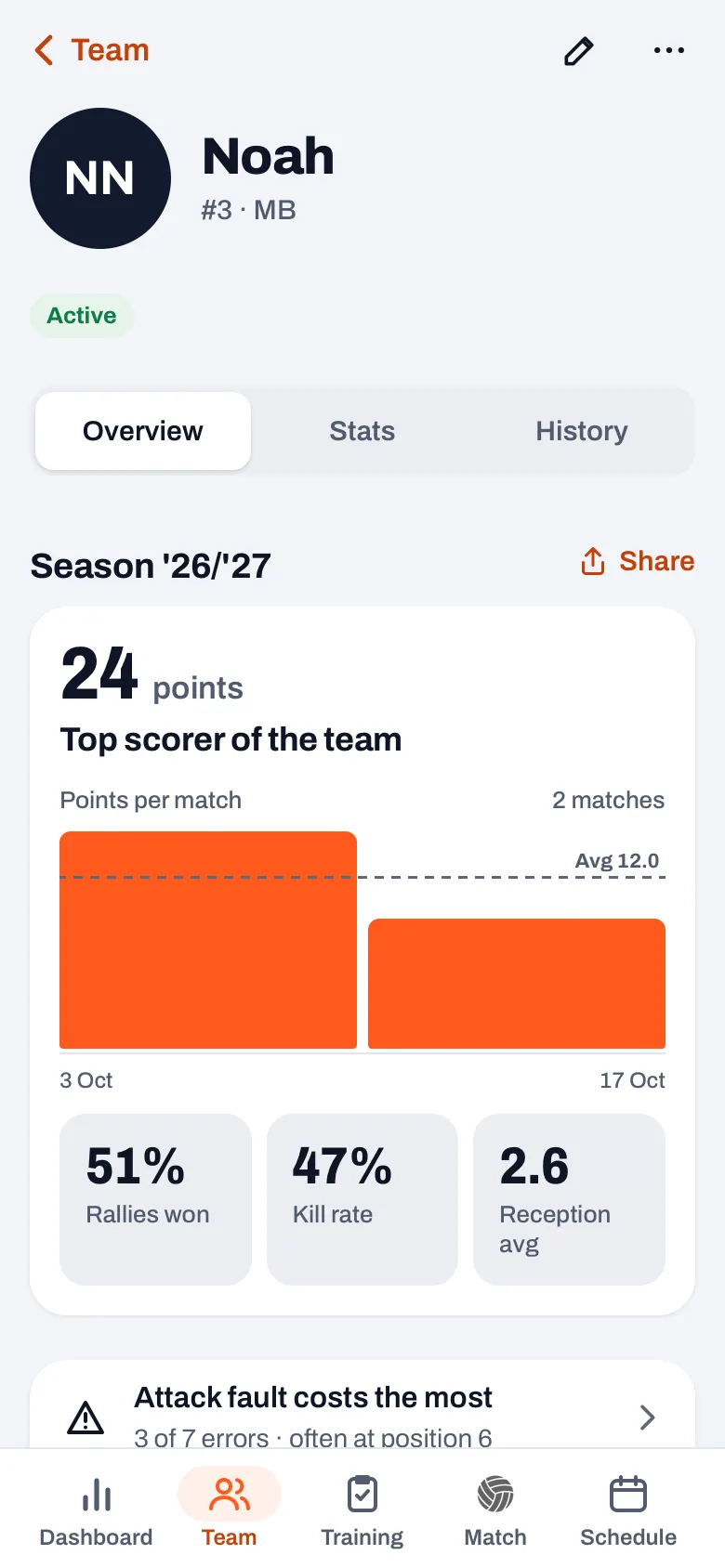
Koach does not make a rehab plan; the physiotherapist does that. What you do see in the app at a glance is who is not fully taking part. On the player profile, tap the pencil (Edit player) and under Status set the player to Injured. The profile then shows that label, when you prepare a match they appear grayed out at the end of the bench, and they get no nudge or reminder to sign up. Teammates see Absent for them, so their knee does not become a topic for the whole group.
Whatever was agreed with the physiotherapist, you write under Overview in Notes. Players and parents don't see those notes; if your team belongs to a club on the Club plan, the club board can read them. Under History, in Trainings, you see how many practices they attended, so after their return you can see how the build-up is going. The status has no end date: when they are fully back, you set them back to Active yourself.
14 days free, no credit card. Add your team tonight and see for every player straight away whether they are injured and what was agreed.
Try Koach with your teamWhat Koach costs after the trial is on the pricing page.
Frequently asked questions
Can you play volleyball with a torn meniscus?
According to the AAOS, many athletes can keep playing at first after a meniscus tear, and that is what makes it treacherous. Swelling and stiffness often only increase in the days after. Whether and when you play volleyball again depends on the type of tear and the treatment, and a doctor or physiotherapist decides that. With a knee that locks, gives way or swells, you do not practice until someone has looked at it.
How long does it take to recover from a meniscus injury?
That varies a lot. The AAOS gives about 3 to 6 weeks after surgery in which part of the meniscus is removed, and about 3 to 6 months after the meniscus is stitched. MedlinePlus speaks in general of a few weeks to a few months. When you jump and turn at full speed again is decided by the person treating you.
What should you do if your knee locks?
Do not force anything: do not shake the knee loose or push it straight, and do not let anyone else do that either. Support the leg in the position that hurts least and make sure you see a doctor the same day. The NHS names a knee that locks, gives way or clicks painfully as a reason to get medical advice right away, and MedlinePlus names a knee that locks and can no longer be straightened as a reason to get in touch.
Is a meniscus tear the same as an ACL injury?
No. The meniscus is a cartilage cushion between the bones; the anterior cruciate ligament (ACL) is a ligament that keeps the lower leg in place when you brake and turn. They can tear at the same time, though: according to the AAOS, a meniscus tear often occurs together with an ACL injury. A pop, a knee that gives way and fast swelling are reasons to have both checked.
Keep track of who is injured
14 days free, no credit card. Your players' status and agreements in one place.
Get started with KoachOr read first what the volleyball coaching app does.