
Jump rope for volleyball: eight drills for footwork and jumping
The short answer
Jump rope for volleyball players is a good extra for footwork, rhythm, calves and conditioning, but it does not replace jump training or strength training. Start with short 30-second blocks on two feet and build up over a few weeks to alternate-foot steps, side-to-side and single-leg jumps.
Jump rope for volleyball makes sense: you jump short and light on the balls of your feet, in a steady rhythm, and that is what your feet have to do in the gym too. Here you read what skipping rope does and does not do for a volleyball player, eight drills, and how to build it into your warm-up or a home session.
Is jumping rope good for volleyball players?
Yes, as an extra. With a jump rope you make hundreds of small jumps in a row, short on the balls of your feet and in a steady rhythm. That trains what a volleyball player needs all match long: staying light on your feet, getting off the floor quickly and coordinating your hands and feet. On top of that it is conditioning you can do in a corner of the gym or at home, with a rope that fits in your bag.
The research is fairly positive, although it is mostly not about volleyball players. A meta-analysis by Singh and colleagues (Journal of Sports Sciences, 2022) combined 21 studies with 1,021 healthy participants, in 18 of those studies younger than 18 on average, who trained with a jump rope for 6 to 40 weeks. They improved in endurance, maximal strength of the legs and arms, jumping and sprinting; the researchers speak of small to moderate benefits. They found no clear effect on bone mass or muscle mass. For volleyball players there is mainly one small study: twelve weeks of jump rope with girls aged 14 and 15, with nine players per rope group and seven in a control group, improved some measures of coordination and proprioception, the sense of where your legs are, especially with a weighted rope (Ozer and colleagues, 2011). Too small to draw firm conclusions from.
What jump rope does not do
Rope jumps are low: a few centimeters, without an approach and without an arm swing. They make you fitter and lighter on your feet, but they do not train your maximum jump. For a higher attack or block jump you need heavier stimuli, such as plyometrics and strength training; how to build that up is in jumping higher in volleyball. For footwork in every direction the rope is limited too: you jump on the spot. Quick movements forward, sideways and back are better trained with the drills in volleyball ladder drills.
What do you need?
- A rope of the right length. Stand with one foot on the middle and pull the handles up: for beginners they reach about to the armpits; if you can already do it, take it a little shorter.
- A floor with some give. A gym floor, a wooden floor or a rubber tile. Avoid concrete and tiles.
- Court shoes with cushioning. Barefoot or in socks, your feet and calves have more to absorb.
- The right posture. Elbows close to your body, turn the rope from your wrists, come off the floor only a few centimeters, land on the balls of your feet with soft knees and look ahead.
Eight jump rope drills for volleyball players
Start at the top and only move down when the drill above it feels relaxed, without the rope catching all the time.
| Drill | How | What it gives you |
|---|---|---|
| 1. Basic bounce | On two feet, one jump per turn | Rhythm and a light landing on the balls of the feet |
| 2. Boxer skip | Shift your weight lightly from one foot to the other | An easy form for longer blocks |
| 3. Alternate-foot step | Run in place, a different foot each turn | Conditioning and quick foot changes |
| 4. Side to side | On two feet over a line, left and right | Lateral stability, as in block footwork |
| 5. Front and back | On two feet over a line, forward and back | Quick changes of direction |
| 6. Single leg | Hop on one leg, then the other | Take-off and landing on one leg, as in the slide |
| 7. High knees | Alternate-foot step with the knees up to hip height | A harder conditioning form |
| 8. Double under | The rope passes under you twice per jump | A higher, quicker take-off; advanced players only |
In the single-leg drill, watch left and right. If it goes clearly worse on one leg, that says something about the balance between your legs; give that leg a few extra sets. The double under is the only drill that really resembles a jump: keep those sets short, five to ten attempts, and stop as soon as the landing gets sloppy.
Progression and dosage
Jumping rope feels easy, but hundreds of small jumps load your calves, Achilles tendons and feet more than you think. So build up over weeks and change one thing per step: the duration or the difficulty. An example for two or three times a week:
- Weeks 1 and 2: six times 30 seconds of basic bounce or boxer skip, with 30 seconds of rest in between.
- Weeks 3 and 4: eight times 30 seconds, adding the alternate-foot step and side to side.
- Weeks 5 and 6: three rounds of one minute: 20 seconds of basic bounce, 10 seconds single leg on the left, 10 seconds on the right and 20 seconds side to side, with a minute of rest between rounds.
- After that: longer blocks for conditioning, or short sets of double unders for the take-off.
If your Achilles tendon, your calf or your shin aches afterward or the next morning, take a step back. Pain while jumping is a reason to stop. If the symptoms persist or get worse, see a doctor, a sports physician or a physical therapist; what can be going on with the Achilles tendon is in the Achilles tendon in volleyball. Kids who are still growing and have heel pain should get it checked first before you add the rope.
Count the rope as part of the week. Low jumps are not maximal jumps, but they do count for your calves and Achilles tendons. If you do ten minutes of rope at home every day after a heavy jumping session, you have not had a rest day. How much a volleyball player already jumps in practice and matches is in how many times a volleyball player jumps.
Where does jump rope fit in the week?
- In the warm-up. Two to three minutes of rope is a good start to warming up: your heart rate goes up and your feet wake up. After that come the mobility work and the jumping and hitting; that progression is in building a good warm-up. You do need a rope per player, or you have groups take turns.
- At home, on a day without practice. Ten minutes of rope keeps up your conditioning and footwork, without a gym. Pick a day that does not come right after a heavy jumping session or a match.
- In the summer or during a break. A simple way to stay fit. After a long break, start again at week 1.
Do not use the rope as a punishment for a mistake. A drill that players get to know as a punishment is one they do reluctantly afterward, even when it is useful.
Putting jump rope in your practice plan
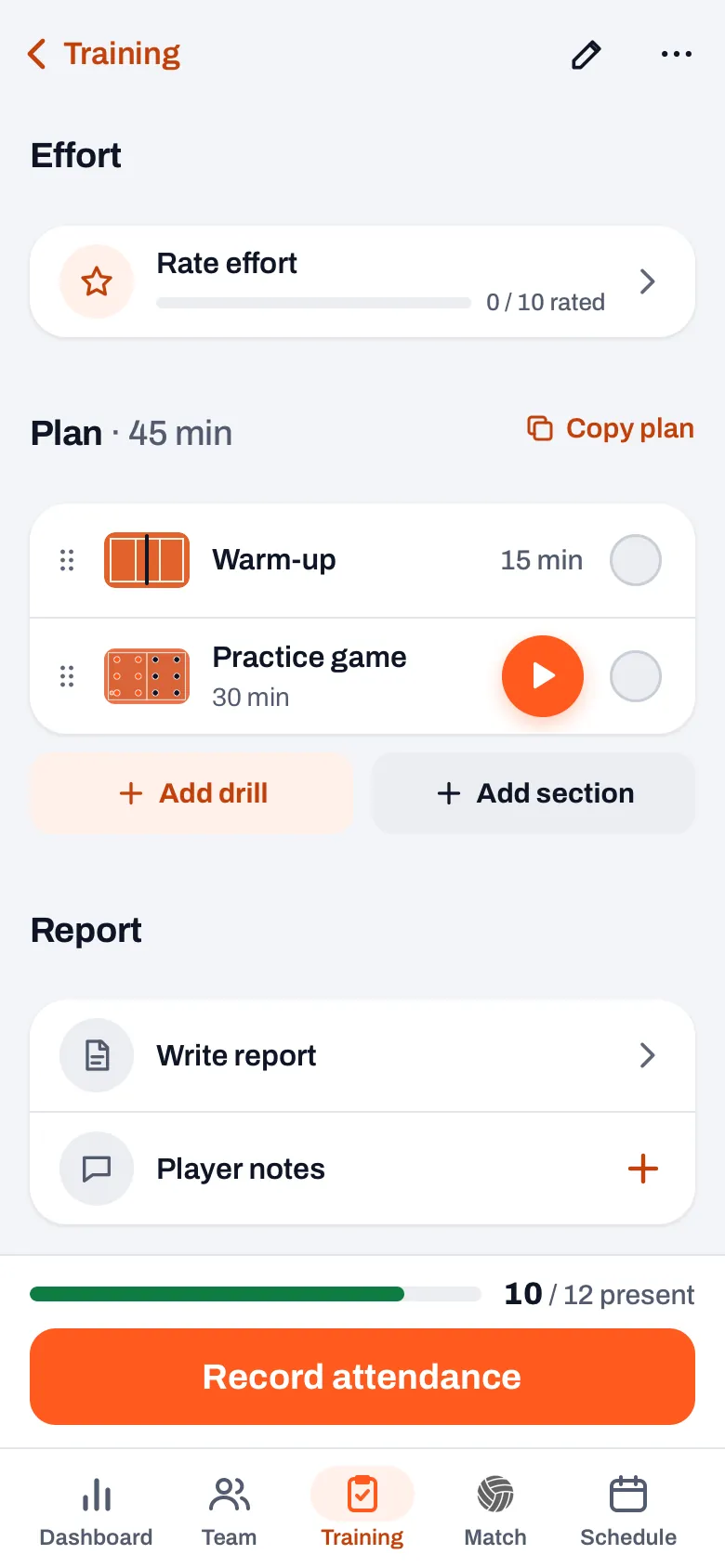
There is no jump rope drill in the Koach drill library, but you add it to your practice plan in a few taps. Under Plan, tap + Add section, name it, for example, Jump rope, and choose the duration in steps of five minutes. With Add description you add that week's blocks, so a second coach knows what is happening. Drag the section to the top, before the rest of the warm-up. With Copy plan you take it along to next week and only adjust the blocks.
If you have just started as a coach, what else to set up for your first season is in starting as a volleyball coach. What Koach costs after the 14 free days is on the pricing page.
14 days free, no credit card. Set up your next practice with a jump rope block and take the plan along every week.
Try Koach with your teamFrequently asked questions
Is jumping rope good for volleyball?
Yes, as an extra. It trains being light and quick on your feet, rhythm, the calves and conditioning, and you can do it anywhere. A meta-analysis of 21 studies, mostly with young people, found improvements in endurance, strength, jumping and sprinting. For your maximum jump and footwork in every direction you also need plyometrics, strength training and movement drills.
Does jumping rope make you jump higher?
A little. In the meta-analysis by Singh and colleagues (2022), jumping improved after weeks of jump rope training. But rope jumps are low and without an approach, so for a higher attack jump it is not enough. See the rope as a base for landing lightly and quickly, and train your maximum jump separately with plyometrics and strength work.
Is jumping rope bad for your knees?
There is little research on this in volleyball players. You jump low and land on the balls of your feet, so mainly the calves, the Achilles tendons and the feet do the work. Do jump on a floor with some give and in cushioned shoes, and build up gradually. If you get pain in your knee, heel or shin, stop. If the symptoms persist, see a doctor, a sports physician or a physical therapist.
How long should a volleyball player jump rope?
Start with about three minutes of rope in total, in 30-second blocks with rest in between, two or three times a week. Build up over six weeks with varied drills and only then move to longer blocks, for example ten minutes. In the warm-up, two to three minutes is enough. Longer only makes sense if you use it as conditioning, on a day without heavy jump training.



Put your jump rope block in the plan
14 days free, no credit card. In six weeks your plans show how you built it up.
Get started with KoachOr read first what the volleyball coaching app does.