
Achilles injury in volleyball: tendon pain, rupture and return
The short answer
An Achilles injury in volleyball is often overload: it builds up gradually, the tendon is stiff when you get up and hurts when you jump. A rupture feels different: a sudden pop or a kick to your calf, and standing on your toes often no longer works. Then you see a doctor right away; recovery takes months.
An Achilles injury in volleyball often creeps up on you: a stiff heel when you get out of bed, a nagging tendon in the warm-up. Sometimes it happens in one go. Here you read how to tell those two apart, when not to wait and what a return roughly involves.
What does the Achilles tendon do in volleyball?
The Achilles tendon connects your calf muscles to your heel bone. It pulls your heel up when you rise onto your toes and push off, and it helps when you absorb a landing. In volleyball it works on every approach, every jump at the net, every landing after a block and every quick start toward a dig. How many jumps that adds up to per practice and per match is in how often a volleyball player jumps.
Two very different things can go wrong. The tendon can become overloaded, slowly and over weeks, or it can rupture in a single moment. The American Academy of Orthopaedic Surgeons (AAOS) describes that a rupture usually happens when the calf muscle is stretched too quickly, for example when landing from a jump or in a sudden change of direction. Those are exactly the movements of volleyball.
Overload or rupture: the differences side by side
| What you notice | Overloaded tendon | Ruptured tendon |
|---|---|---|
| Onset | Gradual, over days or weeks | Sudden, in one moment |
| Feeling | Stiff and painful when you get up, pain that increases with activity | A pop, or as if someone kicked you in the calf |
| After that | Often significant pain the day after a hard practice | Severe pain and swelling near the heel; walking or standing on your toes often no longer works |
| What you do | Reduce the load; if it persists, see your doctor or a physiotherapist | See a doctor right away |
Sources: the AAOS on an overloaded Achilles tendon and on an Achilles tendon rupture, and the patient information from Cambridge University Hospitals (NHS).
A pop or a kick to your calf: stop and see a doctor
The familiar story: a player takes off for an attack or sprints to a short ball, feels a blow at the back of the lower leg and turns around to see who kicked them. Nobody is there. The patient information from Cambridge University Hospitals describes it like this: as if someone hit or kicked you in the calf, with sudden pain. According to the AAOS you may also hear a popping sound, and afterwards standing on the toes of that leg often no longer works.
Then the practice or match is over for that player. Do not let them test whether it is okay and do not let them keep walking on that leg, and make sure they see a doctor the same day. A physiotherapy service of the UK's NHS (Lincolnshire) puts it this way: if you think the tendon has ruptured, have it checked as soon as possible, and if in doubt go to the emergency department. If surgery is needed, it works out better according to the AAOS when it happens soon after the injury, because otherwise the tendon shortens and scars. Whether it becomes surgery or treatment with a brace, walking boot or cast is decided by the doctor and the player together. What you do in the gym until help arrives is in volleyball first aid.
Nagging Achilles pain: what overload means
An overloaded tendon usually has no clear moment when it started. The AAOS names repetitive stress as the cause, with contributing factors such as a sudden increase in the amount or intensity of exercise, a change of shoes and tight calf muscles. The symptoms the AAOS describes: pain and stiffness along the tendon when you get up, pain that gets worse with activity, severe pain the day after exercising, and a tendon that feels thickened or swollen. What to look for with new shoes is in buying volleyball shoes.
What happens next is work for a physiotherapist or doctor. In broad terms the AAOS describes: doing less of what triggers the pain, temporarily doing more of what puts less load on the tendon, such as cycling or swimming, and an exercise program for the calf guided by a physiotherapist. According to the AAOS it can take a few months before the symptoms clearly ease. A program from a video or from a teammate is no substitute: how heavy and how fast you build up depends on your tendon.
Two things from the AAOS information are good to know. Corticosteroid injections into the tendon are advised against, because they can cause the tendon to rupture. And on its page about ruptures, the AAOS also mentions certain antibiotics (fluoroquinolones, such as ciprofloxacin and levofloxacin) as something that has been linked to tendon ruptures. If you take such antibiotics and develop pain in your heel, tell your doctor. If the symptoms persist, get worse or you are unsure: see your doctor, a sports physician or a physiotherapist.
What you do as a coach: dose the jumps, keep the player involved
The general side of preventing injuries, from warm-up to landing technique, is in injury prevention in volleyball. For the Achilles tendon, three things come on top of that:
- Watch the peaks. The first weeks of the season, a tournament day with lots of matches or a week with blocking and attacking practice back to back: those are the moments when the load suddenly rises, exactly what the AAOS names as a contributing factor.
- Ask about it. Hardly anyone reports a stiff heel in the morning on their own. Ask at the start of the week, especially the players who jump a lot.
- Keep the player in the group. A player with a sensitive tendon can often join in passing, setting and tactics and only skip the jumping drills, if the physiotherapist agrees. That way they stay with the team, and you prevent them from going straight back to doing everything after a week at home.
The same jumping load also affects the knee; that is the topic of knee pain and jumper's knee.
Ask about heels on Monday. Asking who has a stiff heel when they get up takes almost no time, and it gives you the chance to adjust the jumps in practice before a problem gets bigger.
Back after an Achilles rupture: think in months
After a rupture the question is not whether a player will still play this season, but when they can jump fully again. The AAOS describes that, with or without surgery, you can expect around six weeks or more in a brace or walking boot, followed by a gradual build-up of mobility and strength with a physiotherapist. Full recovery takes about twelve months according to the AAOS, closer to two years for some people, and some loss of strength is normal. Athletes go through a series of tests before they are allowed to do everything again.
For you as a coach that means: the doctor and the physiotherapist set the pace and the moment the player jumps again, not the league schedule. Ask the player which step they are on now and adjust your practice to it. Keep them involved with the team in the meantime, for example with a task on the bench; a season on the sideline is long.
Keeping track in Koach of who trains with adjustments
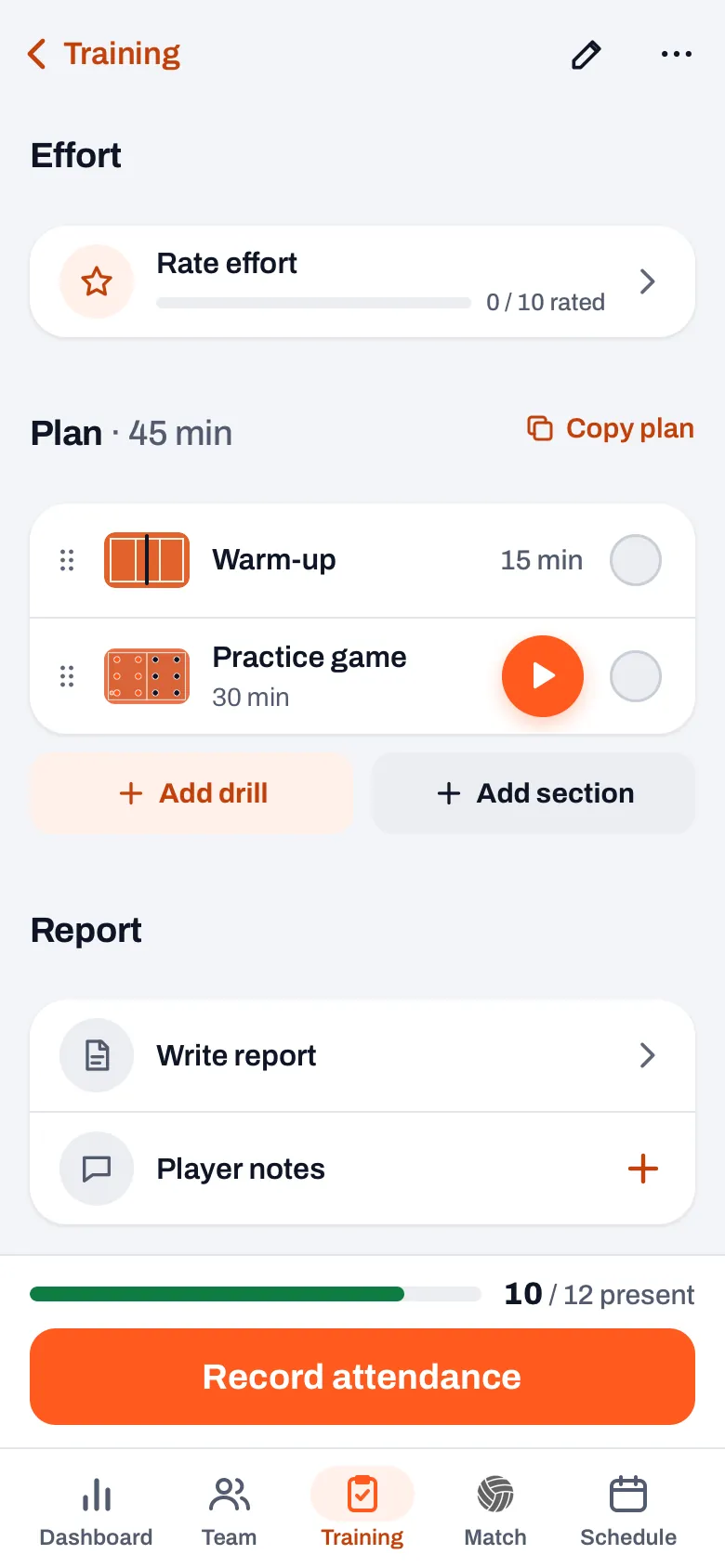
Koach does not make a rehab program; the physiotherapist does that. What you can do in the app is keep track of who is not fully taking part for a while. On the player profile, tap the pencil (Edit player) and under Status set the player to Injured: when you prepare a match, they then appear grayed out with that label at the end of the bench, and they do not get a nudge or reminder to respond. For a practice, write a player note under Report, for example which phase the physiotherapist agreed on and which jumping drills the player skips. That way your assistant knows too, and weeks later you can still see what was agreed.
14 days free, no credit card. Add your team tonight and keep track of who trains with adjustments, without loose notes.
Try Koach with your teamWhat Koach costs after the trial is on the pricing page. If you have just become a coach, also read starting as a volleyball coach.
Frequently asked questions
Can you play volleyball with Achilles pain?
That depends on the pain, and your doctor, a sports physician or a physiotherapist is the one to assess it. A clear signal to cut back is pain that increases during practice or is worse the next day; the AAOS names severe pain the day after exercising as typical of an overloaded tendon. Playing on painkillers only hides the problem. Have persistent symptoms checked, and you also hear what you can still do.
How do you know if your Achilles tendon is ruptured?
Typical is a sudden pop or the feeling that someone kicked you in the calf, with pain and swelling near the heel; afterwards standing on your toes on that side often no longer works (AAOS and Cambridge University Hospitals). A doctor diagnoses it with a physical examination, including the Thompson test, and sometimes an ultrasound or MRI. With this picture, see a doctor the same day and do not keep walking on that leg.
How long does recovery take after an Achilles rupture?
According to the AAOS you can expect around six weeks or more in a brace or walking boot, followed by a gradual build-up with a physiotherapist. Full recovery takes about twelve months, almost two years for some people, and some loss of strength is normal. When you jump and play matches again is decided by your doctor and physiotherapist based on tests, not by the calendar.
Is Achilles tendinitis the same as an overloaded Achilles tendon?
Usually people mean the same thing by it: pain and stiffness in the tendon from repeated load, without one clear moment when it started. The AAOS calls it Achilles tendinitis; doctors and physiotherapists often speak of tendinopathy. A rupture is something else: it happens suddenly. If the symptoms persist, have your doctor or a physiotherapist take a look.
Track who trains with adjustments
14 days free, no credit card. Your team's injuries and agreements in one place.
Get started with KoachOr read first what the volleyball coaching app does.