
Jump set in volleyball: when to jump and how to teach it
The short answer
A jump set in volleyball is an overhead set your setter plays at the top of a jump. They use it on a good, high pass close to the net: they contact the ball earlier, the tempo can go up and the block has to respect the dump. On a low or distant pass they set from the floor.
A jump set in volleyball looks effortless from a good setter, but it is only a weapon at the right moment. This article covers when your setter jumps and when not, how the timing works, what it asks of their legs and how to teach the jump set step by step.
What is a jump set and what does it give you?
In a jump set your setter takes off from two feet and plays the ball overhead at or just before the top of their jump. The hands do the same as in a set from the floor: the hand shape above the forehead, all ten fingers at once, a short and springy contact. That foundation is covered in overhead setting, and it has to be in place first. The jump adds four things:
- Earlier and higher contact. The ball has less distance to fall before you play it, and the set to your hitter has less distance to rise. That lets the tempo go up.
- A threat. If your setter is in the front row, they can attack the second ball themselves out of the same jump. The opposing middle blocker has to keep watching and leaves later for your hitter. How that attack works is in the setter dump.
- Saving a tight pass. A pass that threatens to go over the net can still be kept on your own side by a jumping setter.
- One look. If they jump on every good pass, the block cannot tell from the jump whether a set or a dump is coming.
A worked example for the first point. Say the pass peaks at 3.5 meters and your setter contacts the ball in the air at 2.4 meters instead of standing at 2.0 meters. The ball then falls 1.1 meters instead of 1.5 meters, which takes about 0.47 instead of 0.55 seconds (the square root of 2 times the drop height divided by 9.81). So they play the ball roughly 0.08 seconds earlier, and the set starts 40 centimeters higher. That sounds like little, but on a fast middle attack the hitter is already in the air before the set leaves, and then every fraction counts. Which tempos there are is in attack tempos.
When should your setter jump, and when not?
The pass decides. A jump set on a bad pass costs more than it gives: the setter is off balance, the set gets messy and the hitter gets a ball they cannot hit.
| The pass | Jump set? | Why |
|---|---|---|
| High, on target, half a meter to a meter off the net | Yes | Time to get to the spot and take off; earlier contact and the threat of the dump |
| Tight to the net, threatening to go over | Yes, if possible | In the air you can still keep it on your side; mind the net rule below |
| Low or fast | No | No time to take off; you would contact the ball while still rising |
| Far from the net or far from the target | No | You have to move first; from the floor, with your legs, you set more steadily and further |
| High ball far outside with a young setter | Not yet | In the air the power from the legs is missing; first master the distance from the floor |
Fatigue counts too. After a long rally or at the end of a hard practice a jump set gets sloppy, and then a set from the floor is the better choice. How to turn a ball from a bad pass into something hittable anyway is in setting a bad pass.
Jump set technique and timing
- Get to the spot first. Your setter moves to the target and is stopped before taking off, with the right foot slightly forward and the shoulders turned toward position 4. A setter who takes off on the move keeps drifting in the air.
- Hands up early. The hand shape is already above the forehead before take-off. In the air there is no time left to set the hands.
- Jump straight up. Off two feet, straight up. A setter who jumps toward the net touches the net or puts a foot over the center line. Landing on the same spot as the take-off is a good check.
- Contact at the top. At the top of a jump your body is still for a moment: you are no longer going up and not yet coming down. That is where the contact is calmest. As a starting rule of thumb they take off when the ball hangs at its highest point or just starts to fall; the higher the pass, the later. After that every setter finds their own moment.
- Power from trunk and arms. In the air you cannot extend your legs, so the power comes from the trunk, arms and fingers. That is why the jump set suits short and fast balls best. If the ball has to go high and far outside, they extend the arms fully toward the target. Setting backward works in the air too: the hips only come forward at contact, under the ball. That movement is in the back set.
- Land and cover straight away. On two feet, on the take-off spot, and immediately a few steps behind the hitter for the ball that comes back off the block.
A back-row setter: what is allowed in the air?
A setter in the back row may also jump set. The only thing they may not do is send a ball that is entirely higher than the top of the net over the net from the front zone: that is an attack hit fault by a back-row player (rule 13.3.3 of the Official Volleyball Rules 2025-2028). On a tight pass their jump set really has to go to their own hitter, and a dump out of the jump is only for a front-row setter. Youth competitions may have their own rules.
Load: every jump set is a jump
A setter who jumps on every good pass also blocks in the rotations where they are in the front row. That adds up to a lot of jumps in a practice and a match, mostly not maximal but frequent. In research with senior and professional players the setter even made the most jumps of all positions; the studies are in how often a volleyball player jumps. Count those jumps when you plan the week, build up the number of jump sets gradually and let a young setter who is still growing also set from the floor in long setting series. If a setter has persistent or severe pain in the knee, ankle or lower leg, have it checked by a doctor, a sports physician or a physical therapist.
How to teach the jump set: a five-step progression
- The jump without a ball. Hands up in the setting shape, take off, straight up, land on the same spot. Put a line on the floor parallel to the net and check after every landing that the feet are behind it.
- Self-toss and catch. The setter tosses the ball above themselves, jumps and catches it in the setting shape at the top. Then the same drill, but now setting the ball up to themselves instead of catching it. That builds the timing without a target.
- A tossed ball to a target. A coach tosses high and easy to the target spot, the setter jumps and sets to a hoop or partner at position 4, then backward to position 2. Only when that works does the toss get lower and faster.
- Off the pass, with a decision. A passer receives a tossed or hit ball. If the pass is good, the setter jumps; if it is low or far, they set from the floor. Have them say out loud after each ball why they chose. You get lots of reps for several setters at once with the Setter carousel.
- With a block and a threat. A blocker on the other side, and the setter chooses in the air between setting and attacking themselves. The Setter dump decision drill trains exactly that moment: reading the block while the ball comes to your hands.
Give your setter one decision rule. Can I play the ball at the top of my jump, close to the target? Then jump. In doubt? Then from the floor. A setter who only uses the jump set on good passes makes fewer errors with it than one who jumps on everything.
Seeing whether the jump set helps your attack
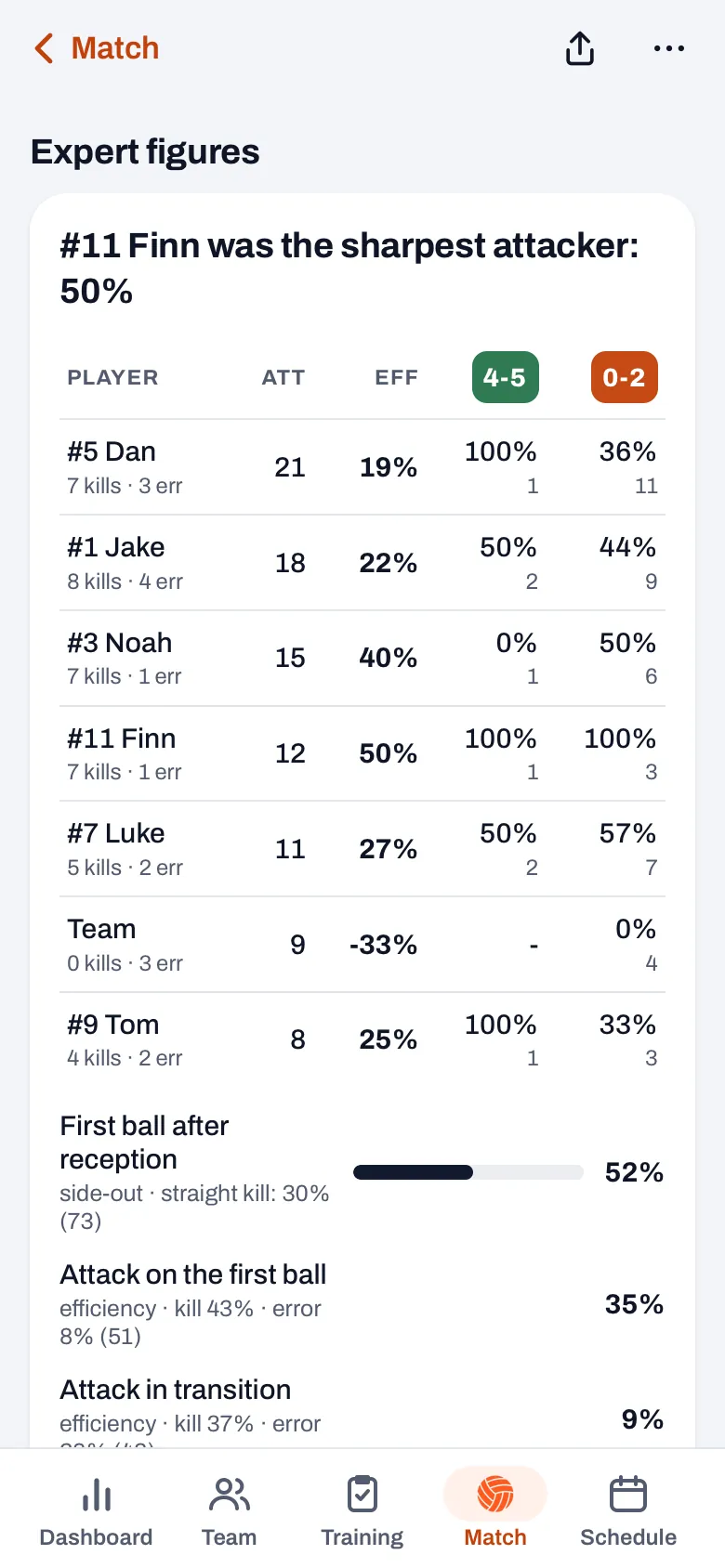
Whether the jump set pays off, you see in your hitters, not in your setter. In Koach's Expert mode you rate every set from 0 to 5, from Error through Poor, Fair, OK and Good to Perfect, with that rotation's setter already selected. After the match, Expert figures show for each hitter their attempts and efficiency, and in the 4-5 and 0-2 columns what share of their attacks became a kill after a pass or dig rated 4 or 5, and after a 0 to 2. Those good passes are the ones your setter jumps on. Whether a set was in the air, the app does not record; so compare the matches from before and after. If your hitters get more kills after a good pass since your setter started jump setting, it works. What Koach costs after the trial is on the pricing page.
14 days free, no credit card. Track your next match in Expert and see whether your hitters score on the good passes.
Try Koach in your next matchHow setting fits in with the other fundamentals, and in what order you teach them, is in learning volleyball technique.
Frequently asked questions
Should a setter always jump set?
No. A jump set is a choice for a good, high pass close to the net. On a low, fast or distant pass a set from the floor is steadier, because you can use your legs and do not have to move and jump at the same time. Many setters jump on the good passes and stay on the floor for the rest.
Is a jump set harder than a regular set?
Yes, because timing is added. You have to be at the spot in time, jump straight up and contact the ball at the top, and in the air you lose the power from your legs. That is why you learn the set from the floor first, then the jump without a ball, and only after that the jump set on an easy tossed ball.
Can a back-row setter jump set?
Yes. A setter in the back row may jump set to their hitter. The only restriction is that from the front zone they may not send a ball that is entirely higher than the top of the net over the net, because that is an attack hit fault by a back-row player. So a dump out of the jump is only possible when they are in the front row.
How high does a setter need to jump for a jump set?
Not high. It is not about how high they get, but about playing the ball calmly at the top of their jump. A small, stable jump with a clean contact is worth more than a high jump in which they drift toward the net or contact the ball while still rising.


See whether your hitters score on the good pass
14 days free, no credit card. After three matches you see what the jump set gives you.
Get started with KoachOr read first what the volleyball coaching app does.