
Playing volleyball with glasses or contact lenses: what is safe
The short answer
Playing volleyball with glasses is allowed: the rules permit glasses and contact lenses at your own risk. Ordinary glasses do not protect your eye and can break when a ball hits your face. Sports glasses with polycarbonate lenses and a strap, or contact lenses, are the usual choices; what suits you is something to discuss with your optician or eye doctor.
Playing volleyball with glasses is perfectly possible, but anyone who does it knows the moment when the glasses slide across the floor after a ball to the head. Here you read what the rules say, what ordinary glasses, sports glasses and contact lenses mean in practice, and what to arrange for children.
Playing volleyball with glasses: what do the rules say?
The official FIVB rules say it in one sentence: players may wear glasses or lenses at their own risk (rule 4.5.2 of the Official Volleyball Rules). At their own risk means: the referee does not forbid it, but if the glasses break or your eye gets hurt, that is your responsibility. What the rules say about clothing, jewelry and shoes beyond that is in the volleyball uniform rules. If you play in a national or regional league, also check your federation's rules, and if in doubt ask the referee before the match.
So the question is not whether it is allowed, but how to do it safely: with your own glasses, sports glasses or contact lenses.
Ordinary glasses: possible, but with two risks
Ordinary glasses are the obvious choice: you already have them. That goes fine until a ball hits your face or you dive. Then the glasses can fly off or shift, and you do not see the next ball. And they can break. The American Academy of Ophthalmology (AAO), the US professional association of eye doctors, writes that ordinary glasses do not protect the eye properly and can even make an injury worse if they break.
If you keep your own glasses on, at least ask your optician about lenses that do not shatter and about a sports strap that holds the glasses in place behind your head. That is not full eye protection, but it stops your glasses from shifting with every jump.
Prescription sports glasses
Sports glasses are made to stay in place and to absorb a blow. For sports such as basketball, racquet sports and soccer, the AAO recommends lenses made of polycarbonate, a plastic that does not shatter, and eye protection tested to a recognized standard. Volleyball is not on that list. That the same choice is also sensible for volleyball is our own conclusion: in the joint statement of the American pediatricians and eye doctors (AAP and AAO, see further on), volleyball is listed among the sports with a moderate risk of eye injury, and they name polycarbonate as the lens material for all protective eyewear. For volleyball you also look at three things:
- They stay on. A strap or a frame that wraps around your head, so the glasses stay in place during a jump, a dive or a quick turn.
- You can see to the side. In volleyball the ball comes from above and from the side, and at the net you watch the hitters next to you. A frame that blocks your side vision as little as possible helps.
- They do not fog up. In a warm gym lenses fog up quickly; ask about ventilation or a coating against it.
Sports glasses can be made in your prescription. Try them on while turning your head quickly and looking up, because that is how you look during a rally.
Contact lenses: no frame, but a few things to watch
With contact lenses there is no frame on your face, nothing can break and you see to the side just as well as without. Three things weigh against that:
- A lens does not protect your eye. AAP and AAO say so too; if you want to protect your eye, you need sports glasses as well.
- A lens can shift or fall out, for example after a ball to the face or when you rub your eye. Bring spare lenses and your regular glasses in your bag.
- Hygiene. The US public health agency CDC advises washing your hands with soap and water before you touch your lenses, taking them out before you swim or shower, and not sleeping in them unless your eye doctor says so. Keep that in mind with beach volleyball by the sea and in the shower after practice.
Which type of lens suits you is something to discuss with your optician or eye doctor. The AAO writes that most people choose soft lenses because they are comfortable, and that some eye doctors recommend daily disposable lenses for people who wear lenses only now and then, such as only for sports.
A ball to the face with glasses or lenses: what now?
Stop playing and take the glasses off carefully. Do not rub the eye and do not press on it. The UK's health service NHS says: go to the emergency department if something sharp has got into the eye, or if after an eye injury your vision has changed, you have severe pain, there is blood coming from the eye, you get a headache or become sensitive to light, you feel sick or vomit, or you cannot open or move the eye.
In the days after, also watch for flashes of light, new floaters or a shadow that moves across your vision like a curtain. Those can be signs of a detached retina, and according to the NHS that needs to be treated quickly. According to the same source, a previous eye injury and short-sightedness make a retinal detachment more likely, and glasses with a minus prescription are precisely glasses for short-sightedness. What else to do after a ball to the face or the head is in volleyball first aid.
Children with glasses at practice
In a joint statement (Protective Eyewear for Young Athletes, 2013 version), the American pediatricians and eye doctors (AAP and AAO) strongly recommend eye protection for all young athletes in sports where the eye can be hit. According to that statement, eye protection should be mandatory for children who see well with only one eye, and for children whose eye doctor advises it after eye surgery or an eye injury.
In practice that means: a sports strap or sports glasses, and a coach who knows that your child wears glasses or contact lenses. From what age a child can wear and care for contact lenses on their own is for the optician or eye doctor to judge. What else your child needs for the first practice is in what your child needs for volleyball.
Keep a glasses case in your sports bag. Anyone who switches to lenses halfway through practice, or takes their glasses off for a scrimmage, then does not leave them on the bench where the next ball finds them.
What do you discuss with your optician or eye doctor?
- Your sport. In volleyball the ball comes from above and from the side, you jump and dive, indoors or on sand.
- The lens material. Ask about polycarbonate and about sports glasses that have been tested to a recognized standard.
- The fit. How the glasses stay on during jumps and dives: strap, frame and soft edges.
- Contact lenses. Which type, how often you wear them and what you do if one falls out.
- Your eyes themselves. If you see much worse with one eye than with the other, even with glasses, mention it: according to AAP and AAO, eye protection is then extra important.
If you have symptoms after a blow to the eye that do not go away, or you have doubts about your vision, see your doctor or an eye doctor.
Getting used to new sports glasses or contact lenses
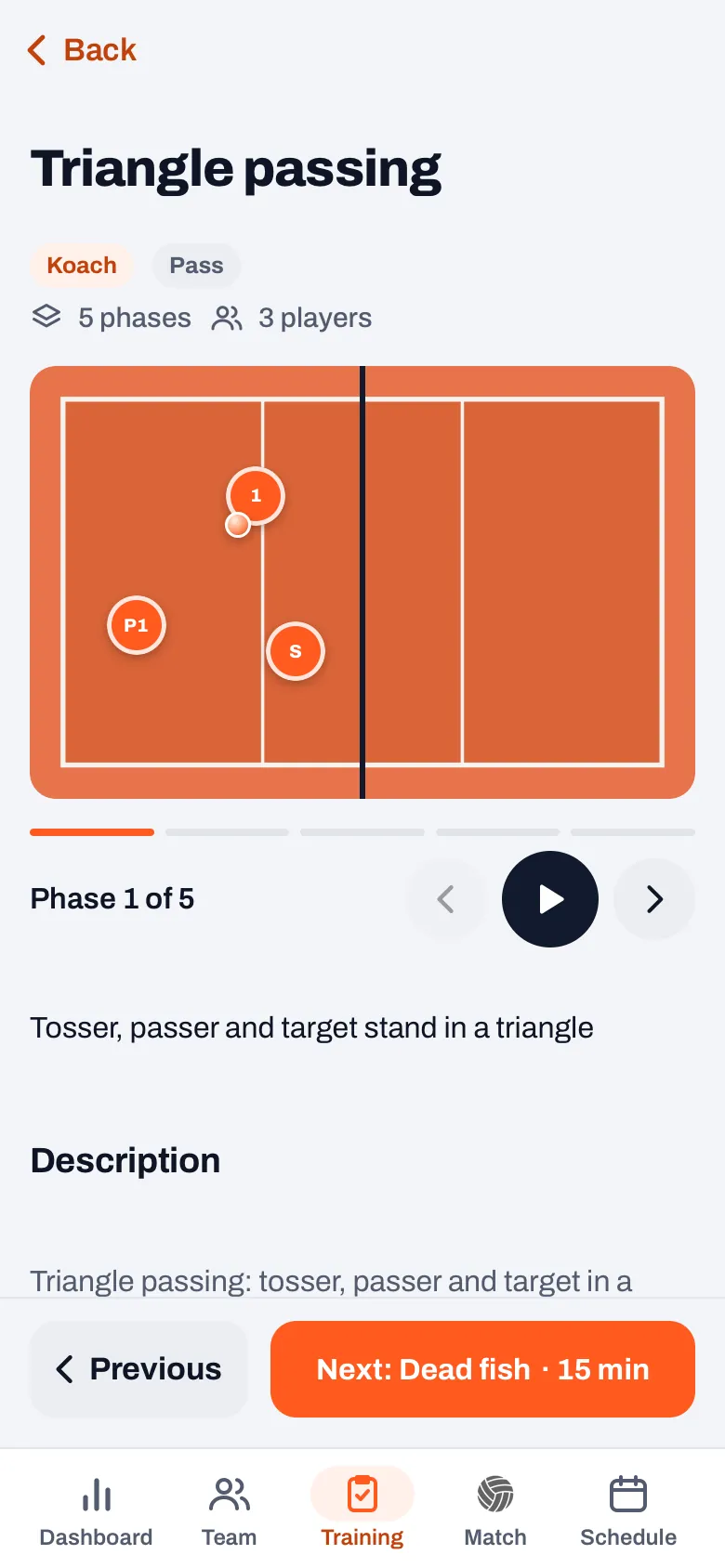
You do not try new glasses or new lenses for the first time in a match. Start at practice with calm passing drills, where you get used to how the ball looks and how the glasses sit, and only then move on to diving and blocking. As a coach you can put a passing drill at the start of the plan that evening. In Koach you open every drill from the plan with the phases as an animation, and you go to the next part with one button. If you are a new coach, starting as a volleyball coach helps you get going.
14 days free, no credit card. Put your practices in tonight, with drills you show phase by phase.
Plan your practice in KoachWhat Koach costs after the trial is on the pricing page.
Frequently asked questions
Can you play a volleyball match with glasses?
Yes. The FIVB rules allow glasses and contact lenses at your own risk (rule 4.5.2). Objects that could cause injury are forbidden though (rule 4.5.1), so the referee can refuse glasses with sharp or loose parts. Also check the rules of your own federation, and if in doubt ask the referee before the match.
Are sports glasses or contact lenses better for volleyball?
That depends on what you are looking for. Contact lenses give clear side vision and nothing can break, but they do not protect your eye and can fall out. Sports glasses with polycarbonate lenses and a strap do protect the eye, but you have to get used to them and they can fog up. Discuss with your optician or eye doctor what suits your eyes and your game.
Can a volleyball damage your eye?
Yes, a hard ball can hit the eye, especially if ordinary glasses break at the same time. Go to the emergency department if your vision has changed afterwards, you have severe pain, there is blood coming from the eye or you cannot keep the eye open. If in the days after you get flashes of light, new floaters or a shadow in your vision, have a doctor look at it quickly.
Does my child have to wear sports glasses for volleyball?
The rules do not require it, but the American pediatricians and eye doctors strongly recommend eye protection for young athletes in sports where the eye can be hit, and they count volleyball among them. For children who see well with only one eye, or after eye surgery or an eye injury if the eye doctor says so, they consider it a must. A sports strap on regular glasses is a first step.
Plan your next practice in Koach
14 days free, no credit card. Drills phase by phase, on your phone in the gym.
Get started with KoachOr read first what the volleyball coaching app does.