
The coaching zone: what are you allowed to do?
You know the rules of play: three contacts, rotation, net fault. But the rules that are about you — where you may stand, who you are allowed to say something to, how you request a substitution — sit in two short articles you have probably never read. You see the result in every league hall: a coach addressing the first referee, a substitution penalised as a delay, a coach who has drifted three metres too far towards the net halfway through a rally. Here is what you are actually allowed to do.
Your counterpart is the second referee
The rules cover the coach in two short articles, and the first sentence is immediately the most important one: the coach directs the team from outside the playing court, and his functional counterpart is the second referee (rule 5.2.1). That is the referee standing next to the post by the scorer's table, not the one on the stand. Everything you formally have to communicate during the match goes to that second referee — and to nobody else.
That isn't etiquette but a division of rights. The first referee is out of reach for you: only the game captain talks to him, and then solely about the application or interpretation of a rule. How that captaincy works — team captain, game captain, and who takes over the moment he leaves the court — is in the captaincy rules. For you only this matters: you don't have that right, not even when you are right.
That second referee does more for you than you think. He judges your requests, controls how long they last, keeps track of how many time-outs and substitutions each team has used, and tells you unprompted about your second time-out and your fifth and sixth substitution. So know that it is his job: then at a dead ball you only have to look his way instead of walking to the table. Everything else he does is in the second referee's task list.
The rule numbers below refer to the FIVB Official Volleyball Rules. National federations adopt them virtually unchanged, but everything around them is set by your own federation: a taped coaching zone, a buzzer at the table, technical time-outs, the match sheet. Check that in your own competition regulations.
The coaching zone: where you may stand and when you sit
The rule has two parts, both from rule 5.2.3 ("during the match"). First: you sit on the team bench nearest the scorer, but you may leave that bench. Second, and this is the coaching zone proper: you may give your instructions standing or walking, in the free zone in front of your own bench, from the extension of the attack line up to the warm-up area — without disturbing or delaying the match.
On your own hall floor that becomes very concrete. The attack line is three metres from the centre line; its extension is an imaginary line three metres out from the middle, on your side, and you don't come any closer to the net than that. The other limit is the corner, where the warm-up area is. In between lies your walking strip: about six metres along the sideline, from the attack line to the end line, and as wide as the free zone allows — in many halls no more than the prescribed minimum of three metres.
Three things fall outside it: entering the playing court (not even with one foot over the line to point something out), walking past the attack line towards the net, and going over towards the opponent's side. One other important difference: that freedom to walk applies to the coach. Your other team members — substitutes, physio, assistant — give their instructions seated from the bench. Half a bench standing and shouting in the free zone is exactly what a second referee watches for.
If no zone is taped down and the free zone is tight, ask the second referee before the match where he wants you. That costs ten seconds and it prevents the first whistle being about you instead of about the game.
Coaching during the rally is allowed — with one condition
Contrary to what many coaches think, you may give instructions while the ball is in play. The rule explicitly allows it, for you and for your other team members. The condition is the whole limitation: without disturbing or delaying the match.
What counts as "disturbing" is easy to mark out. Shouting at an opponent's player. Commenting on a whistle. Standing in the line of sight or the walking line of a line judge — which happens more often than you think, because your walking strip and his position share the same corner. And if the ball goes into the free zone while you are walking there, the player has right of way and you step aside.
That you are allowed to shout doesn't mean it works. During a rally, in practice, little more than one word gets through, and then only if it comes before the action and is attached to a name: "Tim, short!" achieves something, "concentrate now" doesn't. Where and when to use your voice is in coaching from the sideline. Here it is about the boundary: anything aimed at the referee, the opponent or the table falls outside your right to coach.
Requesting a time-out: signal, moment, and the mistake that costs a point
A regular game interruption may only be requested by the coach or the game captain, and by nobody else; under the rules the captain does so when the team has no coach. Not your assistant, not a substitute, not the parent operating the scoreboard.
The moment is just as strict: only when the ball is out of play and before the whistle for service. The signal is the referee's own — the palm of one hand against the fingers of the other, together forming a T — directed at the second referee. If your competition plays with a buzzer at the table, you press that. The second referee whistles and repeats the signal; only then does your time-out start.
What goes wrong is called an improper request in the rules. That means: requesting during the rally, requesting at or after the whistle for service, requesting by someone not entitled to, or requesting when you have already used up your time-outs. The first improper request in the match that does not hold up the game is rejected and recorded, without further consequences. Every subsequent improper request counts as a delay, and that scale runs from a warning to a penalty costing a point and the serve — set out in full in yellow and red cards in volleyball.
You have two per set, of thirty seconds, and they expire at the end of the set. Whether your competition also has technical time-outs differs per federation. When it is best to take them and what to say in those thirty seconds is in using time-outs.
Requesting a substitution without it becoming a delay
A substitution follows the same route — coach or game captain, at a dead ball, before the whistle for service — but has one extra requirement that goes wrong constantly in club matches: the substitute has to be standing ready already. He stands in the substitution zone, the piece of free zone in front of the table between the extensions of the two attack lines, ready to play, waiting there for the second referee's signal. You make the gesture: rotating the forearms around each other. In competitions with numbered paddles the substitute holds up his number.
The classic mistakes aren't rule violations but delays. The substitute is still tucking in his shirt. You call the substitution only after the whistle has gone. Or you request a second substitution before play has resumed after your previous one — there must be at least one rally in between. In all three cases the clock is running, and that is penalised on the same scale as above.
Two substitutions at once is allowed: a double substitution counts as one request, with the substitutes standing side by side in the substitution zone. How many substitutions you have per set, how the linked-substitution rule works and which exceptions apply for injuries is in the substitution rules — but do check the number in your own competition regulations.
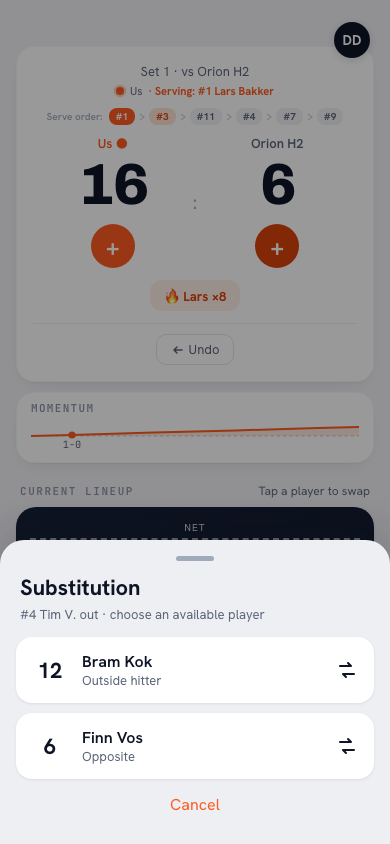
Counting them yourself is the cheapest win here. The second referee telling you about your fifth and sixth substitution is a safety net, not your admin: request a substitution at 22-22 that you no longer have and it is an improper request. Anyone scoring live in Koach makes the substitution on the scoring screen itself: you tap the player going off and pick his replacement, and with that it is recorded with the match.
The line-up sheet: your only paperwork duty
Before the match you check or enter the names and shirt numbers of your players on the match sheet and sign it (rule 5.2.2). After that you have one task per set: before each set you hand the line-up sheet to the second referee or the scorer, fully filled in and signed (rule 5.2.3 again).
That sheet is binding. Once handed in, you don't change the line-up any more — except through the substitution rules. And if someone else is on court than on the sheet, the line-up is corrected to match that sheet; if a player is in the wrong position at the moment the serve is struck, it is a positional fault and it costs a point. How that fault arises exactly is in the positional fault.
The trap is the timing. The interval between two sets is short, and in those same minutes you want to talk to your team and pass on your adjustment. Turn it around: write out the sheet for the next set while the current set is still running, around 20 points, and only correct it if the set ends differently than you expected.
What you never do, and the three sentences your captain may say
The list of prohibitions is short and it is absolute. As a coach you do not address the first referee. You do not argue about a judgement call: a line call, a lifted ball, a touch off the block. You do not walk to the table to check the score or the service order. You do not ask for the opponent's line-up to be verified. And you do not react from the bench to a whistle — that is the behaviour a coach's card usually comes from.
The point isn't that those things may not happen — they just may not be done by you. Your captain has the rights you lack, and you can direct him. Give him three sentences he can say word for word, calmly and at a dead ball:
- "Referee, may I have an explanation of how the rule applies to that ball?" For the moment you don't understand which rule was applied.
- "May we have the line-up verified?" If you think from the sideline that the opponent is standing wrong, he asks — not you.
- "We would like that recorded on the sheet." If you keep disagreeing about the application of a rule; what happens with such a note afterwards is set by your own federation.
And two that will earn him a card: "That was clearly out!" — a judgement call, and there is no clarification to ask for on those — and any repetition after the referee has already answered. Continuing to press leads first to a warning and then to a card.
Also brief him on when not to go: once a set is normal, three times makes him a nuisance. Who stands there on your behalf is a choice you make in August — that is the subject of choosing a captain.
Key point: your entire formal repertoire during the match consists of three things — handing in the line-up sheet, requesting a time-out and requesting a substitution. All three with the second referee, all three at a dead ball. Everything else goes through your captain or doesn't happen.
The assistant coach, and what happens if you get sent off
The assistant coach sits on the bench and has no right to intervene in the match (rule 5.3.1). So he doesn't request a time-out or a substitution, however handy that would be when you are busy with a player. He may give instructions to players, seated from the bench.
There is one exception: if the coach has to leave his team, the assistant may take over his functions — at the request of the game captain and with the authorisation of the first referee (rule 5.3.2). That order is the whole story: it doesn't happen automatically and it doesn't go through you, your captain asks for it.
That is also exactly what happens if you are expelled: you may not have anything to do with the team for the rest of the set. What is left of your coaching then depends on whether your captain knows he has to ask for that handover — so arrange it before it comes to that.
Two practical points for amateur teams. If your team has no coach, the game captain requests the time-outs and substitutions — he has that right explicitly. And the father who shuffles onto the bench without being on the sheet is formally not a team member: whether and how you have to register an assistant differs per federation.
Youth and recreational teams: same rules, different hall
The rules have no milder version for youth volleyball. What differs is the practice: the second referee is often someone who has only just started refereeing, there is no buzzer, no zone taped on the floor, and the free zone is sometimes so tight that little is left of a walking strip. That is precisely why your behaviour weighs more heavily there than in the top division. So don't let it depend on your mood: write down once what applies in your team — only the captain talks to the referee, the bench says nothing about line calls, the coach doesn't walk to the table — and put it in your team agreements. Then it is an agreement and not a reproach after the event.
Frequently asked questions
May I stand as a coach during the rally?
Yes. The rules let the coach give instructions standing or walking, in the free zone in front of his own bench, from the extension of the attack line up to the warm-up area, as long as he doesn't disturb or delay the match. Your other team members give their instructions seated from the bench.
May I address the referee as a coach?
No. Only the game captain may speak to the referees, and then solely about the application or interpretation of a rule — not about judgement calls. Your point of contact is the second referee, and only for the line-up sheet, a time-out or a substitution.
How do I request a time-out?
At a dead ball and before the whistle for service, with the T signal towards the second referee, or with the buzzer if your competition has one. Only the coach and the game captain may make the request. The second referee whistles and repeats the signal; only then does the time-out start.
What happens if I request a substitution at the wrong moment?
That is called an improper request. The first one in the match that doesn't hold up play is rejected and recorded without further consequences. Every subsequent improper request counts as a delay: first a delay warning, then a delay penalty that costs a point and the serve.
May my assistant coach request a substitution or time-out?
Not under the rules: the assistant coach sits on the bench and has no right to intervene in the match. Only if the coach has to leave his team may the assistant take over his functions — at the request of the game captain and with the authorisation of the first referee.
Who requests the time-outs if the team has no coach?
The game captain. In the absence of a coach he may request the time-outs and substitutions, on top of his ordinary right to ask for clarification on the application of a rule. Worth going through with him beforehand, including the signal and the moment.