
Volleyball coaching certification: the levels and what you learn
The short answer
You usually earn a volleyball coaching certification through your national federation or a regional branch, in levels from an entry course to the highest license. You learn to teach, build technique, manage load and coach, with assignments in your own team. Names and rules differ by country: check with your federation.
A volleyball coaching certification turns someone who looks after a group into a coach who knows why they do what they do. But which course fits you? Here you read how coaching courses are generally structured, what you learn, how the FIVB courses work and what to ask your own federation.
Who trains volleyball coaches?
Coach education is usually run by the national volleyball federation. How the work is divided varies: some federations run every level themselves, others leave the first levels to regional branches or to clubs that host a course in their own gym. Besides that, there are three other routes:
- The international federation. The FIVB has its own coaches courses, which are organized through national federations. How they work is explained further down.
- A sports degree. A program in physical education or sports science can include volleyball as a module or a specialization. Whether that counts toward a federation license differs by country.
- Clinics and continuing education. Short sessions on one topic, run by a federation, a club or an experienced coach. They add to a course but do not give you a license on their own. Some federations do count them as continuing education.
What exists in your country, what the levels are called and what they cost is on your federation's website, or you ask the department that runs coach education.
How is a volleyball coaching course structured?
The names and the number of levels differ per federation. The idea behind them is the same: you start by looking after a group and end up coaching at the highest level. For a higher level you usually need the previous one, sometimes with a period of coaching experience in between. The table is an example of such a structure, not the system of any particular federation.
| Level | For whom | What it adds |
|---|---|---|
| Entry or starter course | Parents, players and new coaches who look after a youth or recreational group | Organizing a practice, working safely, games for beginners |
| Basic level | Coaches of youth teams and lower adult teams | Teaching and refining technique, planning a practice and a season, first steps in match coaching |
| Competitive level | Coaches of higher adult teams and select teams | Systems and tactics, load and physical training, analyzing the opponent and your own team |
| Highest license | Coaches at the top, of national teams, and coach educators | A program across one or more seasons, leading a staff |
Some federations have separate routes for youth and adults, or their own course for beach volleyball. And in some competitions the coach of a team must hold a certain level; which level and from which division is set by your federation.
What do you learn on a volleyball coaching course?
The program differs per federation, but these five topics are part of the job. At a higher level you go one step deeper:
- Teaching. How to explain and demonstrate a drill, how to make it easier or harder, how to give feedback and how to organize a group so everyone gets lots of contacts.
- Technique and tactics. The movements of the pass, set, attack, serve and block, the errors you see most often and how to correct them. At higher levels, systems, rotations and a game plan against an opponent are added.
- Load and the body. Warm-up, injury prevention, what you can and cannot ask of growing children, and how to spread jumps and hard sessions across the week.
- Coaching. The match, with timeouts, substitutions and your place on the sideline, but also the conversation with a player, the contact with parents and the atmosphere in the team.
- Rules and safety. The rules you need to know as a coach, what to do when someone gets injured, and the conduct rules for working with young players. One example is a code of conduct for coaches.
What a course cannot give you is experience. That is why coach education usually has a practical part.
Practical assignments and placement: what you do in your own gym
A large part of the work does not happen in the classroom but with the group you coach. What that practical part looks like differs per federation. Elements you may come across:
- Practice plans on paper. A plan for each practice with a goal, sections, times and the organization. A mentor mainly checks whether the goal and the drills fit together.
- A visit from a mentor. Someone from the federation or an experienced coach watches one of your practices and discusses it with you afterward.
- Reflecting on your own practice. A short report on what went well and what can improve, sometimes with a video of part of the session. Only film with the players' consent, and for young players with their parents' consent.
- Shadowing. A few practices with a coach at a higher level, to see how someone else goes about it.
- An exam. For example a practical exam in which you run a practice while an examiner watches, sometimes with a written test or a final assignment.
For the practical assignments you need a group. If you do not have your own team, ask at registration whether that is a problem. Your club may be able to pair you with a team as an assistant; how to fill that role is described in the duties of an assistant coach.
The FIVB coaches courses
Besides the courses of the national federations, the FIVB has its own coaches courses. According to the FIVB course calendar there are three levels for indoor volleyball, Level I, II and III, and a course for beach volleyball. A national federation or a development center organizes the course and decides who is admitted; that is also where you register. For Level II you need at least twelve months of experience since your Level I. With a recommendation from your federation you can skip Level I in some cases, for example with a recognized national coaching diploma. For Level III you need at least twelve months of experience since your Level II, plus a recommendation from your federation. The courses are taught in English, French or Spanish, and you must speak the language of the course. If you pass, you receive a certificate from the organizer, signed by the FIVB instructor; the FIVB itself does not issue certificates.
There is also an online version of Level I and II and of the beach course. It does not lead to a certificate, but to a digital statement that you completed it. The FIVB recommends it as preparation for the course in the gym; whether it counts toward admission is up to the organizer. Source: the calendar and FAQ of the FIVB Coaches Courses, accessed on 6 November 2026.
Online courses, clinics and continuing education
An online course is useful for the theory: rules, how a practice is built, technique on video. Teaching is something you learn in the gym, so a course with only online lessons does not replace the practical part. A clinic is a good addition when you want to go deeper into one topic, such as block and defense or coaching the youngest players. Ask your federation whether a license expires, and whether you need continuing education to keep it.
You also learn a lot outside a course: an experienced coach who watches a session once, or preparing a practice together with a colleague. How a club organizes that, with goals and conversations across a whole season, is covered in coach development in your club.
Which course fits you?
- You are just starting, with a youth or recreational group. Choose the entry level. If you have never stood in front of a group, coach for a few weeks first: then you know what you want to learn. For that first season there is starting as a volleyball coach.
- You have coached a youth or adult team for a few seasons. The basic level gives you the technical knowledge and the season planning you now do by feel.
- You want to move up, or your club asks you to. Check which level your competition requires and how much experience you need to be admitted. Check in time, because a higher course can have a registration deadline and a limited number of places.
- You mainly want to know more about one topic. A clinic or an online module is enough.
Choose your course for the group you will coach next season. You do the practical assignments with that group. A competitive-level course while you coach beginners mostly gives you assignments that do not fit your gym.
What to ask your federation
- Which levels are there, and which level fits the team I coach?
- What are the entry requirements: age, previous level, years of experience?
- How many sessions are there, where, and which part is online?
- What do I have to do in my own team, and do I need a regular group for that?
- What does the exam look like?
- What does it cost? Ask your club too: some clubs pay for the course or part of it, sometimes on the condition that you stay for a number of seasons.
- Is the license also recognized in another country, if you ever move?
Whether and how licensed coaches get paid is covered in volleyball coach salary.
Keeping track of your practical assignments in Koach
Koach is not a course and does not keep track of diplomas or licenses. But if you already plan your practices in the app, the material a course asks for ends up in one place by itself. For each practice you set out the plan in sections with a duration: with Add drill you choose a drill from the library, with Add section you create a block of your own, such as a warm-up or a game. After practice you mark for each section what was done, and with Write report you fill in what went well, what can improve and the focus for next time.
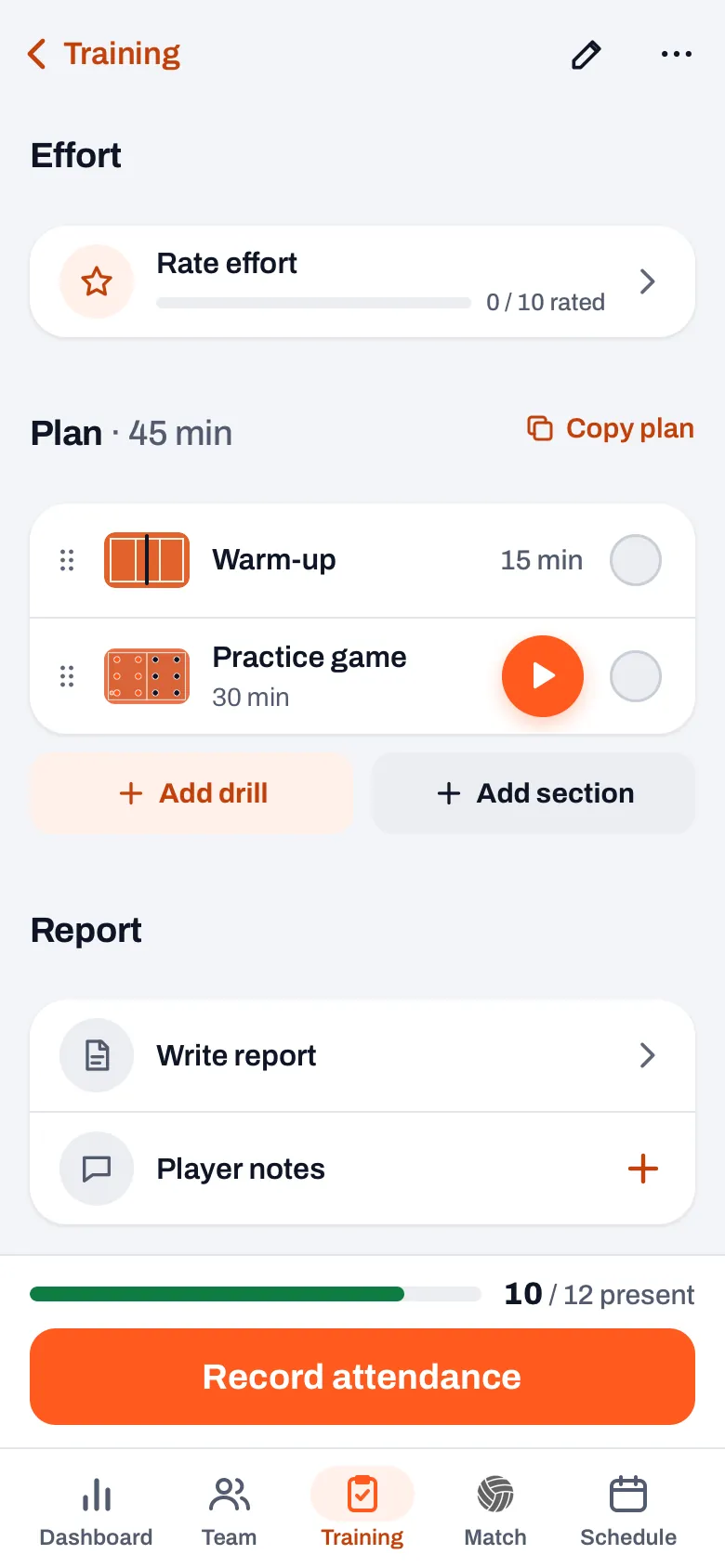
For a mentor that is useful: they see what you planned and how you looked back on it, not just the one evening they came to watch. If you add them to your team as a coach, they can read along themselves, but they also see your players, their notes and absence reasons; consider whether that is necessary. With the Coach plan two coaches work in one team; if you already have an assistant, a third coach requires the Club plan. After a season you have a series of plans and reports you can show when you apply for the next level. You can try Koach free for 14 days; what it costs after that is on the pricing page.
14 days free, no credit card. Set out your next practice in sections and write your first report afterward.
Try Koach with your teamFrequently asked questions
How long does it take to get a volleyball coaching certification?
That differs per federation and per level. An entry course can consist of a few sessions; a higher level often runs across a large part of a season, because you do the practical assignments in your own team. Between two levels there is often a period in which you gain experience; for the FIVB courses that is at least twelve months. The exact number of sessions is listed with the course on your federation's website.
Can you take a volleyball coaching course online?
Partly. Some federations teach the theory online, and the FIVB has an online version of Level I and II and of the beach course, with a statement that you completed it instead of a certificate. The practical part, running a practice while someone watches, happens in the gym. Ask your federation which part of a course can be done online and whether an online module counts toward a license.
Is a coaching certification from one country valid in another?
Not automatically. Every federation has its own levels and decides for itself whether it recognizes a diploma from another country, and at which level you then enter. If you move, take your diplomas and an overview of what you have completed to the new federation and ask how to continue there. If you hold a certificate from an FIVB course, also ask what it is worth at your new federation.
Who pays for the coaching course, you or the club?
That is something you agree with your club. Some clubs pay for the course in full or in part, because the whole club benefits from a trained coach, sometimes on the condition that you stay for a few seasons. Others leave it to the coach. Ask before you register and put the agreement in writing, especially if you have to pay part of it back when you stop earlier.
Record your practices for your course
14 days free, no credit card. The plan and report of every practice in one place.
Get started with KoachOr read first what the volleyball coaching app does.