
Volleyball coach salary: from volunteer to paid contract
The short answer
A volleyball coach salary depends on the country, the club and the level. In community volleyball, coaching is often volunteer work, with or without an expense allowance. Higher teams sometimes pay a fixed fee, and at top clubs, federations and in some countries at schools it is a paid job.
What is a normal volleyball coach salary? If you spend two evenings a week in the gym and coach on Saturdays, you will wonder sooner or later. There is no amount that applies everywhere. What you can see is how coaches get paid, what determines the amount and how to add up your own hours.
Volleyball coach salary: the forms at a glance
Naming an amount makes little sense: it differs per country, per club and per level. What comes back everywhere are the same forms of payment. The table runs from community volleyball to the top; the last column gives examples, not a fixed rule.
| Form | What it is | Where you might see it |
|---|---|---|
| Volunteer without pay | You coach because you enjoy it, for the club or because your child is on the team | Recreational, youth and lower divisions |
| Volunteer with expense allowance | Travel costs, clothing or a small amount per season | Clubs at every level |
| Fixed fee | An amount per month, per season or per practice | Higher divisions, select teams, coaches with a higher license |
| Contract, part-time or full-time | Work with fixed hours, as an employee or as a contractor | Top clubs, federations and their talent programs |
| Coach at a school or university | Coaching as part of a job, often alongside teaching | Countries where teams belong to schools, such as the United States |
| Self-employed | Private lessons, clinics and camps | Alongside a club, or as your own business |
Two caveats. An allowance and a contract are legally different things: if a club pays more than a volunteer allowance, it may count as work in your country, with tax and sometimes social contributions. When that applies differs by country. And a paid coaching job is often part-time. The US Bureau of Labor Statistics writes about coaches across all sports that part-time work is common, and that high schools fill most coaching positions with a teacher or school administrator who coaches alongside that job (source: Occupational Outlook Handbook, Coaches and Scouts, accessed on 6 November 2026).
What determines how much a coach gets?
- The level of the team. Clubs are more likely to pay the coach of their first team or a select team than the coach of a recreational group. Experienced coaches are scarcer there, and results carry more weight.
- Your training and experience. A higher license makes you employable at more levels, and some competitions require the coach to hold a certain level. How that education works is covered in volleyball coaching certification.
- The hours. Two practices and a match per week is different from four practices, a strength session and a match.
- Extra tasks. Technical director, youth coordinator or mentor of other coaches are roles that are sometimes paid separately.
- The country. How popular volleyball is, how many sponsors and spectators there are, and how volunteering in sport is organized differ per country. As a result, the same role can be a volunteer task in one country and a job in another.
- The club's budget. An allowance for coaches comes out of the same budget as gym rental and equipment. At an amateur club the members largely pay for that through their dues, so every allowance is a choice the board must be able to explain.
What players earn, and why that varies just as much, is covered in volleyball player salary.
How many hours is a season as a coach?
If you want to know what an allowance means per hour, you first need to know your hours. Say you coach one team, with two practices a week and a match on Saturday:
| What | Hours per week |
|---|---|
| Two practices of an hour and a half | 3 |
| Preparation, half an hour per practice | 1 |
| Match with travel, warm-up and debrief | 3 |
| Messages, sign-ups and meetings | 1 |
| Total | 8 |
Over a season of thirty weeks that is 240 hours. How many weeks your season has depends on the competition and the school holidays in your country, so count your own calendar. Divide an allowance by that number of hours and you see what you get per hour. It also works the other way round: if a club knows what it considers an hour to be worth, it can agree an amount per practice or per season that it can explain to every coach.
Count your hours for one real month. For four weeks, write down how much time you spend on practices, preparation, the match and messages. That number is a better start to a conversation with your club than an amount you read somewhere.
Allowances and tax: what to check yourself
The rules for payments to coaches differ per country. In some countries an allowance for volunteers or sports coaches is tax-free up to a certain limit; above it, or if you coach at more than one club, other rules apply. Such a limit can change from year to year. So always do two things:
- Check with your club or with the tax authority in your country before you agree an allowance.
- Keep a record of what you receive and of your travel costs, even when the amounts are small.
What to agree with your club
Even without an allowance it helps to put agreements on paper. A list to start with:
- Which team, how many practices per week, and whether the match is included.
- What you receive: an amount per month, per season or per practice, travel costs, clothing.
- What the club pays for your development: a coaching course, clinics, materials.
- What happens with canceled practices, illness and holidays.
- How long the agreement runs and when you review it together.
For a club, money is rarely the only thing that keeps a coach. Why coaches quit and what makes them stay is covered in recruiting and keeping coaches.
Can you make volleyball coaching your career?
It is possible, but the number of paid positions is small compared with the number of coaches. They are mainly at professional clubs, at federations and their talent programs, and in countries where volleyball is played at schools and universities. In the United States, for example, college coaches work in a system with athletic scholarships; more on that in a volleyball scholarship in the United States. Those who do coach for pay often combine it with other work: teaching, a job outside sport, or private lessons and clinics. How to structure a private lesson is covered in private volleyball lessons.
If you are just starting out, the question is whether you want to do it rather than what it pays. For that first season there is starting as a volleyball coach.
Counting your season in Koach
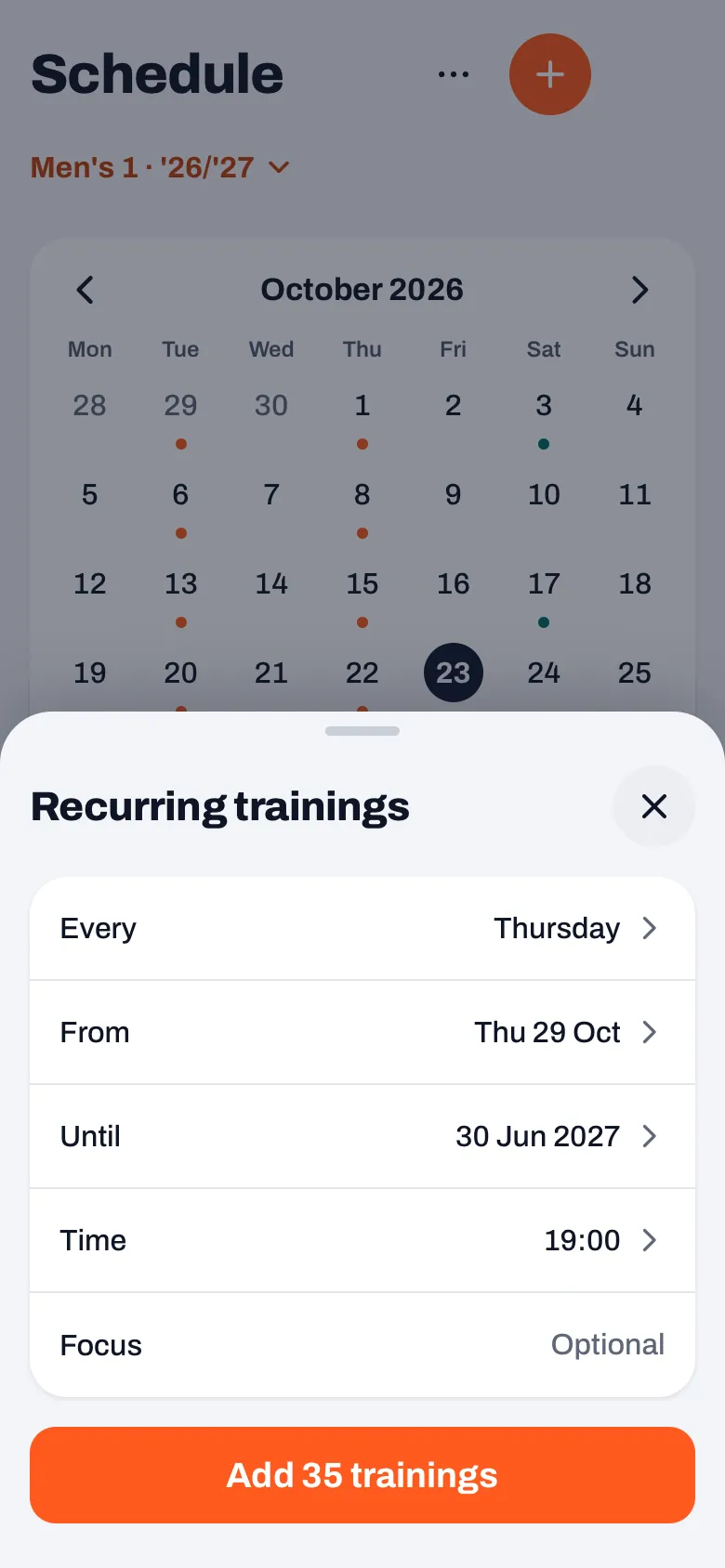
Koach does not track hours or payments. But it quickly shows you how many evenings a season takes. As a coach, tap the three dots at the top right of the schedule and choose Recurring trainings. You choose the day, the first and last date and the time, and the button at the bottom tells you how many trainings that makes before you add them. Add the matches too, and the whole season sits in one schedule; take that number with you to the conversation with your club.
Less admin also saves hours. Players sign up and drop out in the app, so before practice you see who is coming without calling around. If the club wants to pay for the app for all its teams, it can do so with the Club plan, for unlimited teams and coaches; see Koach for clubs. If you coach one team yourself, you can try Koach free for 14 days; what it costs after that is on the pricing page.
14 days free, no credit card. Put this season's practices in the schedule and see how many evenings it adds up to.
Try Koach with your teamFrequently asked questions
Do youth volleyball coaches get paid?
That differs per country and per club. In community volleyball a youth coach is often a volunteer, with or without an expense allowance: a parent, a player from a higher team or a former player. Some clubs give a fixed fee to coaches of select teams or to coaches with a higher license. Ask the board or the technical committee what is usual at your club; what form an allowance may take depends on the rules in your country.
What does an assistant volleyball coach earn?
Often less than the head coach, and in community volleyball often nothing: there the assistant is usually a volunteer. At clubs that pay their head coach, an assistant sometimes gets a smaller allowance, depending on their tasks and hours. At professional clubs it can be a paid position. Count your hours here too, because an assistant who keeps stats at every match and attends every practice puts in almost as many hours as the head coach.
How do you ask your club for an allowance?
Start with your hours: how much time does the team take per week and per season? Then ask what the club gives other coaches, so you know what is usual. Propose what you are looking for, for example a travel allowance or a paid coaching course, and say what the club gets in return. Do it before the new season, while the budget is still being drawn up, and put the agreement in writing.
Can you become a full-time volleyball coach?
Yes, but full-time jobs are few: at professional clubs, federations, talent programs and in countries where teams belong to schools and universities. If you want to go that way, you need a higher license, experience at a high level and a network; for coaches at colleges and professional clubs, the US Bureau of Labor Statistics also mentions playing experience in the sport. The road there therefore often runs through years of part-time or volunteer coaching alongside another job.
Count your season in Koach
14 days free, no credit card. See how many practices and matches your season holds.
Get started with KoachOr read first what the volleyball coaching app does.