
Private volleyball lessons: who they help and how to plan an hour
The short answer
Private volleyball lessons are one-on-one sessions with a coach, usually to improve one technique, such as the serve, the pass or the set. The player touches a lot of balls and gets feedback after every attempt. They work best with one goal, a fixed structure and a word with the club coach.
In private volleyball lessons, an hour revolves around one player and one technique. That can pay off, but not every player benefits. Here you read who it makes sense for, what you train better one on one than in a group, how to structure an hour and what to agree beforehand.
Who are private volleyball lessons for?
A private lesson is a session with one coach and one player, sometimes two. It does not replace team practice, but adds to it for a player with a clear question. It makes the most sense for these players:
- The player with one stubborn technical error. A serve that keeps going into the net, a pass that flies off backward, an approach that is off. In a group of twelve there is no time to work on that one error for fifteen minutes in a row.
- The player who changes position. An outside hitter who becomes a libero, or a player who is going to set, has to get a lot of new repetitions in a short time.
- The player who is coming back. After a long break, or after an injury once the physiotherapist or doctor has given the green light, to get the feel for the ball back.
- The adult beginner. Someone who takes up volleyball later in life can learn the basic technique in a few lessons before joining a team.
- The player preparing for a tryout. To polish one skill, not to reach a different level in a few weeks.
Are you a parent wondering whether your child needs it? Ask the club coach first, and above all ask your child. A player who wants to get better at something themselves gets much more out of a lesson than a player who is sent.
What works better one on one than in a group?
- Repetition on one thing. The coach tosses, the player works; there is no line and no waiting, so every minute is practice time.
- Feedback after every attempt. Short, about one point, and straight on to the next ball. In a group you give the same cue to one player a few times per drill at most.
- The player's pace. If it works, you make it harder straight away; if it does not, you take a step back, without anyone else waiting for it.
- Watching video back. With a phone on a tripod you film a few attempts and watch them back together. A player who sees what they are doing can place a cue faster. Only film with consent, for minors with their parents' consent, and agree where the footage is kept and when you delete it.
- Room for questions. Why does my arm have to go like that? What do I do with a low ball? A player who never asks anything in the group will do so here.
What a private lesson cannot give: playing together, game sense, serve receive formations and the pressure of a match. Those are learned in the team. If a player wants to train extra with a friend, a full session for two players is in volleyball drills for two people.
Structuring a sixty-minute private lesson
A fixed structure helps both player and coach. This example assumes a player who wants a reliable overhand serve. For the preparation, the same principles apply as for any practice; see running a volleyball practice.
| Minutes | Block | Example for the serve |
|---|---|---|
| 0 to 10 | Warm-up with the ball and discussing the goal | Warm up, loosen the shoulders, and write down one sentence together: what should be better after this lesson? |
| 10 to 15 | Baseline | Ten serves from the end line; count how many land in the court |
| 15 to 40 | Main block in steps | First only the toss, then toss and contact from close to the net, then step by step back to the end line |
| 40 to 50 | Under pressure | Rounds of five from the end line: a round is only done at five good serves in a row, a miss means starting over. If that works, aim at one half of the court |
| 50 to 60 | Measure again and wrap up | Ten serves again; compare with the baseline and agree what the player practices until the next lesson |
For a different technique the plan stays the same: measure, build up in steps, add pressure, measure again. Keep the main block on one technique. Three topics in one hour feels like a lot done, but then the player goes home without any of them really sticking. Have five or six balls ready, so nobody has to fetch balls between attempts.
Start and end with the same test. Ten attempts at the start and ten at the end show the player what the hour achieved. Write down both numbers at every lesson, and after three lessons you can see whether the approach works.
Agreements beforehand: goal, number of lessons and the club coach
- One goal. Write it down in the player's own words, for example: my serve lands in the court during matches.
- A block of lessons. Agree on a fixed number, for example four, and then discuss whether it works. That gives you a fixed moment to stop or continue.
- A word with the club coach. A private coach who teaches a different technique than the club coach makes a player unsure. Ask the club coach what they are working on, and tell them after the lessons what you did.
- Gym and equipment. Where do you train, who books the gym and are there enough balls?
- Cost and cancellations. What a lesson costs and what happens if someone cancels is agreed beforehand. Rates differ per country and per coach. How coaches get paid in general is covered in volleyball coach salary.
- With young players: safe and visible. Train in a gym where others can walk in, never behind a closed door or in a locker room, and always make a parent welcome. You make agreements with the parent, not only with the player. If your club or federation requires a background check or safeguarding clearance for anyone working with young players, arrange it beforehand; what it is called differs by country. An example of conduct rules is in the code of conduct for coaches.
When a private lesson makes no sense
- When the player does not want it. An hour in which a player is just serving time achieves nothing, however good the coach is.
- When the problem is not technique. A player who does everything right in practice and not in the match will gain more from work on nerves and routines than from an extra hour of technique; see mental training for volleyball.
- When it hurts. If a movement causes pain, extra training is not the answer. Have persistent or severe complaints checked by a family doctor, sports physician or physiotherapist.
- When it becomes too much. A youth player with three practices and a match a week, plus a private lesson every week on top, may be left with too little time to recover. Add it all up and discuss it with the club coach.
- When the basics are missing. A player who still has little feel for the ball often learns more at first from lots of playing in a group than from technique work alone.
Between two lessons: practicing with Koach
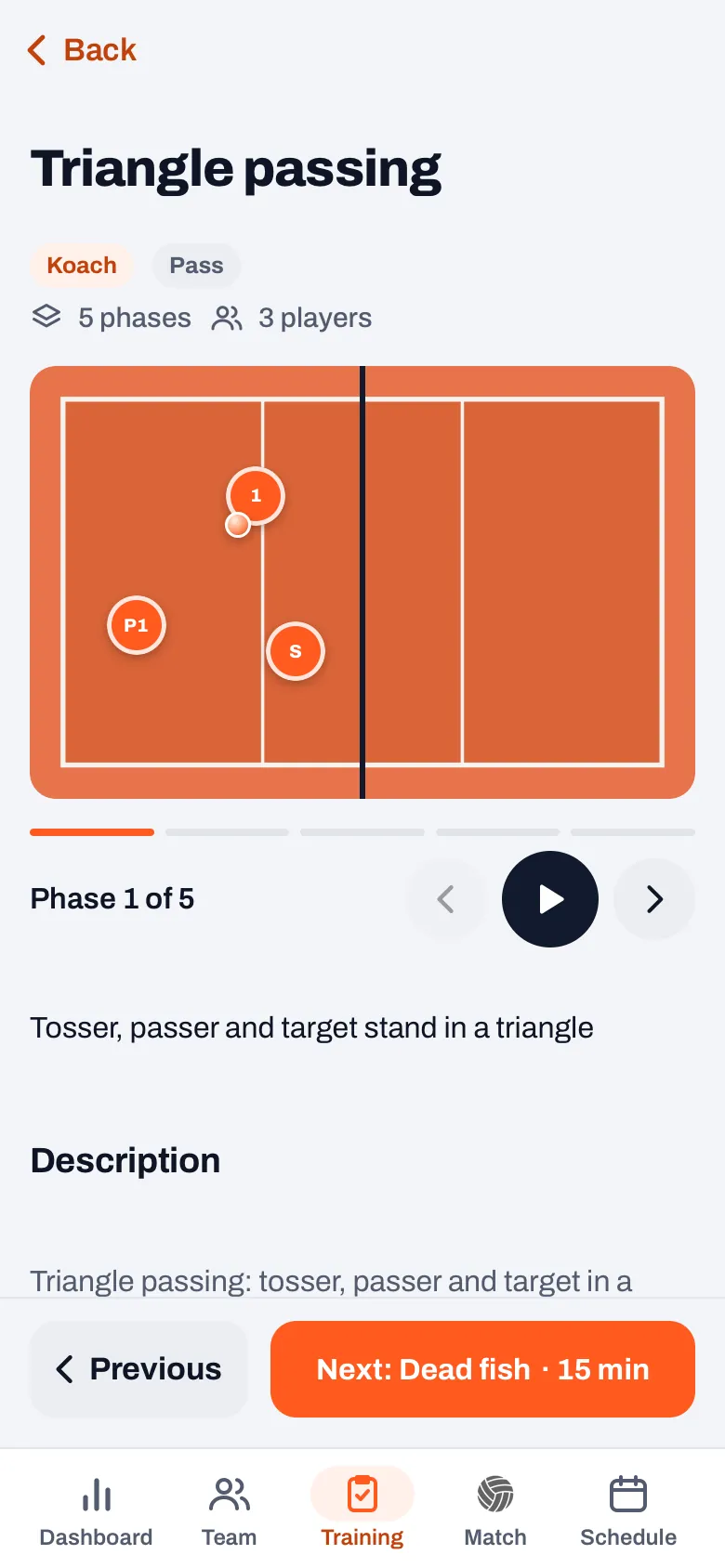
Koach is not an app for scheduling or billing private lessons. It does help when the player is on a team whose coach uses Koach. The drills show for each phase where the players and the ball are on the court, and with the play button the drill runs as an animation, so a player can still see at home how it went.
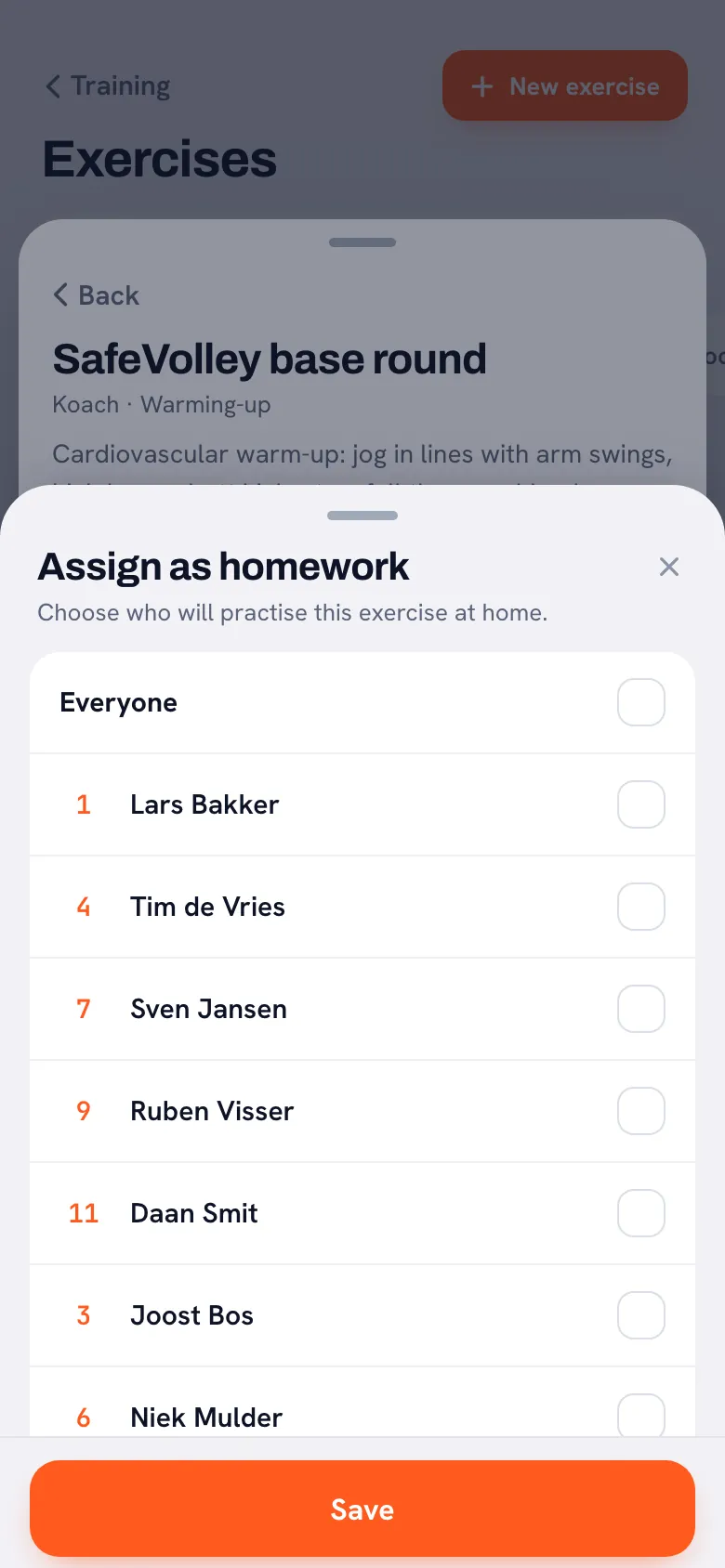
When the coach opens a drill from the library, the Homework button is at the bottom. With it they choose the players who will practice the drill at home, or Everyone. Those players then see the drill on their dashboard under Homework, and a parent sees it with their child. If the private coach and the club coach agree on which technique the player is working on, the club coach can easily assign a matching drill. How that works and what the player and the parent see is in giving players homework.
What else a player can do on their own outside practice is in how to get better at volleyball. As a player you pay nothing for Koach: your account falls under the team's subscription. Your coach can try Koach free for 14 days; what it costs after that is on the pricing page.
14 days free, no credit card. Give your players a drill to practice at home and see who has received it.
Try Koach with your teamFrequently asked questions
How many private volleyball lessons do you need?
That depends on the goal. For one technical error, a short series of lessons with practice in between can already make a difference; learning a new position takes longer. Agree on a block, for example four lessons, and measure the same thing at the start and end of every lesson. If you see no difference after that block, discuss whether the goal or the approach needs to change.
At what age do private volleyball lessons make sense?
There is no fixed age. Young children learn volleyball mainly by playing a lot, in a group and in game-based drills; for them more playing is usually worth more than technique work alone. A private lesson suits a player who already plays on a team, has a clear question of their own and can concentrate on one technique for an hour. Check with the club coach whether it fits.
Can two players share a private lesson?
Yes. With two players and one coach there is still a lot of repetition, and the players can also play to each other, for example pass to set. It works best when both players want to work on the same thing and are at roughly the same level. With three or more it quickly becomes a small group session, with more waiting and less attention per player.
Should you tell your club coach you take private lessons?
Yes, that is sensible. The club coach knows your game and knows what you are working on. If the private coach teaches something different from what you hear at club practice, you get two cues that contradict each other. Say beforehand what you want to improve and, after a few lessons, what you have done. Then the club coach can take it into account in practice.
Send your players home with a drill
14 days free, no credit card. Players see their homework on their own dashboard.
Get started with KoachOr read first what the volleyball coaching app does.