Volleyball Double Substitution: How and When to Use It
There is one substitution that looks like an emergency measure but is the opposite: the double sub. Two players go off at the same time, two come on, and your offense changes face for three rotations. You pay for it in substitutions.
The problem it solves
In a 5-1, your setter is in the front row for three rotations. In those three alignments you only have two front-row hitters, because the setter is playing the second ball instead of attacking. The opponent knows it: two hitters are easy to block and your chance of scoring visibly drops. For a lot of teams, those three rotations are the weak half of the set.
The double substitution turns them into three hitters. You take the setter who is rotating into the front row off and replace her with a hitter; at the same time you take the opposite — who is in the back row at that moment — off and bring on a backup setter, who sets from the back corner. For three rotations you are effectively running a 6-2, and as soon as your original setter would rotate back, you reverse the substitution.
Who swaps with whom
It works because setter and opposite stand opposite each other in a 5-1 — three positions apart. If the setter is in the front row, the opposite is by definition in the back row. Concretely, with the setter having just rotated to P4:
- Off: the setter at P4 (front row). On: a hitter, who is immediately your third front-row attacker.
- Off: the opposite at P1 (back row). On: the backup setter, who penetrates from P1 and plays the second ball.
You request both substitutions in one go with the second referee; they count as two separate substitutions. Always report them together, or your team will briefly be standing in a lineup you never intended.
The moment in the rotation
Classically the double sub goes in as soon as your setter reaches the front row — so on the rotation from P5 to P4 — and comes back out as soon as she would rotate from P2 to P1. That gives you three full rotations with three hitters.
You are also free to make it shorter. Plenty of teams only swap once the setter is at P3 or P2, for two reasons: it costs fewer substitutions to reverse within the same set, and the backup setter does not have to serve from P1 straight away. Pick one version and stick to it, because this is a substitution that has to run on routine.
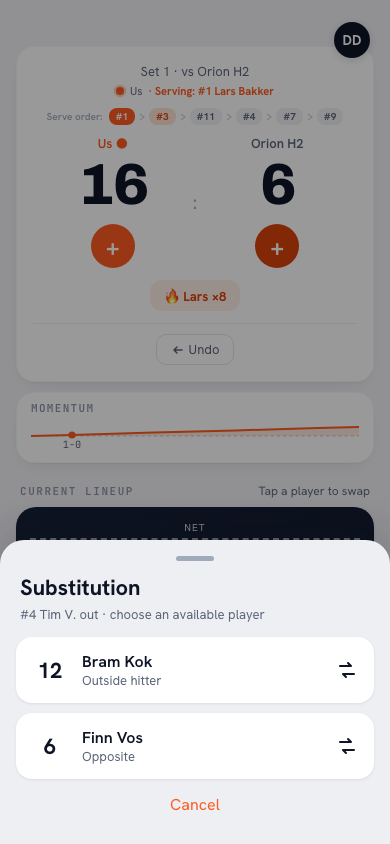
Which is exactly why it pays to track your substitutions: Koach counts them per set, so you can see whether a double sub still leaves you room for the changes you really need at the end.
The maths: four of your six substitutions
Every team may make six substitutions per set. The double sub costs two, and reversing it costs two more. One complete cycle therefore uses four of your six substitutions and leaves two for the rest of the set. On top of that, the substitution rules say a starter may only return once per set, and only for the player who replaced her. In practice that means you can run the double sub out and back exactly once per set.
So think your set through in advance. If you expect to need a serving specialist or a defensive change in the closing stages, two remaining substitutions is tight. If you are not going to reverse it — because the end of the set is approaching, say — it only costs you two and you keep four.
When it pays off
- Your backup setter is genuinely a setter. Without a second setter who puts the ball where it belongs, you are trading two hitters for three hitters without a usable set. That is not a gain.
- Your bench has a hitter who can hit. The third front-row attacker has to be a real threat, otherwise the opposing block simply stays where it already was.
- Your opposite is weak in the back row. If the opposite is already struggling in defense or serve receive, taking her off costs you nothing.
- The numbers point that way. If your side-out visibly dips in the rotations with the setter in the front row, you have a reason. How to measure that is in finding your weakest rotation.
When to leave it alone
With a thin bench the double sub is a luxury you do not have. It is also rarely wise with junior teams: swapping two players at a time costs playing time for four players at once and mostly produces confusion about who is standing where. And if you already have two comparable setters, just run a 6-2 or a 5-2 — you get the same effect without spending a single substitution.
Rehearse the double sub in a friendly, not in a league match. Four players have to know at the same time where they are standing, and the referee wants one clear request. The first time always costs a time-out's worth of confusion — do not let that happen at 22-20.
Frequently asked questions
What is a double substitution in volleyball?
Two substitutions made at the same time: the setter rotating into the front row comes off for a hitter, and the opposite in the back row comes off for a backup setter. That lets you attack with three front-row hitters for three rotations.
How many substitutions does a double sub cost?
Two going in and two coming back out, so four of your six per set. If you do not reverse it, it only costs two.
Can I make a double substitution twice in one set?
Not completely. A starter may only return once per set, and only for the player who replaced her, so one full cycle out and back is the maximum.
Do I have to request both substitutions at once?
Yes, report them in one request to the second referee. They count as two substitutions, but requesting them together stops your team from briefly standing in an unintended lineup.