
Volleyball presentation for school: structure, topics and sources
The short answer
Build a volleyball presentation for school in five parts: an opening that makes people curious, what volleyball is, how it started, the main rules, and your own experience with time for questions. Bring something to show, such as a ball, and say where your information comes from.
A volleyball presentation for school is a good choice: almost everyone knows the game a little, but few classmates know how it really works. Here is how to pick a topic, a structure in five parts, what you can bring, how to find and cite good sources, and tips for parents.
First choose: what is your presentation about?
Volleyball is a big topic. The smaller you make it, the easier it gets to say something good about it. A few choices that work well:
- Volleyball in general. What it is, where it comes from and how you play it. A good choice if your class knows little about it.
- Your own club or team. If you play yourself, this is where you have the most stories, and you can tell things no book knows.
- Beach volleyball. Two against two on sand, with different rules than indoors. What is different is in indoor and beach volleyball compared.
- Sitting volleyball. Volleyball where you sit on the floor, a sport at the Paralympic Games.
- One position. For example the libero, the player in the different shirt. A small topic with a lot to tell.
Ask your teacher beforehand how long the presentation should be, whether you may show a video and whether you need a list of sources. For a written report, also ask how many pages it should be. That differs per school and per teacher.
A structure for your volleyball presentation in five parts
This structure works for most topics. Next to each part is where you find the content.
| Part | What do you tell? | Where do you find it? |
|---|---|---|
| 1. Opening | A question for the class or a surprising fact | Volleyball fun facts with sources |
| 2. What is volleyball? | Two teams of six, a net, three touches, the ball must not hit the floor | How to play volleyball |
| 3. How did it start? | The first game in 1895, the name, the first Olympic Games | The history of volleyball |
| 4. The rules | Points and sets, rotating, the libero | Volleyball rules at a glance |
| 5. You and volleyball | Your own club, what you like about it, questions from the class | Your coach, your club and yourself |
Say you have ten minutes. Then you could take one minute for the opening, two for what volleyball is, two for the history, two for the rules, two for yourself and one for questions. Don't explain every rule: pick three or four your class will understand, such as how many times you may touch the ball and why players keep changing places. Don't read from paper either; on a note card, write only the words that help you remember what you wanted to say.
Writing a school report on volleyball instead?
A written report often has a research question with a few sub-questions. Parts 2 to 5 from the table then become your sub-questions: what is volleyball, how did it start, what are the rules and what is it like to play yourself. A research question makes your report sharper than just a topic, for example: how did a game from a gym become an Olympic sport? At the end you answer that question in a short conclusion, and the list of sources goes at the back. Whether you need a research question depends on your school; ask your teacher.
Start with a question for the class. For example: how high do you think the net is? Let everyone guess, then tell them that according to rule 2.1 of the FIVB rulebook it is 2.43 meters for men and 2.24 meters for women. That way the class is listening from the first minute.
What can you show?
- A real ball. Pass it around. An official indoor ball has a circumference of 65 to 67 centimeters and weighs 260 to 280 grams, according to rule 3.1 of the Official Volleyball Rules 2025-2028.
- The court on the board. Draw a rectangle of 18 by 9 meters with the center line and the two attack lines, 3 meters from the center line. Put the six players in it. All lines and zones are in the dimensions of a volleyball court.
- Your own gear. Your shirt with your number, your knee pads, your court shoes. Explain why you wear them.
- How you play the ball. Together with a classmate, calmly show a forearm pass and an overhead pass. No hard hitting in the classroom.
- A short video. One minute at most, from the official channel of a federation or league. Test it beforehand on the classroom computer, with sound, and say where it comes from.
- A quiz at the end. Three or four questions about what you told. Questions with answers are in the volleyball rules quiz.
Choosing and citing good sources
A source is the place your information comes from. A good source knows for sure, and you can show where you read it.
- Start with the federation. The FIVB, the world volleyball federation, has the official rulebook on its website and a page about the history of volleyball. For sitting volleyball that is World ParaVolley. The volleyball federation of your own country has a website too.
- Use the library. A book about sports or about volleyball is a good source, especially if it lists an author and a year.
- Ask three questions about every source. Who made it? Does it have a date? Can you find the same thing in a second, reliable source? If the answer to any of those is no, keep looking.
- Write down right away where something comes from. Note the name of the website or book, the title of the page and the date you read it. For example: FIVB, Official Volleyball Rules 2025-2028, read on 6 November 2026.
- Use your own words. Don't copy chunks of text. If you do want to use one sentence word for word, put it in quotation marks and name the source.
- Never make up a source. A text without an author, a video without a sender or an answer from a chatbot is not a source. Check it with the federation or in a book, and name that.
- Pictures have a source too. If you use a photo from the internet, say where it comes from. With your own photos and drawings you don't have that problem.
Are you talking about your own club or team?
Then you are a good source yourself, together with your coach. A short interview gives your presentation something no classmate has. Five questions to ask:
- When was the club founded, and how many teams are there?
- How did you become a coach?
- What is the first thing you teach new players?
- Which match with a team will you never forget, and why?
- What should someone who wants to start do?
If you want to show photos of your team, first ask your teammates (and for young children, their parents) whether they are okay with it. Also tell the class something about a normal week: how often you practice, what you do at practice and how a match day goes.
Tips for parents
- Help plan, don't write. Start a few weeks ahead: one week to find sources, one week to build the structure, one week to practice.
- Practice at home with a clock. Be the audience, keep time and ask a question afterwards, the way the class will.
- Look for sources together. Show how you check who made a website and whether something also appears somewhere else.
- Ask the coach for help. A coach is often happy to answer five questions, or to lend an old ball or a training bib for the classroom.
Your own season on a slide
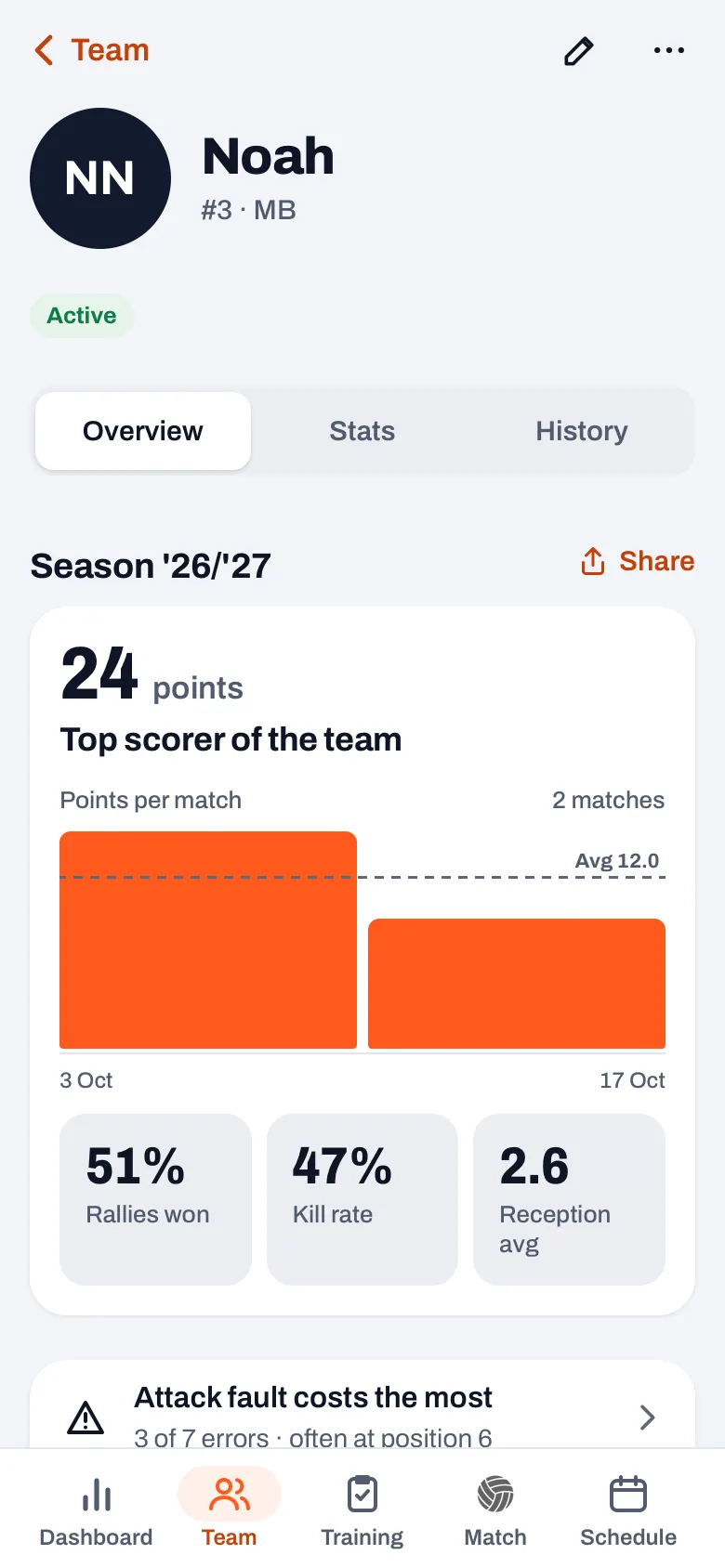
Do you play on a team whose coach uses Koach, and do you have your own player account? Then your player profile shows your season: your points per match and a few numbers from the matches your coach tracked in the app. Next to the season is Share. With it you turn your season into an image, the season card, which you can put straight onto a slide. The button appears as soon as you have been at a played match this season. Don't have your own account? Ask your coach: they can make the card from your profile too.
Are you a coach who landed here because a player is giving a presentation? You can try Koach free for 14 days; what it costs after that is on the pricing page. Players pay nothing.
14 days free, no credit card. Put your team in Koach, and your players have a season card after their first match.
Try Koach with your teamFrequently asked questions
How do you start a presentation about volleyball?
With something the class can do something with right away: a question to guess, a ball you hold up or a photo of a match. Better not to start by saying your presentation is about volleyball, because the class already knows that. After the opening, say in one sentence which parts are coming, so everyone knows where you are going. Practice the first minute most often, so you feel calm right from the start.
What is a good research question for a school report on volleyball?
A question you can't answer with yes or no and that you can find enough about. For example: What does a libero do, and why does that position exist? How is beach volleyball different from indoor volleyball? Or: How can volleyball be played sitting down? With three or four sub-questions you answer the research question step by step. Whether you need a research question is up to your school.
Can you use Wikipedia for a volleyball presentation?
As a starting point, yes. A Wikipedia article gives you a quick overview and lists the sources it is based on at the bottom. Open those sources, for example the FIVB website, and check there what you want to tell. In your list of sources, name the place where you actually read it. How your teacher feels about Wikipedia as a source differs per school, so ask if you are not sure.
How do you make slides for a volleyball presentation?
Put little text on each slide: a title and a few words, with one photo or drawing. The class should listen to you, not read your slides. Slides that work well: the court with the six positions, a photo of a ball, something about your own team and, at the end, a slide with your sources. If you use a photo from the internet, put in small print on the slide where it comes from.

Give your players a season card
14 days free, no credit card. After the first match their season is ready.
Get started with KoachOr read first what the volleyball coaching app does.