
Volleyball fun facts: twenty facts about the game, with sources
The short answer
Volleyball fun facts that hold up come from the rulebook and from the federations themselves. For example, a gym must be at least 10 degrees Celsius, FIVB matches have five balls ready with six ball retrievers, and sitting volleyball was first played in the Netherlands, in 1956.
Volleyball fun facts are everywhere, but far from all of them are true. Here are twenty facts in five groups, each with its source: the FIVB rulebook, the FIVB history pages, World ParaVolley and the International Paralympic Committee. Anything that could not be checked is left out.
The history from 1895 to today, with William G. Morgan, the name mintonette and the first Olympic Games, is in the history of volleyball. Why a ball floats or dives is explained in the physics of volleyball. Below are the facts you won't find there. Every fact from the rulebook comes with its rule number from the FIVB Official Volleyball Rules 2025-2028.
Fun facts about the game and the people around it
- The first demonstration had teams of five. When William G. Morgan showed his game at a conference in Springfield in early 1896, two teams of five played. The captains were the mayor and the fire chief of Holyoke, the city where the game was invented. Source: FIVB, history of volleyball.
- The first referee looks down from above. They stand on a referee's stand at one end of the net, opposite the scorer, and their eyes should be about 50 centimeters above the net (rule 23.1).
- The captain thanks the referees. After the match, the team captain thanks the referees and signs the scoresheet to confirm the result. That is how the rulebook puts it (rule 5.1.3.1).
Fun facts about the ball, the net and the gym
- Five balls and six ball retrievers. At FIVB matches, five balls are ready. There are six ball retrievers: one in each corner of the free zone and one behind each referee (rule 3.3).
- The net is black, with a white band. The net is made of black square mesh of 10 centimeters and measures 1 meter from top to bottom. Along the top runs a white band of 7 centimeters, made of two-fold canvas (rule 2.2).
- A gym is never colder than 10 degrees. The rulebook says the temperature in the hall must not drop below 10 °C (50 °F). At FIVB matches, the technical delegate decides the maximum temperature (rule 1.5).
- The lighting is set in lux. A hall should have at least 300 lux. At FIVB matches it is at least 2000 lux, measured 1 meter above the floor (rule 1.6).
- White lines on an approved floor. At FIVB matches only a wooden or synthetic floor is allowed, and the FIVB must approve it in advance. The lines are white, and the court and the free zone each have a different color (rule 1.2).
- A dotted line beside the court. At FIVB matches the attack line continues outside the court as a broken line: five short lines of 15 centimeters, each 20 centimeters apart, over a length of 1.75 meters (rule 1.3.4).
Volleyball rules that changed
- The first ball had more leeway. The ball made for Morgan had a circumference of 63.5 to 68.6 centimeters and weighed 252 to 336 grams (source: FIVB, history). Today it is 65 to 67 centimeters and 260 to 280 grams (rule 3.1): about the same size, with much less leeway.
- A net serve used to be a fault. If a serve touched the net, it was a service fault and the rally was over. Now play goes on if the ball crosses the net between the antennas. Source: FIVB, the game; the FIVB does not give a year there.
- The beach court shrank in 2002. That year the FIVB confirmed rally point scoring and a smaller court of 16 by 8 meters, for the World Tour and for the Athens 2004 Olympic Games. Source: FIVB, history of beach volleyball.
Two changes you notice in the gym every week, the libero and rally point scoring, are explained in the history of volleyball; all the current rules are in volleyball rules at a glance.
Fun facts about beach, sitting and snow volleyball
- On the beach around 1915. According to the FIVB, beach volleyball probably started in 1915 on Waikiki beach in Hawaii. Most stories still place its beginnings in Santa Monica, California, where the first courts on the beach appeared. Source: FIVB, history of beach volleyball.
- The first FIVB beach tournament was in Rio. The first international beach tournament recognized by the FIVB was played in 1987 on Ipanema beach in Rio de Janeiro (same source).
- Sitting volleyball comes from the Netherlands. It was first played in the Netherlands, in 1956, and was originally meant for wounded soldiers. Women have competed at the Paralympic Games since Athens 2004; that same year standing volleyball disappeared, after joining the program at Toronto 1976. Source: International Paralympic Committee. The rules are in sitting volleyball rules.
- There is also snow volleyball. The FIVB recognizes volleyball on snow as one of its disciplines, alongside indoor and sand. Source: FIVB, snow volleyball.
What else differs between the gym and the sand, from the number of players to the scoring, is in indoor and beach volleyball compared.
Striking numbers about volleyball
- 200,000 players in 1916. Twenty years after the first demonstration, Robert C. Cubbon estimated in an article on the growth of volleyball in the United States that 200,000 people were already playing, 70,000 of them at the YMCA. Source: FIVB, history.
- Equal prize money in 1998. That year, according to the FIVB, men and women at the open tournaments of the beach World Tour received the same prize money for the first time. Source: FIVB, history of beach volleyball.
- 107,000 spectators in six days. At the first Olympic beach volleyball event, in Atlanta 1996, more than 107,000 people came to watch over six days according to the FIVB, in a stadium with 10,000 seats (same source).
- Sitting volleyball in more than 75 countries. According to World ParaVolley, more than 10,000 athletes play sitting volleyball, in more than 75 countries. At the London 2012 Paralympic Games, 197 athletes from 15 countries took part, a record; at Arnhem 1980 there were seven countries, according to the IPC. Sources: World ParaVolley and International Paralympic Committee.
Check a fact before you pass it on. If there is no source, look it up with the FIVB, with your country's federation or in the rulebook. If you can't find it there, don't present it as a fact. Want to test the rules as a game? Use the volleyball rules quiz, and for a school presentation the structure is in a volleyball presentation for school.
And a fun fact about your own team: how do you score?
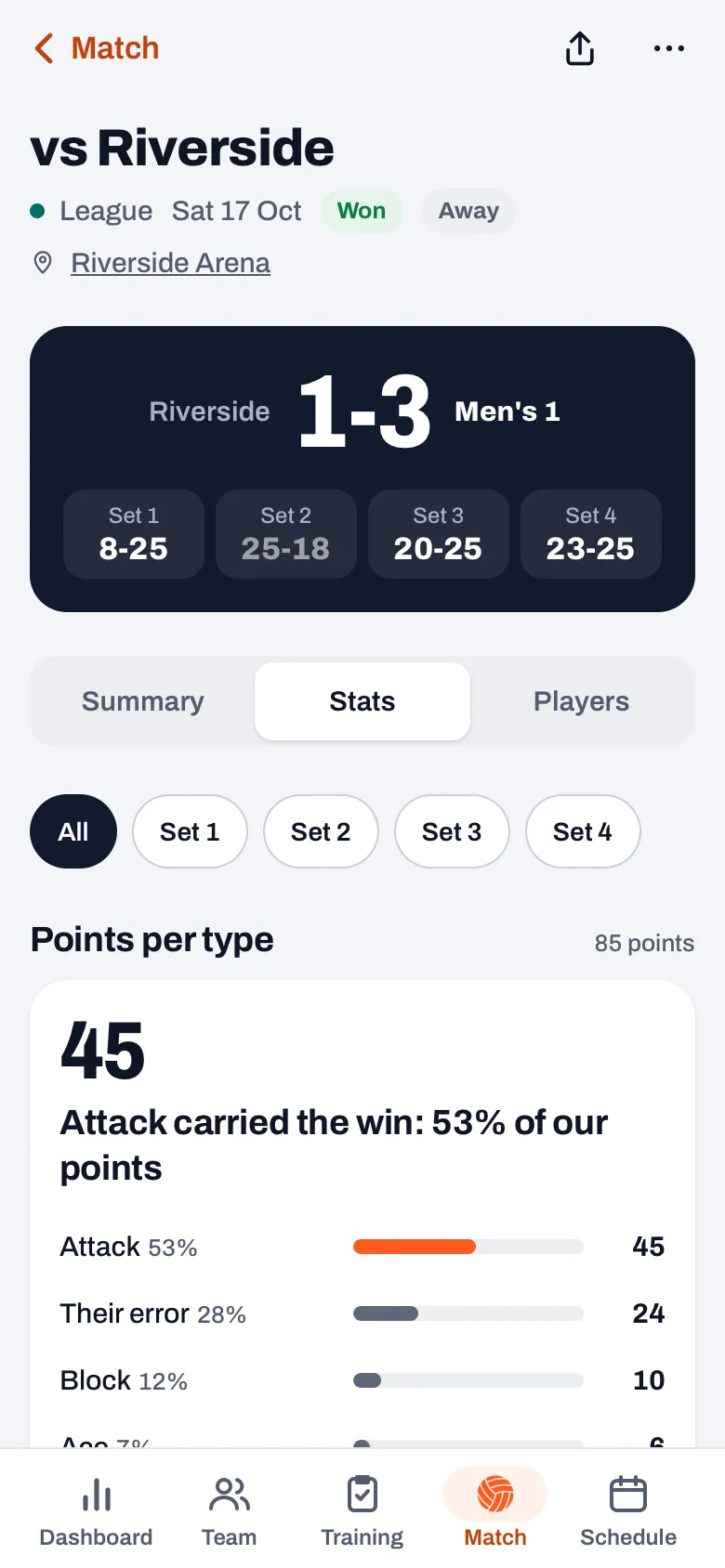
Fun facts about the game are nice for the bleachers. For a coach, their own team's numbers are often more surprising. How many of your points came from your own attacks, and how many did the opponent hand you? If you score a match live in Koach, afterwards you find that under Stats at Points per type: attack, Their error, block and ace, each with its share, for the whole match or per set.
What Koach costs after the 14 free days is on the pricing page.
14 days free, no credit card. Score your next match live and see afterwards how your team really won its points.
Try Koach with your teamSources, accessed on 6 November 2026: FIVB, Official Volleyball Rules 2025-2028; FIVB, history of volleyball; FIVB, the game; FIVB, history of beach volleyball; FIVB, snow volleyball; International Paralympic Committee, sitting volleyball; World ParaVolley, sitting volleyball.
Frequently asked questions
What is a fun fact about volleyball?
At the first demonstration in 1896, two teams of five played, and the captains were the mayor and the fire chief of Holyoke. Another one: at FIVB matches, five balls are ready and six ball retrievers stand around the court. Both facts come from the FIVB itself: from its history page and from the official rulebook.
Where does sitting volleyball come from?
According to the International Paralympic Committee, sitting volleyball was first played in the Netherlands, in 1956. It has been on the Paralympic program since the Arnhem Games in 1980, and women have competed since Athens 2004. World ParaVolley counts more than 10,000 athletes in more than 75 countries.
How many balls are used in an official volleyball match?
At FIVB matches, five, with six ball retrievers: one in each corner of the free zone and one behind each referee (rule 3.3 of the rulebook). All balls in a match must have the same circumference, weight, pressure and color. In lower leagues, the federation or the organizer decides how many balls there are.
How warm does a gym have to be for volleyball?
According to the FIVB rulebook, the temperature must not drop below 10 °C (50 °F). The rulebook gives no fixed upper limit; at FIVB matches, the technical delegate decides what the maximum temperature may be. Your federation or league may have additional rules for its own matches.

Discover your own team's fun facts
14 days free, no credit card. After your first live match you see how your team scores.
Get started with KoachOr read first what the volleyball coaching app does.