
Volleyball spike speed: how hard do players really hit?
The short answer
Volleyball spike speed averaged about 97 km/h (60 mph) for ten international men, measured right after contact (Coleman, 1993). Players from the Spanish first division averaged 76 km/h (47 mph) without a jump. Youth players hit much softer in the few measurements there are, and harder is not automatically more effective.
Volleyball spike speed is harder to pin down than serve speed: it gets measured less often, and plenty of numbers without a source circulate online. Here are the measurements that do have a source, for men, women and youth, what they mean for the defense and how to measure it yourself.
How fast is a volleyball spike?
A widely cited measurement of international-level players is old, but careful. Coleman, Benham and Northcott (Journal of Sports Sciences, 1993) filmed ten male internationals at the 1991 Universiade, the World University Games, with two cameras at 100 frames per second. From the three-dimensional footage they calculated the speed of the ball right after contact: on average 27.0 meters per second, about 97 km/h.
Other studies measure with a radar, and often with a test instead of in a match. That gives this series:
| Who | How it was measured | Speed |
|---|---|---|
| Ten international men | 3D film, spike with approach and jump | Average 97 km/h (60 mph) |
| 83 women from the Spanish first division | Radar, standing hit without a jump | Average 76 km/h (47 mph) |
| 15 male university students who play volleyball | Standing hit without a jump | Average 73 km/h (45 mph) |
| Ten high school students, average age 15.5 | 3D lab measurement, spike with approach on a ball held in a holder | 31 to 66 km/h (19 to 41 mph) |
Sources per row: Coleman and colleagues (1993), Palao and Valadés (2012), Del Coso and colleagues (2014, the measurement without caffeine) and Howard and colleagues (2023). Compare the rows with care: a standing hit misses the approach and the jump, a ball in a holder does not come flying in like a set, and a film measurement works differently from a radar. Online you will also see much higher numbers for the spike; only take one over if there is a measurement with a source behind it.
How hard do women and youth players hit?
For women there is a large measurement by Palao and Valadés (Biology of Sport, 2012). They tested 83 players from the nine best teams in the Spanish first division with a fixed test: the player tosses the ball herself and hits it with both feet on the floor, without a jump, toward a target area. A radar measures three attempts and the fastest one counts. On average that came to 76.1 km/h. By position:
- Outside hitters: average 78.2 km/h
- Opposites: average 78.0 km/h
- Middle blockers: average 76.9 km/h
- Liberos: average 73.0 km/h
- Setters: average 71.9 km/h
The foreign players in the league hit 79.0 km/h on average, the Spanish players 74.4 km/h. The researchers give 70 to 82 km/h as a reference for players at that level, and add themselves that it only applies to comparable groups.
A comparison of men and women in exactly the same test comes from sitting volleyball: there, thirty top-level players hit an average of 67 km/h for the men and 52 km/h for the women (Sun and colleagues, 2026). How else the men's and women's game differ is in the difference between men's and women's volleyball.
For youth there are few measurements. In the lab of Howard and colleagues, ten American high school students with an average age of 15.5 hit a ball hanging still in a holder after an approach; the ball speed ranged from 31 to 66 km/h, a difference of a factor of two within one small group. For younger kids and recreational players we found no reliable measurements. So measure yourself and mainly compare a player with themselves.
Is a harder spike also a better spike?
Not automatically. In a Belgian study, players from the first division did hit harder than players from the second (Forthomme and colleagues, 2005). But among 22 men from the top Cypriot division, followed over four matches, a spike speed above 90 km/h actually seemed to have a negative effect on how effectively they attacked (Challoumas and Artemiou, 2018). One possible explanation, which the study did not test: whoever hits at full power aims less accurately.
Speed does take time away from the defender. Say the ball travels 9 meters from the contact point to a defender. At 90 km/h, that is 25 meters per second, it takes about 0.36 seconds; at 60 km/h, about 16.7 meters per second, about 0.54 seconds. In reality the ball slows down a little on the way, so the real time is a bit longer. But an attack that lands neatly next to a defender, or a tip behind the block, also costs them a point without any speed; see poke, tip and roll shot.
Always measure speed together with the target. Have a hitter hit ten times at a target area on the court and write down, for each ball, the speed and whether it landed in the target. If the speed goes up while as many balls land in the target, they have really improved. If fewer land in it, you have only bought risk.
Where does spike speed come from?
In the Coleman study, ball speed was related to how fast the upper arm of the hitting arm rotated. In the Belgian study, a higher jump and more strength in the shoulder and elbow went together with a faster spike. In the Cypriot study, those were a higher jump, a larger share of lean body mass and more frequent strength training, and players who had had pain in the hitting shoulder hit slower. In every case these are associations in small groups, not proven causes. The hitting technique itself, from the approach to the wrist snap, is covered step by step in how to hit a volleyball harder.
Measuring spike speed yourself
The simplest repeatable test is the one by Palao and Valadés: toss it yourself, hit without a jump with both feet on the floor, three attempts with 30 seconds of rest in between, and the fastest counts. Place the radar in line with the flight of the ball; if it is at an angle, it reads too low. With a real spike with an approach it is harder, because the net and the block are in the way. Then slow-motion video from the side is an alternative. How to measure and calculate with a radar or video is explained in detail in serve speed in volleyball; for the spike it works the same way. Only compare measurements that were done the same way. So always measure after the warm-up, with the same ball at the same pressure and at the same point in practice; in the Palao and Valadés research it was done that way too. Write down the fastest of three attempts per player and measure again a month later. A player who hits harder than at their previous measurement has improved in speed, whatever the rest of the team hits.
Measure speed at practice, the effect in the match
Koach does not measure speed. What the app does track is what an attack produces. If you score in Expert mode, after the match you see under Expert figures, per attacker, how many attempts they had, how many kills and errors, their efficiency, and how they scored after a good and after a poor pass. How to calculate that efficiency and what a good number is, is in hitting percentage in volleyball.
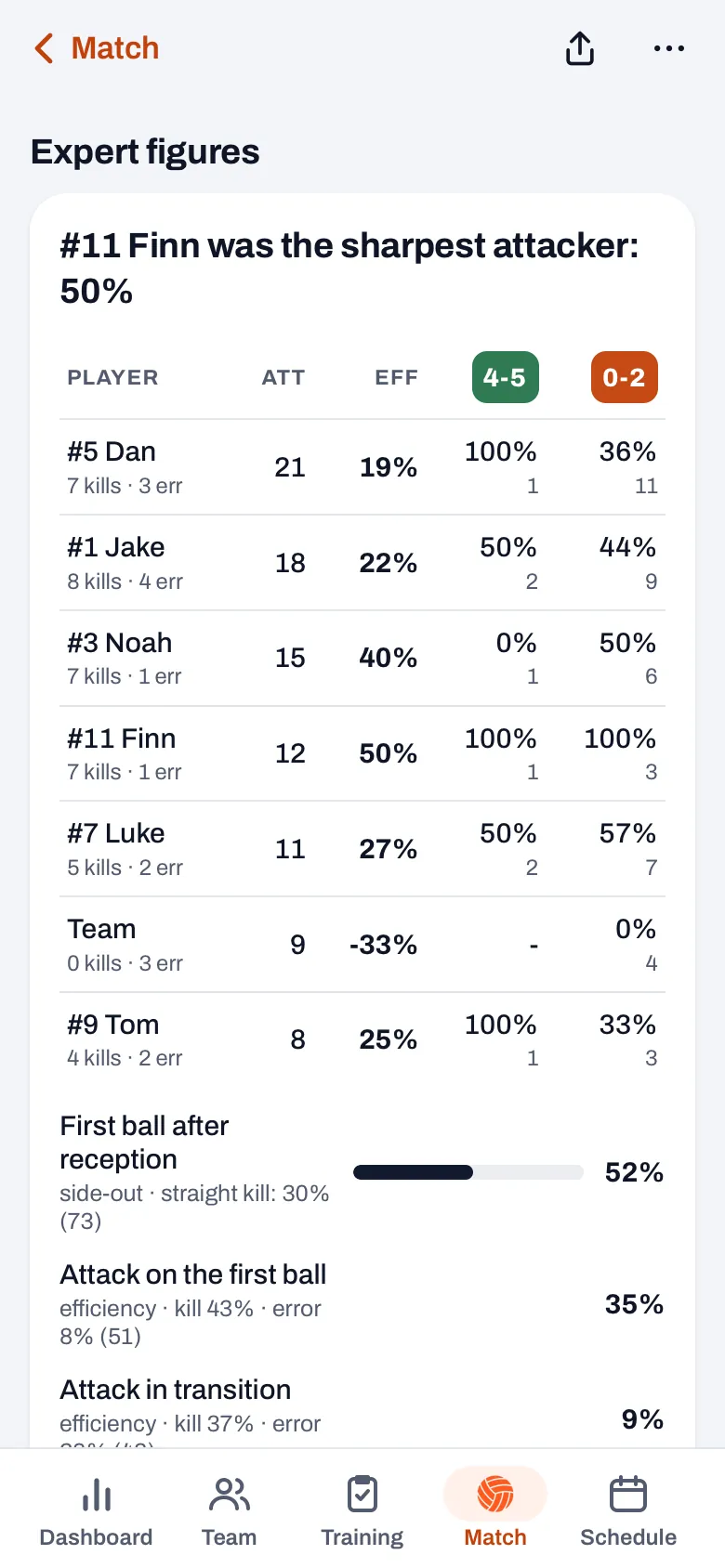
Put the speed measurement from practice next to those numbers and you see whether a harder spike also scores more points. Which other stats exist and how to read them is in understanding volleyball statistics. What Koach costs after the 14 free days is on the pricing page.
14 days free, no credit card. Score your next match in Expert mode and see which hitter really scores points.
Track your hitters in KoachFrequently asked questions
How fast is a spike in volleyball?
For ten international men, an average of 27 meters per second was measured right after contact, about 97 km/h or 60 mph (Coleman and colleagues, 1993). Women from the Spanish first division hit an average of 76 km/h, about 47 mph, in a test without a jump (Palao and Valadés, 2012). For youth players it is considerably lower in the few measurements there are, with big differences between players.
Is a spike faster than a serve?
They are in the same range. In radar measurements in the men's World League, a jump serve reached 73 to 104 km/h (Palao and Valadés, 2014); the international spike in the Coleman study averaged about 97 km/h. Because the measurements were done with different methods and with different players, you cannot compare them precisely. A standing float serve is clearly slower than a spike, though.
How hard do women spike a volleyball?
A large measurement of women comes from the Spanish first division: 83 players hit an average of 76 km/h in a standing test, without a jump. Outside hitters and opposites averaged about 78 km/h, setters about 72 km/h. A spike with an approach and a jump is a different movement, which this research did not measure.
How do you measure spike speed without a radar?
Film the spike from the side in slow motion, for example at 240 frames per second, and count the frames between contact and the moment the ball hits the floor. Estimate the distance traveled using the lines on the court; because the ball also goes down, it is a little longer than the distance along the floor. Divide the meters by the seconds and multiply by 3.6 for km/h. That gives you the average speed, a bit lower than what a radar shows right after contact.


See which attack really scores
14 days free, no credit card. After three matches you see what each hitter's attack produces.
Get started with KoachOr read first what the volleyball coaching app does.