
Volleyball hitting percentage: the formula and what is good
The short answer
Volleyball hitting percentage is kills minus attack errors, divided by total attempts. An attack that is blocked straight down counts as an error. Twelve kills and four errors from 32 attempts gives (12 − 4) / 32 = .250. Koach calculates it per player in Expert mode.
Volleyball hitting percentage shows what an attacker is worth once you count the errors too. A player who hits a lot of kills can still add little. Below you find the formula, a worked example you can check, what published targets call good and how Koach works it out for you.
What is hitting percentage in volleyball?
Hitting percentage is the number that tells you what an attacker produces per attempt. You count the kills (attacks that win the point outright), subtract the attack errors and divide by the number of attempts. It also goes by attack efficiency; in Koach it is called Efficiency. American stat sheets write it as a three-decimal number without the leading zero, like .250. That is the same as 0.250, or 25%: per four attempts, one point more won than given away.
The difference with plain kill percentage is in the errors. Kill percentage only divides the kills by the attempts. Hitting percentage subtracts the errors, because an attack into the net hands the opponent a point just as surely as a kill gives you one. How to calculate and improve kill percentage is covered in calculating and improving your attack percentage. How this number fits in with your other match stats is in understanding volleyball statistics.
How do you calculate hitting percentage? The formula
Hitting percentage = (kills − attack errors) / attempts
The maths is simple. The debate is about what you count. Agree on it beforehand, or your numbers won't compare from week to week:
- Attempt: every attack meant to score. That includes a tip, a roll shot, an attack the opponent digs and an attack that comes back off the block and is covered by your team. A ball you send over without attacking, because nothing else was on, is not an attempt.
- Kill: the attack wins the point outright. A ball that goes out off the block is a kill too.
- Attack error: the attack lands out, goes into the net or outside the antenna, or the hitter touches the net. An attack that is blocked straight down for a point to the opponent also counts as an attack error in the usual count.
Worked example: three hitters in one match
Say you track three attackers for a whole match. The table shows the numbers, the kill percentage as a decimal and the hitting percentage:
| Player | Attempts · kills · errors | Kill % | Hitting % |
|---|---|---|---|
| A | 32 · 12 · 4 | .375 | .250 |
| B | 18 · 9 · 7 | .500 | .111 |
| C | 10 · 3 · 0 | .300 | .300 |
| Team | 60 · 24 · 11 | .400 | .217 |
Written out: player A (12 − 4) / 32 = 8 / 32 = .250. Player B (9 − 7) / 18 = 2 / 18 = .111. Player C (3 − 0) / 10 = .300. The team together: 24 kills and 11 errors from 60 attempts, so (24 − 11) / 60 = 13 / 60 = .217.
Look at player B. Half of B's attacks were kills, so on kill percentage B was the best attacker of the night. But seven of those eighteen attacks were errors, and every error is a point for the opponent. Player C swung less often, made no errors and has the highest hitting percentage. That is why the number exists: if you only count kills, you reward the attacker who tries everything, even when it often goes wrong. Who scored the most points shows up in your team's top scorers; hitting percentage tells you what those points cost.
A negative hitting percentage is possible too: more errors than kills. That is not a calculation mistake but a signal, especially when it happens a few matches in a row.
What is a good hitting percentage?
There is no official standard. Coaches and analysts do publish targets, and almost all of them come from the United States. Two examples:
- A Hudl blog post on volleyball stats names .300 as a team target, .250 for outside and opposite hitters and .450 for middles (source, checked in October 2026).
- An analysis by Dartmouth Sports Analytics of the top 100 attackers in US men's college volleyball (2021 season) found the best middles all above .333, while the outside hitters mostly stayed between .200 and .300 (source, checked in October 2026).
Two lessons from that hold at every level. Compare by position: a middle gets quick sets against a block that isn't set yet, an outside gets the high balls after a bad pass, often against two blockers. And know which level a target was made for. If you coach youth or recreational volleyball, compare mainly with your own earlier matches. If an attacker's hitting percentage rises over a few weeks, things are moving the right way, even if it is nowhere near an American target yet.
Watch the number of attempts as well. With five attempts, one extra error already moves the hitting percentage by .200. So only draw conclusions over a few matches together.
Hitting percentage after a good or a bad pass
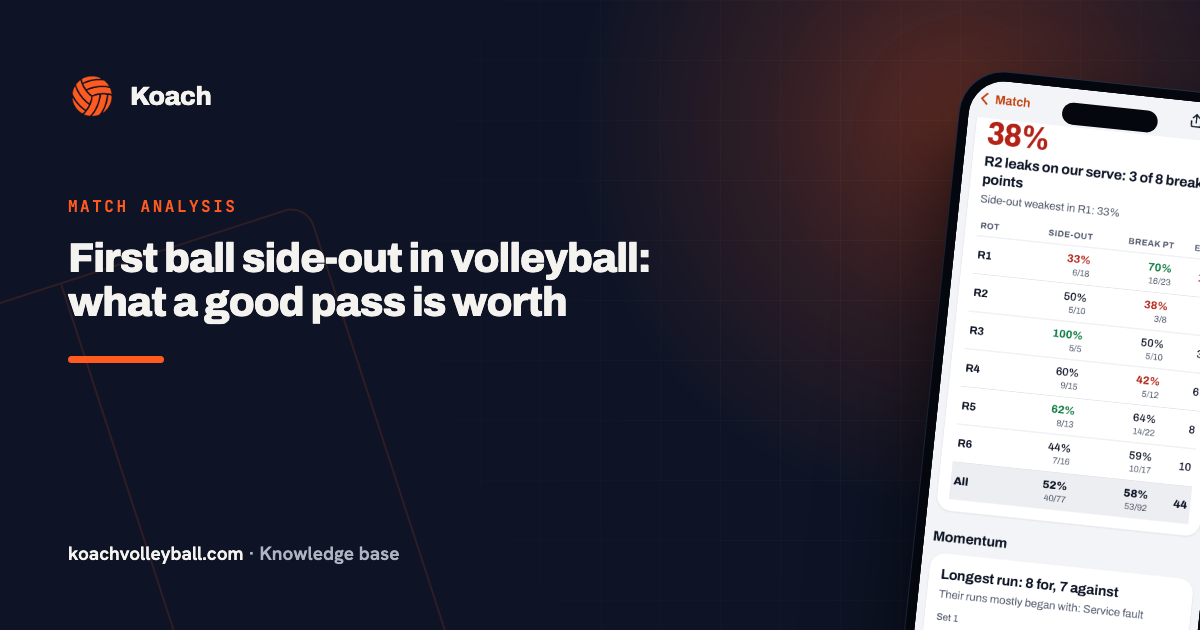
An attacker is only as good as the ball they get. After a perfect pass your setter has every option; after a bad pass it becomes a high ball to the outside against a block that is waiting. Split the attacks by the quality of the pass before them, and you see whether an attacker falls short or mainly gets the hard balls. How to rate the pass itself is in the serve receive rating from 0 to 5, and what a good pass earns in points in first ball side-out after a good or bad pass. How to still score when the pass is off: playing out of system.
How does Koach calculate hitting percentage?
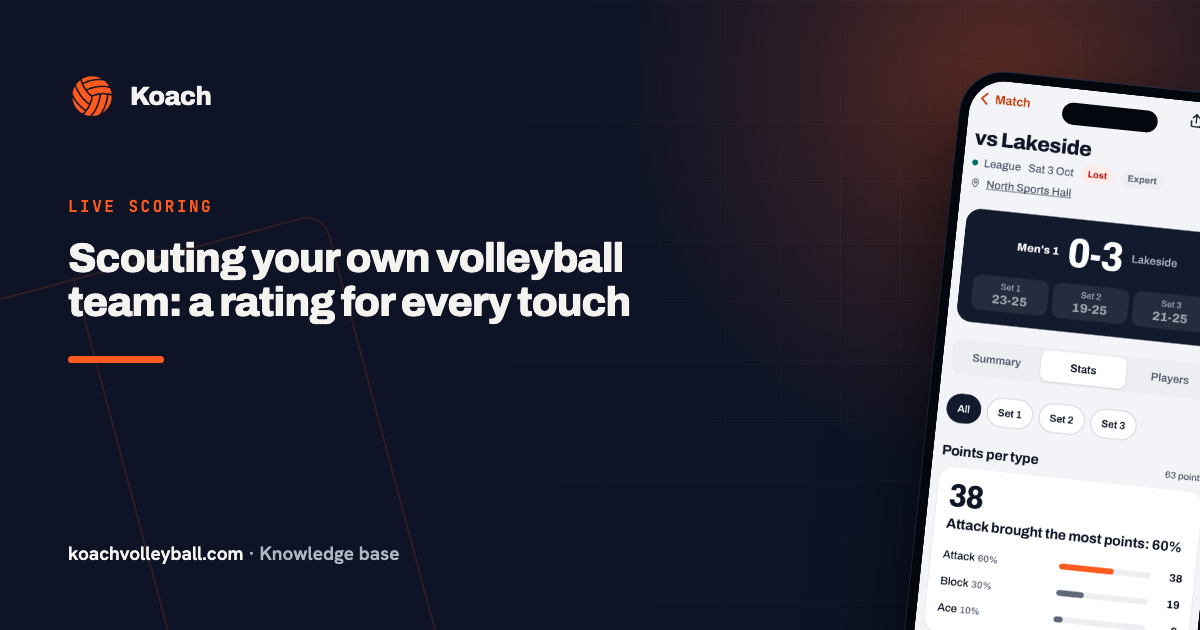
Koach has two ways of scoring live: Simple and Expert. You choose on the start screen under Scoring and can switch mid-match via ⋯ (More) at the top right. In Simple you tap after each point how it was won (Attack, Block, Ace or Their error) and who made it, and for a point to the opponent which error was behind it, such as Attack error. That gives you each player's kills and attack errors, but not the attacks that produced nothing. So Simple does not count attempts, and without attempts there is no hitting percentage.
In Expert you rate every ball contact of your own team from 0 to 5, including every attack. At the Attack step the six numbers carry the words Error, Free ball, Easy dig, Covered, Tough and Kill. A 5 is a kill and gives your team the point right away (you tap the attacker first). A 0 is an error and gives the opponent the point. Ratings 1 to 4 are attempts without a point. Koach calculates exactly as above: Efficiency = (kills − errors) / attempts, with a 5 as a kill and a 0 as an error. Only the notation differs: Koach shows it as a percentage, so .250 appears as 25%. How Expert mode works as a whole, from serve to block, is in scouting your own team.
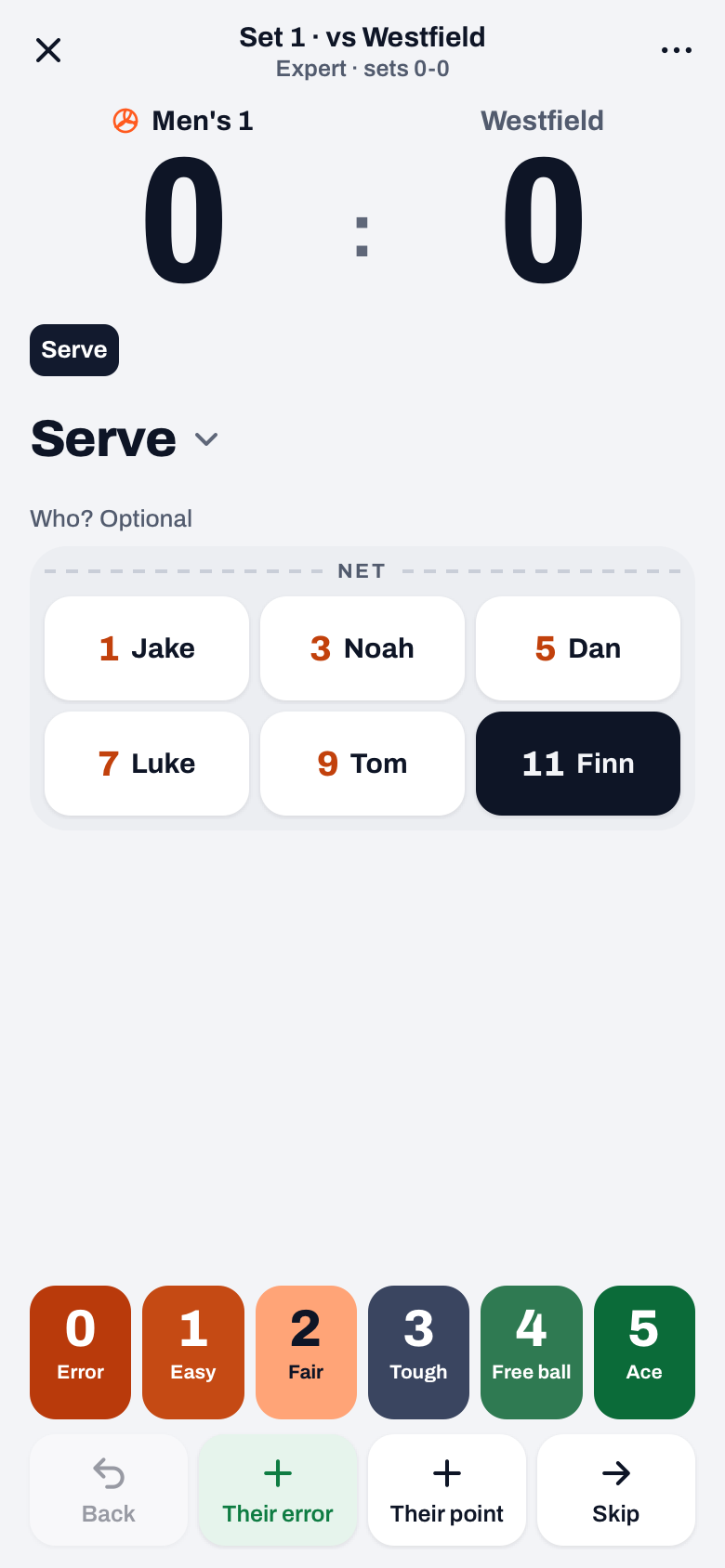
Two agreements keep your numbers clean. If your attack is blocked straight down for a point, tap a 0: then it counts as an error, as in the usual count. If your team sends the ball over without attacking, tap Skip: Koach skips the step and does not count it as an attempt. A real attack so weak that the opponent gets a free ball is an attempt: that is the 1 (Free ball).
14 days free, no credit card. Score your next match in Expert mode and see each attacker's hitting percentage afterwards.
Try Koach with your teamWhere to find hitting percentage in Koach
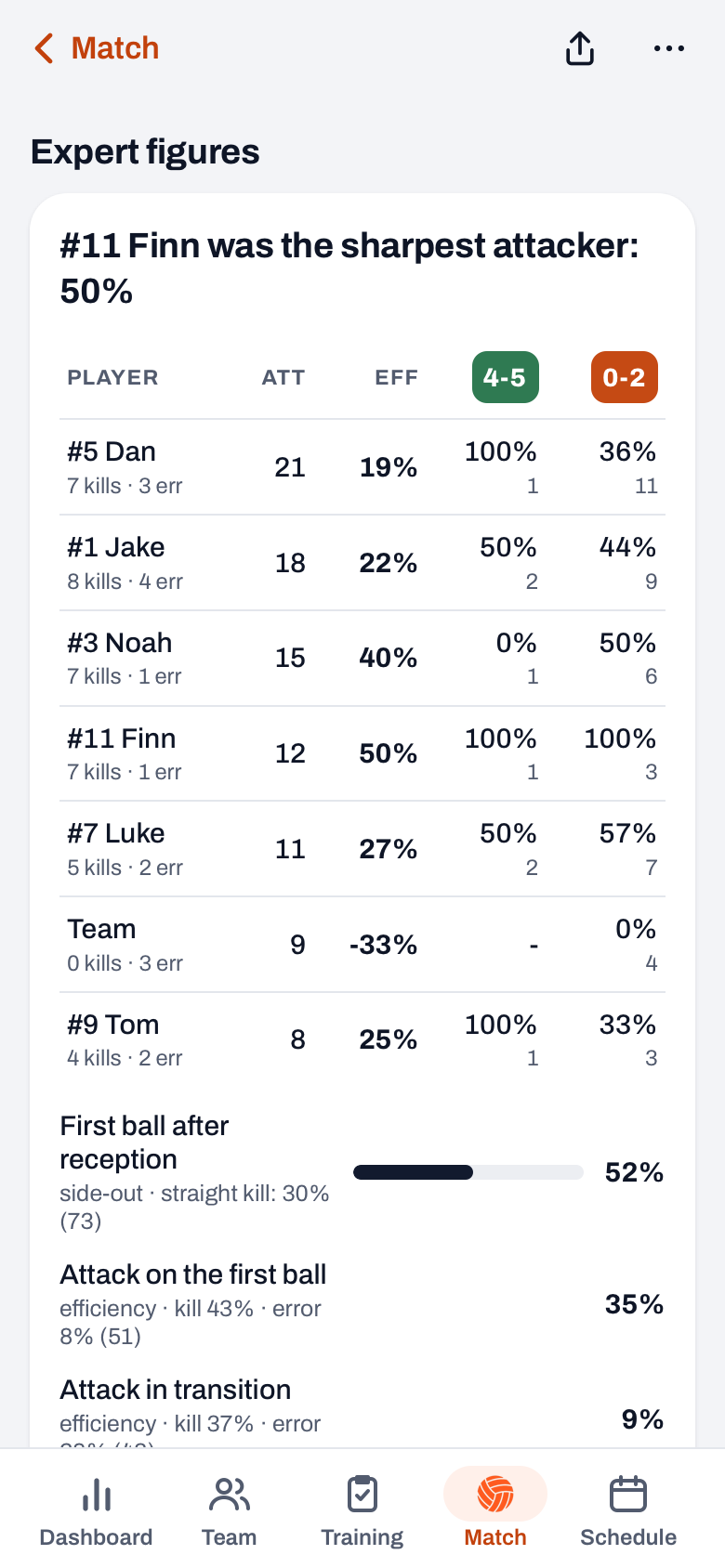
- After the match. Open the match on the Match tab and choose Stats. For an Expert match, the Expert figures block sits at the bottom. The first card opens with the line … was the sharpest attacker, followed by the efficiency: the player with the highest efficiency among those who attacked at least five times. Below it is a table with each player's attempts (Att), efficiency (Eff), kills and errors, and their kill percentage after a good pass (4-5) and after a bad pass (0-2). The pass that counts is the last reception, dig or free ball before that attack. You also see how your attack on the first ball after reception did compared with your attack in transition.
- Per player over the season. In the player profile under Stats > Attack you find the tiles Kill, Error and Efficiency, the kill rate per position on court and a table with attacks after a good and after a bad pass. Under Per match, the Attack efficiency chip shows the trend; a match in which the player attacked fewer than three times is left out.
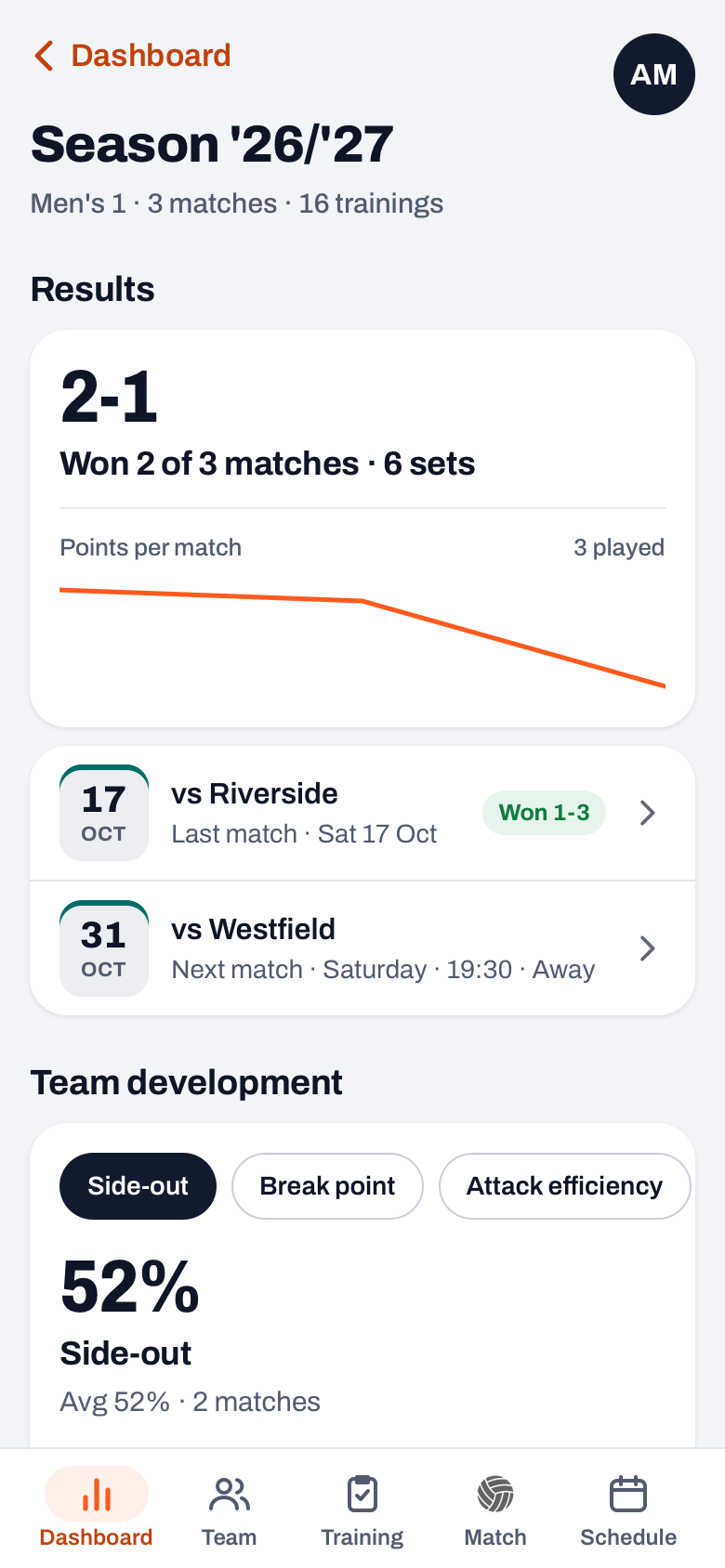
- For the whole team. On the dashboard, under All season insights > Team development, the Attack efficiency chip shows your team's efficiency per match.
Expert mode is included in both plans, Coach and Club. What they cost after the 14 free days is on the pricing page.
Agree on the edge cases before you start counting. Blocked straight down for a point is a 0, off the block and out is a 5, and a ball sent over without an attack is Skip. Give that note to whoever scouts: then you can put September's numbers next to March's and compare them fairly.
Frequently asked questions
Does a blocked attack count as an attack error?
Yes, if the block sends the ball straight back for a point to the opponent. In the usual count that is an attack error, just like an attack that goes out or stays in the net. If the ball comes back off the block and your own team plays it on, it is a normal attempt with no kill and no error. If the ball goes out off the block, it is a kill.
What is the difference between hitting percentage and kill percentage?
Kill percentage divides the kills by the attempts and ignores the errors. Hitting percentage first subtracts the attack errors from the kills. An attacker with 9 kills and 7 errors from 18 attempts has a kill percentage of .500 but a hitting percentage of only .111. So hitting percentage tells you what an attacker adds in net terms, kill percentage only how often they finish.
Can hitting percentage be negative?
Yes. If an attacker makes more errors than kills, the result gets a minus sign. With 3 kills and 5 errors from 20 attempts you get (3 − 5) / 20 = −.100. In one match with few attempts that says little, but if you see it a few matches in a row, look at shot selection and at the quality of the sets the attacker gets.
Does Koach calculate hitting percentage in Simple mode?
No. In Simple you count each player's kills and attack errors, but not the attacks that produced nothing, and without attempts there is no hitting percentage. For that you score the match in Expert mode, which is included in Coach and in Club. You can try Koach free for 14 days, no credit card needed.
Measure your attackers at the next match
14 days free, no credit card. After one Expert match you'll see who really delivers.
Get started with KoachOr read first what the volleyball coaching app does.