
Volleyball talent identification: what to watch in youth players
The short answer
Volleyball talent identification in youth players works best when you do not look at who is best right now, but at how fast someone learns, how they move, how they read the game and how they deal with mistakes. Watch for those several times, with more than one pair of eyes, and keep your judgment provisional.
Volleyball talent identification seems simple: you can just see it, right? With youth players you mostly see who is furthest along right now, and that is often who is oldest, tallest or has played longest. Here you read why current performance predicts little, which signals say more and how to watch fairly over a whole season.
Why talent is hard to predict at a young age
A youth coach sees every week who stands out: the player who hits hardest, jumps highest or digs the most balls. The question is what that says about the player they will be five years from now. The honest answer from the research: less than you hope. A systematic review by Johnston and colleagues in Sports Medicine (2018) brought together studies that compared higher- and lower-performing athletes, over a longer period or looking back. They found twenty, most of them about physical characteristics, and the factors that made the difference varied widely. Their conclusion: little is known yet about talent identification in elite sport.
There are three reasons for that, and you see all three in a volleyball gym.
- Maturation. Two thirteen-year-olds can be far apart physically: one is in the middle of their growth spurt, the other has yet to start. Whoever grows early hits harder and jumps higher, and so looks better. That advantage disappears when the others catch up. Why height is a poor yardstick in youth players is in height in volleyball.
- Birth month. Within one age group there can be almost a year of difference, and players born early in the year are more often in selection teams (meta-analysis by Cobley and colleagues, 2009). What that means for your own youth section is in the relative age effect.
- A head start in hours. A player who started early and played a lot of volleyball is further along now. That is experience, not automatically talent. A meta-analysis by Barth and colleagues (2022) found that what gives youth athletes a head start now, starting early and training a lot in one sport, was actually less common among later world-class athletes. What that means for choosing and specializing is in early sport specialization.
What to take from this: a judgment about talent in a player of eleven, twelve or thirteen is a provisional estimate, not a verdict. Treat it that way, in your head and in what you tell parents.
Four signals that say more than current performance
What a player can do today mainly shows how far along they are now. These four things tell you more about where they can go. None of the four is a proven predictor, but taken together and over a longer period, they say more than one good evening.
1. How fast someone learns
Give a player one concrete cue, for example "get set earlier before you pass", and watch what happens. Does it work a few times that same evening? Is it still there the following week? A player who is average now but picks up a correction quickly deserves at least as much attention as the player who is furthest along now and keeps making the same mistake. Write it down, because after a month you will not remember who picked up what.
2. How someone moves
Watch a player when the ball is not coming to them. How do they move around, how do they land, how quickly do they pick up a new movement in the warm-up or in a game from another sport? A child who moves easily has a base on which volleyball technique can land. Be careful during a growth spurt: a player who suddenly moves awkwardly has not gotten worse, their body has changed.
3. How someone reads the game
You do not see game awareness in a row of drills, but you do in small-sided games. Are they in the right spot before the ball comes? Do they call? Do they see where the open space is? Two against two or three against three shows who plays the ball into a gap instead of straight back. That does not depend on height or strength, so it does not disappear when others catch up.
4. How someone handles mistakes and feedback
What does a player do after a mistake: do they want the next ball, or do they look at the floor? What happens after you have said something? And do they enjoy the game? A player who likes volleyball keeps training, and whoever keeps training has the best chance to develop. Be careful not to confuse confidence with talent: a quiet child who listens well stands out less than a loud one, but can learn just as well.
| What you see | What it might say | Check first |
|---|---|---|
| Hits the hardest ball in the group | Strength and timing, or an early growth spurt | Birth month and height compared with the rest of the group |
| Picks up a cue the same evening | Learning speed | Whether it is still there a week later |
| Is always in the right spot in small-sided games | Game awareness | Whether it also works with other teammates |
| Wants the next ball right after a mistake | Attitude | Whether that holds when things go badly |
| Is the best in the group at everything | Talent, or a head start in age and hours | How long they have played and whether they did other sports |
Watch more often, and with more than one pair of eyes
One tryout day measures how someone played that evening. If you want to identify talent, you watch over a season, at different moments and in different situations.
- Three or four moments per season. For example at the start, before winter and at the end. Then you see who is growing, not just who was already there.
- Practice, small-sided games and matches. Some players are strong in a drill and disappear in a match, others the other way around.
- More eyes, separately first. Have your assistant, last year's coach or the technical coordinator watch too, and let everyone make their own notes before you compare. That takes your own preference out of it.
- Write down behavior, not a label. Write "picks up passing corrections quickly" instead of "talent". A label sticks for good; an observation is something you can check three months later.
If you do organize a tryout day, the setup with criteria, schedule and results is in running volleyball tryouts. And if you have to advise in spring whether a player moves up a level, it helps to have those observations at hand; how to build that advice is in backing up promotion advice.
Follow three players closely each practice. Choose them beforehand, watch only them for one evening and write down two lines. Switch every week. After a month or two you have really seen everyone a few times, including the quiet players who would otherwise never stand out.
What to do with a talented player, and what not to do
When a player stands out, it is tempting to move them up to an older team quickly, give them a fixed position or have them train more. A few guidelines that work with youth players:
- Keep them broad. Let them play several positions and encourage a second sport. A fixed position can come later; for now they learn more from all positions and from other movements.
- Make the task harder, not the group. Give them a tougher requirement in the same drill: a smaller target, overhead only, the difficult ball. That way they stay with players their own age and are still challenged. How to fill that in by age is in coaching youth volleyball by age.
- Training up a level now and then is fine. One practice a week with an older team gives a challenge. Do keep an eye on the total load: more practices and more jumps during a growth period call for rest in between. If a player has knee, heel or back complaints that persist, have them assessed by a doctor, sports physician or physiotherapist.
- Keep the door open for late bloomers. Players who do not stand out now get as much playing time and attention. In two years the picture can be very different, and then you want that player to still be playing volleyball.
And with parents: be careful with the word talent. Say what you see ("she picks up new things quickly") and what you are going to do, not what you expect her to be in five years.
Keeping track of your observations over a season
If you watch several times, you have to write it down somewhere. In Koach you do that after each practice. With Rate effort you give each player who was there a score from 1 to 5 for Technique, Game awareness, Coachability, Work ethic and Effort, player by player, with the Next button showing the name of the next player. In the player profile, under History in the Trainings section, you see the average effort and a line across the practices. Only the coach sees this, not the player.
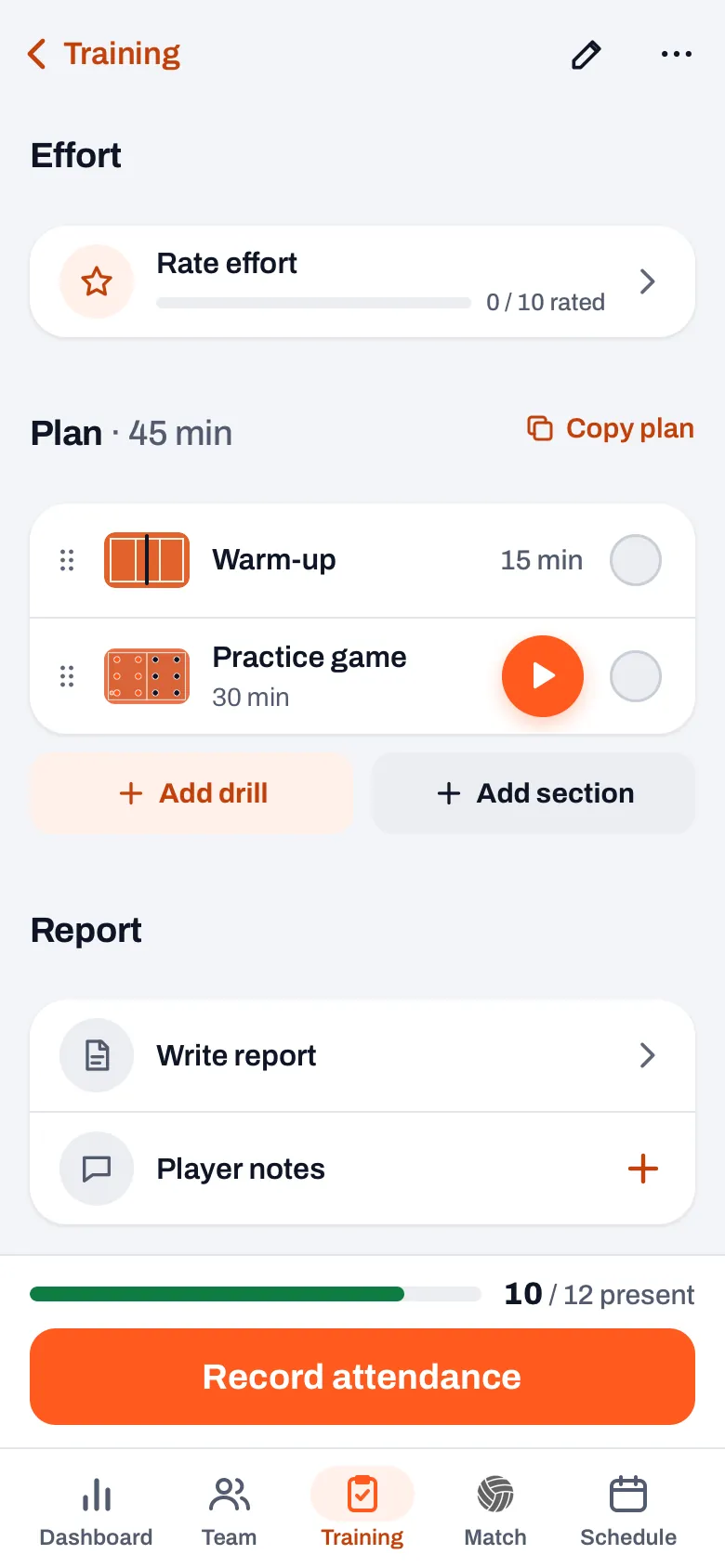
What you see goes into Player notes: choose the player, write what you saw and tap Save note. The note goes into the player's profile under Notes, for coaches only; players and parents do not see it. If your club has the Club plan, the club leadership (admins, board members and the technical manager) can read that evening's notes in the team log, and with Follow up you mark a note they need to act on. That way more eyes are watching; what else the club features do is on Koach for clubs. What Koach costs after the 14 free days is on the pricing page.
14 days free, no credit card. Rate your players briefly after each practice and see in winter who has really grown.
Try Koach with your youth teamFrequently asked questions
At what age can you identify volleyball talent?
There is no age at which it works reliably. Before and during the growth spurt, current performance says little, because maturation, birth month and the number of years someone has played distort the picture. So look at how fast someone learns, how they move, how they read the game and how they deal with mistakes, and keep your judgment provisional until after the growth spurt.
What is the difference between talent and an early maturing player?
An early maturing player is bigger, stronger and faster than players their age right now, and performs better because of it. That advantage disappears when the others catch up. Talent shows more in how fast someone learns something and how they read the game. So put every standout player's birth month and height next to their performance, and check whether they are also growing in things that have nothing to do with height.
Should a talented youth player train with an older team?
Training with an older team now and then can give a challenge, but do not take a player away from their peers too quickly. Make the task harder within their own group, let them play broadly and watch the total load, especially during a growth period. A player who enjoys it and keeps playing volleyball has the best chance to develop.
How do you tell parents their child has talent?
Carefully and concretely. Say what you see, for example that the child picks up new things quickly or reads the game well, and what you are going to do with it. Promise nothing about later: in youth players, a judgment about talent is a provisional estimate. Add that moving in many ways and enjoying the game matter more than specializing early.



Follow your youth players over a whole season
14 days free, no credit card. After a few months you see who is really growing.
Get started with KoachOr read first what the volleyball coaching app does.