
Volleyball while pregnant: what still works and what doesn't
A player tells you she is pregnant, and a few weeks later she has disappeared. Not because anybody sent her away, but because nobody knows what is still possible, so nothing gets agreed. This article is about the two things that go wrong there: the order in which volleyball actions drop away, and the roles you give her so she stays part of the team. It is emphatically not about whether she is allowed to play — nobody in the hall decides that.
First, clearly: who decides what here
This is an article for two readers at once: the player who wants to know what is left of her volleyball, and the coach who has to arrange what happens on Tuesday evening. The same boundary applies to both. Whether playing volleyball during this pregnancy is responsible, and until when, is decided by the doctor or midwife — not by the coach, not by the player on her own, and certainly not by an article. Everything below is general information about how volleyball is put together, not medical advice and no substitute for a consultation.
What does belong on the court is the volleyball side of the question. A doctor may say: moderate exertion is fine, risk of falling and collision preferably not. What that means for a blocking drill, a defensive exercise or a six-versus-six, that doctor does not know — you do. So don't translate the advice into "just take it easy", but into concrete actions that do or do not go ahead. That is the only part of this puzzle where a coach has anything to say, and it is exactly the part that gets left undone.
The thread running through that translation is this: in volleyball the particular risk is not the exertion but the falling and the being hit. Running you can dose; a landing next to a team-mate's foot or a driven ball from four metres away you cannot. That is why actions in volleyball drop away in a recognisable order, and that order does not line up with how heavy something feels.
The order in which actions drop away
There is no week at which the light turns red. There is an order, though, and it follows from what can go wrong in each action; so that order is not a timeline but a set of trade-offs. Work down it from the top and cut whatever is next in line.
- Diving, sprawling and every form of falling. This is the first to go. It is the action in which the belly hits the floor at full speed, and there is no watering it down — half a dive does not exist.
- Block jumping and the landing under it. The jump itself is not the point; the landing is, in the busiest square metre of the court, where a team-mate's or an opponent's foot is lying. On top of that the centre of gravity shifts as the belly grows: a landing that always took care of itself can suddenly need correcting.
- Fast lunging passes and turning in defence. The sideways lunge with a hand on the floor, turning on one leg, picking up a deflection off the block. Here balance is the problem, not strength.
- The approach and the spike. An attack is a sprint, a take-off, an extension and a landing in sequence, with a rotation through the trunk on top. When a player says herself that something "doesn't fit any more", this is often what she means: the rhythm stops working before anything hurts.
- Anything where a hard ball can arrive from close range. Defending at the front, joining in an attacking drill where the ball is hit from nearby, picking up behind the block. This is the only point on the list that is not about her own movement but about other people's, and therefore about something she cannot dose.
- Six-versus-six with contact at the net. This one sits at the bottom because it combines the five points above: if one of them drops away, the match format effectively drops away with it. Yet it is usually the last thing people think of, because it does not feel like a risk, it feels like simply joining in — and it is the hardest thing to dose: when it gets exciting, everybody moves towards it automatically.
Where on that list somebody stops, and when, is different for every person and belongs in the conversation with the midwife or doctor. What you as a coach can do is use the list as a checklist: which of these six are still in Tuesday's practice, and what am I putting in their place?
What can stay in surprisingly long
The reverse list is shorter, but it matters more, because that is where the reason she does not have to drop out sits. Use three questions to test every drill: can she fall here? Can somebody run into her here? Does the ball arrive unpredictably hard? If the answer is no three times, the drill is in principle suitable.
- Serving from the floor. Fixed spot, her own tempo, no opponent nearby. One of the few volleyball actions that stays entirely under her own control, and immediately the most useful role in a practice.
- Overhead setting in a calm format. A tossed or fed ball, a fixed position, nobody in her zone. Technical work she comes out of better than she went in.
- Overhead and forearm handling of a tossed ball. The movement of passing stays perfectly workable for a long time, as long as the ball arrives predictably and no lunge is involved.
- Technical work against the wall or in pairs at a fixed distance. Ball feel, platform, contact point — everything you do too little of in a normal practice.
Watch out for the trap: a drill that is safe on paper becomes unsafe the moment it turns competitive. A setting drill with a score attached soon turns into diving for a bad ball. So don't agree which drill she does, agree what her instruction is — for instance: any ball more than a step away, you let go. That agreement survives the moment it gets fun.
The conversation: what you ask and what you never ask
The player decides for herself when she tells people and whom she tells: one says it immediately, another much later, and in both cases that is entirely her right. Once you know, you need just three things, and none of them is medical: what do you not want to do these weeks, what do you want to keep doing, and may I share it with the team? You do not need to know more than that to adapt your practice.
A sentence you can use word for word: "I don't need to know anything medical and I'm not going to ask about it. I only want to know what you do and don't want to do over the coming weeks, and whether I can share that with the rest. And if it changes, I'd like to hear — I'll check in myself every few weeks anyway."
That last part is not politeness but necessity: what works now may not work in two months' time, and the player is not going to report that unprompted every time. Put a fixed moment on it, once every three weeks after practice for instance, two minutes. What you write down stays functional and limited to what you need in the hall: that is the same rule as for all other health information in your team, and it is set out in which player details you really need as a coach. Passing it on to another coach, the board or the opposition is something you do not do without her knowing.
Six roles that keep her in the team
This is where it comes unstuck in practice. A player who no longer joins in does not disappear through a decision but through a run of small things: she is no longer on the attendance list, she is no longer spoken to in the team talk, and after a few weeks there is no reason left to come. Prevent that by giving her a role with a name — not "just help out a bit", because that is precisely what nobody keeps doing.
- Fixed server in training drills. A lot of good drills start with a serve, and a lot of drills stall because that serve is erratic. She serves for both sides, with an instruction attached (zone 1, or low over the net). She trains something useful and the drill runs better than usual.
- Setter in the calm formats. Technical stations, attacking drills off a tossed ball, hitting warm-up before a match. A steady, good set is worth more to the rest of the team than an extra court player.
- Scorer or live scorer at matches. A real job with consequences, not something to keep her busy. Whoever keeps the score is in the match instead of beside it. How to hand that job over is in delegating live scoring; if you want to keep your own phone, you authorise her per match to score on her own device.
- Observer with one question. Give her one question per set: which opponent misses under pressure, which direction their best hitter goes after a poor pass. That gives you concrete serving targets in the third set, and it is work nobody else has time for.
- Assistant for one block of practice. Not the whole session, but one defined part: the warm-up, or a technical station for the players who need it most.
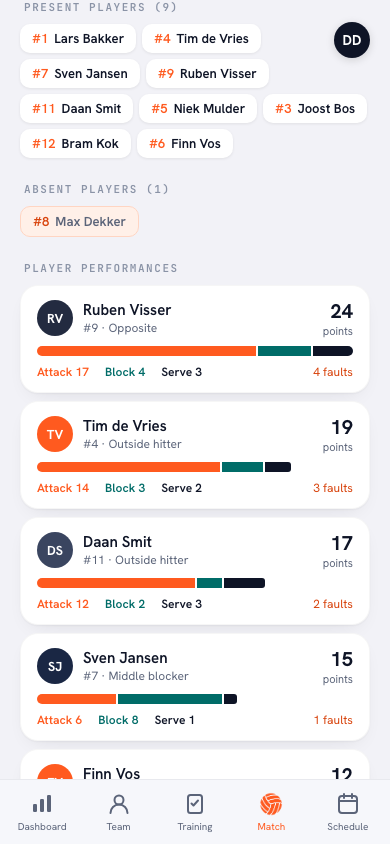
- Simply there, and visibly there. The simplest and the most underrated. Leave her in the team app and let her sign up per match as somebody who is coming to watch; the I'll watch button exists for exactly this: she does not count as a player, but she is on the list. Taking somebody off the list is, in practice, the moment she is really gone.
Make it two or three of these, not six. And agree that the role lapses the moment she wants it to, without explanation. A job that becomes an obligation is just as damaging as no job at all.
What you arrange outside the hall (and what differs per federation)
This is where coaches get stuck on something that is not their job. The administrative side — eligibility to play, insurance, membership and fees — differs per federation and per club. There is no general rule you can copy, and a wrong answer costs somebody money or cover. Ask, and ask once.
Send the secretary or the membership administration a single email with four questions. One: can the membership be temporarily converted or paused, and from what date? Two: does the federation's accident or liability cover still apply to somebody who is in the hall but not playing? Three: does she have to come off the team registration, and if so from when and with what consequences if she returns later? Four: if she sits on the bench as a team official or scorer, does she have to be registered somewhere for that? Then put the answer in your team agreements, so the next coach does not have to work it out again — see making team agreements.
Practical points in the hall
A few things that cost little and make a lot of difference, and that you simply arrange without making a topic of them:
- She stops without asking. Agree in advance that she can stop in the middle of a drill, without explanation and without putting a hand up. As long as stopping is a request, somebody carries on too long.
- Drinking and breaks. Her own bottle within reach instead of in the bag at the side, and more short interruptions rather than one long one.
- Toilet close by and without permission. Sounds trivial, isn't.
- Net discipline from the rest of the team. Not stepping under the net during playing formats is the rule for everybody, but this is the moment to enforce it. It keeps the landing zone under the net clear, and that is exactly where most ankle injuries happen — see injury prevention.
- Never impose a position. Exercises on the back, abdominal work, standing still for long stretches: let her say what feels uncomfortable and adapt the format without turning it into a discussion.
- Strength work is a matter for her own care providers, not for your programme. If strength or stability is being worked on, then on the instruction of a physiotherapist or midwife — not in the team schedule.
The return: reverse order, no deadline
The return is the part where most mistakes are made, and the pattern resembles a return after an injury: it is going well, the team needs her, and before you know it she is training fully and playing as well. When she may start is decided by the doctor or midwife, and that moment depends among other things on how the birth went. The fixture list plays no part in it whatsoever.
What you can plan is the order, and that runs in reverse compared with the list this article started with. Work in blocks, not in dates:
- Block 1 — technique without jumping and without falling. Serving, setting, passing off a tossed ball. The aim is to get rhythm and ball contact back, not fitness.
- Block 2 — jump back in, landing controlled. First block jumping on the spot and landing on two feet, only then the approach. No six-versus-six yet and no situations where somebody is standing in her landing zone.
- Block 3 — full practice, and only after that match minutes. Start with one set, not with a whole match. Diving and falling come back last, exactly as they went first.
Two things not to underestimate along the way. The first is the load outside the volleyball: fitness is often back sooner than a regular night's sleep. Expect irregular attendance and don't make an issue of it — a player who has to justify herself three times for calling off will call off entirely the fourth time. The second is the head. The first hard ball in her direction is a moment, and so is the first dive back onto the floor. That is about nerve, not about form, and it recovers through small, successful repetitions rather than through one hard match. How to build that up is in rebuilding a player's confidence.
Finally, give her a broad horizon instead of a target date. "We'll see where you are in January" works; "in eight weeks you'll be back in the starting six" is a promise you cannot keep.
Key point: the medical decision belongs to the doctor or midwife — your job starts after that. Translate their advice into concrete actions that drop away, give her two roles with a name, and leave her on the team list. Players rarely disappear through a decision; they disappear because nothing gets agreed.
Frequently asked questions
Can you play volleyball while pregnant?
There is no general yes or no to that: your doctor or midwife assesses it, based on your situation and how the pregnancy is going. What makes volleyball specific is not the exertion but the risk of falling and collision: diving, landing under the block and hard balls from close range are the elements to raise explicitly in that conversation.
From which week do I have to stop playing matches?
There is no fixed week to point at and it differs greatly from person to person. In practice actions drop away in an order: first diving and falling, then block jumping and landing, then fast lunges in defence, and last the approach. The match format combines all of those, so it drops away as soon as one of the earlier points does; that is why many players stop playing matches before they stop training.
As a player, do I have to tell my coach?
You decide for yourself when you tell people and whom you tell. Practically speaking, though: the sooner your coach knows, the sooner they can adapt drills and arrange a role for you. That takes no medical information at all, only what you do and don't want to do and whether it may be shared with the team.
What may I record about this as a coach?
Only what you need in the hall: which drills drop away and who knows. No diagnoses, no dates, no details, and nothing passed on to anyone else without her permission. The same rule as for all health information in your team, set out in the article on collecting player details.
Does she have to be deregistered with the federation or the insurer?
That differs per federation and per club and it is not a coach's job. Send the membership administration an email with four questions: can the membership be temporarily converted, does the cover still apply to somebody who isn't playing, does she have to come off the team registration, and does she have to be registered if she sits on the bench as a scorer or team official.
How long before she can play again after the birth?
There is no number of weeks for that, and the starting moment is decided by the doctor or midwife, partly depending on how the birth went. The build-up after that runs in reverse order: first technique without jumping and without falling, then jumping and landing, then full practices and only after that match minutes, starting with one set.


Try it yourself in Koach
Less admin, more coaching.
Get started with KoachOr read first what the volleyball coaching app does.