What Does an Opposite Hitter Do in Volleyball?
The opposite is the position that gets explained least and used wrongly most. She never passes, she always plays on the right and she gets the hardest balls of the match. This is what is really being asked of her.
Where the opposite stands and why she is called that
The name is meant literally: the opposite stands opposite the setter in the rotation, three positions away. That has one important consequence — if the setter is in the back row, the opposite is in the front row, and the other way round. So exactly one of the two is at the net at any moment. You will also hear 'right side' or simply 'the oppo' in the gym.
Where the other volleyball positions often have two faces, the opposite is the most specialised of them all: she does not pass, she does not set when things are going well, and she has one clear assignment — score points from the right.
Job 1: attacking from the right, and from the back row
Her main job is the attack from P2. That is technically the hardest corner of the court for a right-handed player: the ball comes from her right side, so she has to reach across her body or contact it early. Which is exactly why left-handed players make ideal opposites — for them the ball on the right sits as naturally as it does for a right-handed outside hitter on the left.
On top of that she is often the fixed back-row attacker: when she is at P1 she hits from behind the ten-foot line, which gives you an extra threat in the rotations where your setter is in the front row and you only have two hitters at the net.
And one job that rarely gets named: she is the release valve. When the pass is poor and a high ball has to go somewhere, it goes right just as often as it goes left — and an opposite who can only score off a perfect pass is half an opposite. See also playing out of system.
Job 2: blocking their best outside hitter
Because she plays at P2, she is directly across from the opponent's P4 — and at virtually every team that is the go-to outside hitter who gets the most balls. So the opposite is your most important blocker against their most important attacker, in every rotation she is in the front row. That makes height and blocking technique at least as important for this position as hitting power: an opposite who cannot block leaves the busiest part of the net unguarded.
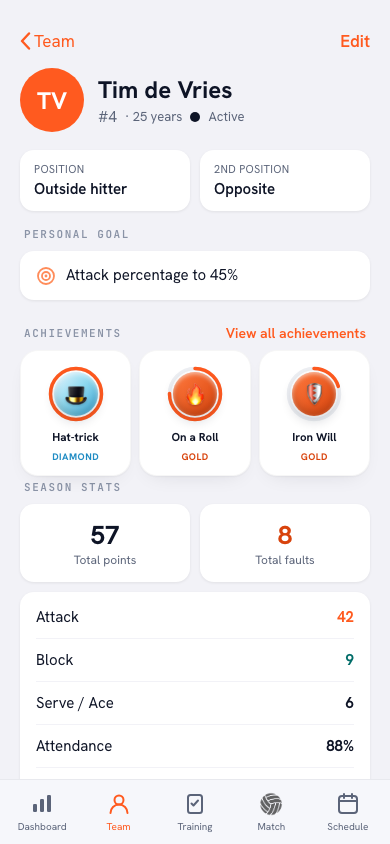
Set the position on the player's profile in Koach and her attack percentage and block points are tracked as a right-side attacker from the first match.
Job 3: the second setter
The opposite is the logical stand-in for the setter in every system. The reason is purely geometric: the moment the setter is in the back row and has to dig the first ball, the opposite is in the front row on the right — exactly where the second ball needs to be played. In a 5-1 that is the standard agreement, and it saves you a handful of rallies a match that would otherwise end in panic. So teach your opposite to set overhead, even if she only does it three times a set.
Why she almost never passes
In most teams the opposite stays out of serve receive entirely. That is not a luxury but arithmetic: she is on the right-hand side of the court while her approach has to come from outside right, and every ball she passes costs her that approach. Keeping her out means you have at least one hitter in every rotation who can take her full approach without a detour. How to make that work inside your formation is in serve-receive formations.
What to look for in an opposite
- Consistency over spectacle. She gets the hard balls; a hitter who only scores off a perfect set is unusable in this position.
- Blocking quality. She stands across from the opponent's best hitter — that weighs more than the last ten centimeters of jump.
- A short approach. There is less room on the right than on the left; a player who cannot shorten her approach is structurally late.
- A calm head. The opposite statistically makes the most errors on the team, simply because she gets the heaviest balls. A player who sinks because of that does not belong here.
How to train her
Give her bad balls on purpose. Set up a series in which three of every five sets are too low, too far off the net or too tight, and count only whether the ball goes into the court under control. Train two things that are often forgotten as well: the back-row attack — from P1, with a real approach — and setting overhead to the left, so she can handle the second ball. Finally, measure her attack percentage separately from your outside hitters': an opposite sitting at 25 percent is often doing better than an outside at 30, because the balls she gets are of a completely different order.
Put your left-handed player at opposite. It is the cheapest positional upgrade there is: the same player suddenly hits in front of her body instead of across it on the right, and her angle into the deep corner opens up by itself.
Frequently asked questions
What is the difference between an opposite and an outside hitter?
The opposite attacks from the right and stays out of serve receive; the outside hitter attacks from the left and does pass. That makes the opposite an attacking specialist and the outside the most complete player on the team.
Why is the opposite called the opposite?
Because she stands opposite the setter in the rotation, three positions away. If the setter is in the front row, the opposite is in the back row — and vice versa.
Does the opposite need to be able to set?
Yes, at least at a basic level. When the setter has to dig the first ball, the opposite is the player standing in the right place to play the second one. A few times a set is enough to save rallies.
Is a left-handed player really better in this position?
Often yes. On the right, the ball comes in front of a left-hander's body instead of behind it, so she can contact it earlier and has more angles. It is not a requirement, but it is a free advantage.