
Opposite hitter drills: five forms for attack, back row and block
The short answer
Good opposite hitter drills train five things: attacking from the right on a set coming from the left, the back-row attack from position 1, blocking the opponent's outside hitter, the emergency set as a second setter, and side-out in the rotations where the opposite is in the front row.
Opposite hitter drills are rare at many practices. The hitting lines are on the left, the scrimmage keeps going and the player on the right mostly gets high balls. Here are five drills with time, scoring and corrections, plus how to see whether they pay off.
Why the opposite gets so few balls of their own in practice
On a normal practice night the hitting lines are almost always at position 4, where the setter sets forward. The opposite joins that line. What they do in a match, attacking from the right and from the back row, blocking the other team's best hitter and playing the second ball, rarely gets its own time. What the role involves is in what an opposite hitter does, and how it differs from the outside hitter in outside hitter vs opposite. This article is about the drills.
The five drills build on each other: first the attack from the right on its own, then from the back row, then the block, then the ball that goes wrong, and finally the game form. Pick two per practice. The target numbers in the drills are our own examples: adjust them to your team's level.
Drill 1: attacking from the right on a set from the left (15 min)
Setup: setter in their spot between positions 2 and 3, a tosser at position 6 who tosses with an arc as if it were a pass, and the opposite starts outside the right sideline at their approach spot. Balls at the side, no block at first.
How it works: fifteen balls to position 2, about half a meter inside the antenna. The opposite starts the approach outside the court, so the ball arrives in front of them and not over their head. For a right-handed player the set comes from their left side and has to travel across the body to the hitting arm; have them choose their approach so they contact the ball in front of the hitting shoulder, not above the head. A left-handed opposite has less trouble with this.
Scoring: how many balls they hit at the highest point with a straight arm, and how many of those land in the court. An example of a target: once they manage that on ten of the fifteen, add a blocker.
Variation: have the tosser throw some of the balls too far off the net or too far to the left, so the set gets worse too. That is the ball an opposite often gets in a match. Then only count whether they hit the ball into the court under control. Hitting direction, line or cross-court, is not trained here: that technique is in hitting line or cross-court.
In the Koach library, the back set to the right is part of the drill Around the world 4-3-2: two players and a coach, twelve phases, with the hitter attacking from positions 4, 3 and 2 in a row.
Drill 2: the back-row attack from position 1 (15 min)
When the setter is in the front row, the opposite is in the back row and you only have two attackers at the net. A back-row attack from position 1 turns that into three again. The rules allow it as long as the player's foot does not touch or cross the attack line at take-off; after the hit they may land in the front zone (rule 13.2.2 of the FIVB Official Volleyball Rules).
Setup: setter in their spot, tosser at position 5, the opposite starts deep in the court at position 1. A player or coach stands next to the attack line and watches only the take-off foot.
How it works: twelve balls. The setter sets a little flatter than a high ball, to a point about a meter behind the attack line, above position 1. The opposite takes off behind the line and hits through the ball, deep into the court.
Scoring: a ball only counts if the take-off was behind the line and the ball lands in the court. Taking off on or over the line is a fault in a match and counts as zero here. How the approach and the take-off spot work technically is in the back-row attack.
Correction: a player who takes off too close to the line starts their approach further back.
Drill 3: blocking their outside hitter (12 min)
In the front row the opposite is at position 2, across from the opponent's position 4. That is where many teams send most of their balls. An opposite who does not block leaves that part of the net open. A back-row player may not take part in a block that touches the ball (rule 14.6.2 of the same rules), so this drill belongs with the rotations in which the opposite is in the front row.
Setup: on the other side, two lines of hitters at their position 4 with a setter; on your side, the opposite at position 2 and a middle blocker at position 3.
How it works: the middle blocker slides over and closes next to the opposite, who holds the outside of the block, so the line is shut and there is no gap between them. Ten attacks, then switch middle blockers. This form is in the library as Closing the double block: two players, six phases, with the outside blocker at position 2. Start with it without hitters, so the closing is right first.
Scoring: for every ten attacks, tally block points and touches after which your team could still play the ball. A touch that slows the attack wins rallies too.
Variation: after landing, the opposite turns, moves off the net and immediately calls for a set for their own attack. That way you practice block and attack in one sequence, as in a match.
Drill 4: the emergency set as second setter (12 min)
When the setter plays the first ball, the opposite is often closest to where the second ball has to be played. They do not need to become a setter, but they must be able to give a high, hittable ball to position 4.
Setup: the coach stands on the other side and hits or throws a ball at the setter, who is defending in the back row. The opposite is in the front row on the right, an outside hitter at position 4.
How it works: the setter digs the ball up toward the middle, the opposite calls it, gets under it and sets it high, overhead, to position 4. If the ball is too low for an overhead set, a high forearm pass. Ten balls, then the outside hitter rotates out. As a base you can use the library drill Out-of-system setting and attacking: two players, six phases, in which the libero sets; put the opposite in the role of the player who sets.
Scoring: the outside hitter rates each set: 2 is a ball they could take a full approach on, 1 a ball they could still get over, 0 a ball nothing could be done with. As an example of a target: fifteen points from ten balls.
Have them call before they move. Most emergency sets do not go wrong on the set itself, but on two players arriving at the same time or both staying put. Agree that the opposite calls 'mine' as soon as the setter touches the first ball, and have the outside hitter start looking for their approach only after that.
Drill 5: side-out with the opposite in the front row (20 min)
Setup: six against six, or your receiving six against a line of servers. Start in one of the three rotations in which the setter is in the back row, and the opposite is therefore in the front row.
How it works: serve, pass, set, attack. The receiving team plays ten rallies per rotation and then moves on to the next rotation with the opposite in the front row. The library has this form as Side-out per rotation: seven players, six phases, moving one rotation on after each completed side-out.
Rule: a side-out counts double if it went through the opposite, from the front row or the back row. That way the setter really has to look for them, even when the pass is not perfect.
Variation: the same form in the three rotations with the setter in the front row. Now the opposite is in the back row and their attack is the back-row attack from drill 2.
How it fits into a practice, and what it asks of the legs
Two forms per practice, about half an hour together, is enough if it comes back every week. A workable split: drill 1 or 2 in the technique block while the outside hitters do their own series, drill 3 in the blocking block with the middles, and drill 5 as the game at the end. Drill 4 fits with any defensive drill. How to build an evening like that is in running a volleyball practice.
Drills 1, 2 and 3 are jump-heavy. Do not put them all on the same night, and not on the day after a match. If a player has knee, back or shoulder complaints that do not go away after a few practices, have them assessed by a doctor, sports physician or physiotherapist.
How to measure whether your opposite is improving
Their number of points says little, because they get the hardest balls. Look at three things:
- Efficiency by type of ball. How often do they score after a good pass, and how often after a bad one? An opposite who keeps the ball in the court after a bad pass is doing their job, even if they score less then.
- Side-out in the rotations with them in the front row. Compare those three rotations with the other three. If your team wins the serve back more often there after a few weeks of drill 5, it is working.
- Block touches. For a whole match, tally by hand how often they touch the ball at the block, not just their block points.
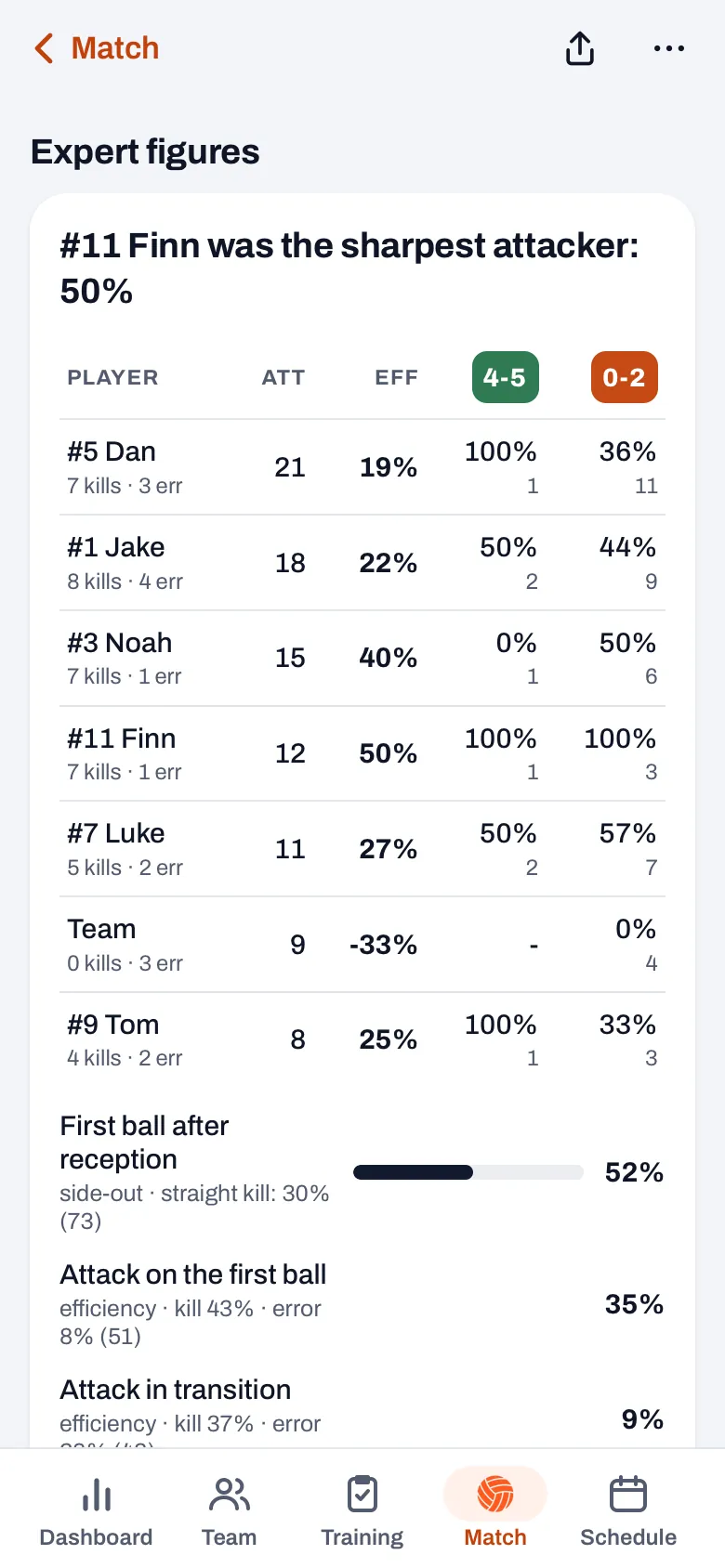
If you track a match in Koach in Expert mode, you rate every touch from 0 to 5. Afterward, Expert figures shows for each attacker the attempts, the efficiency and how often they scored after a pass of 4 or 5 and after a pass of 0 to 2. Below that you see the efficiency of the attack on the first ball and in transition.
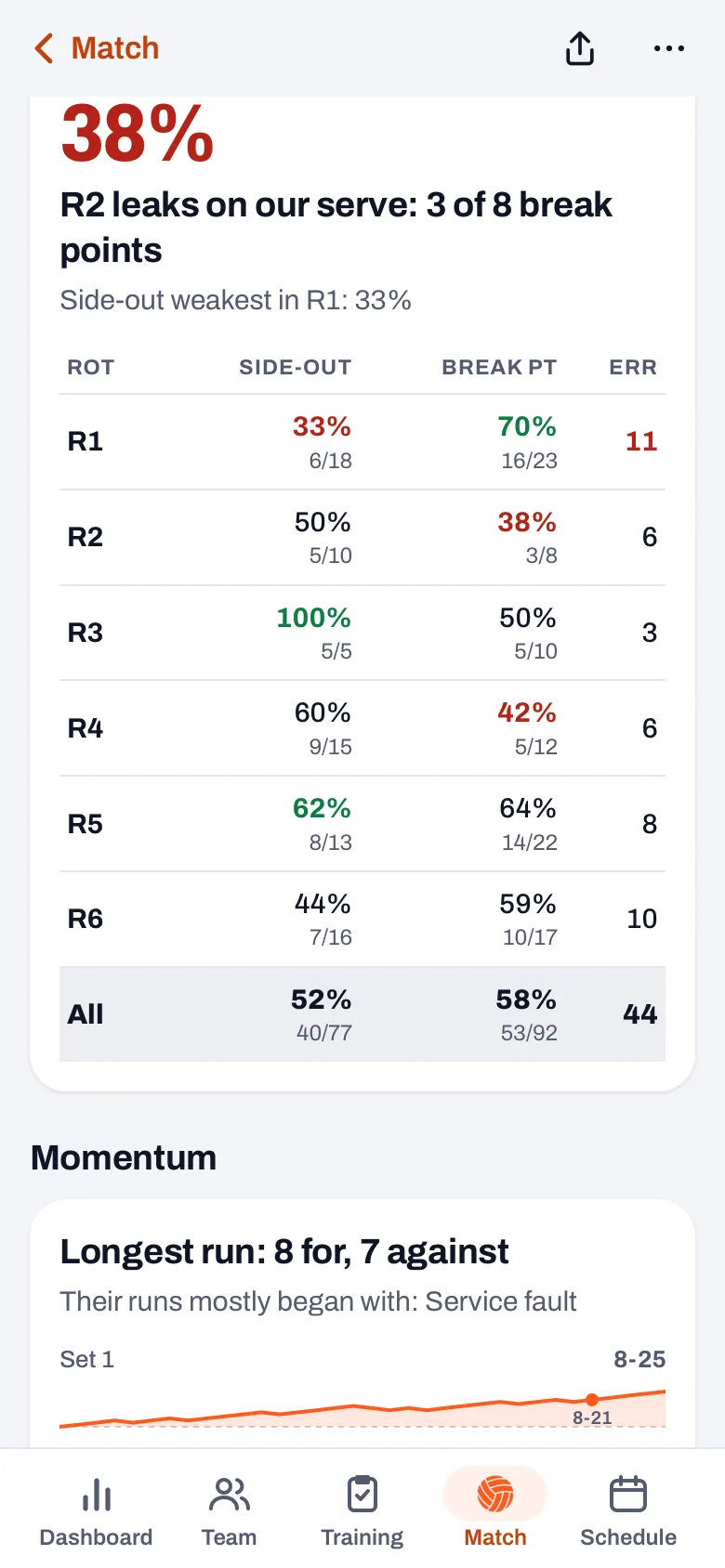
The match stats also include a table with side-out and break point per rotation. There, R1 is the rotation with the setter at position 1, R2 with the setter at position 6 and R3 with the setter at position 5. In a 5-1 the setter is in the back row in R1, R2 and R3, and your opposite is in the front row. How to read that table is in side-out and break point by rotation. The table also works in Simple mode.
14 days free, no credit card. Track your next match in Expert and see whether your opposite also scores after a bad pass.
Try Koach with your teamWhat Koach costs after the trial is on the pricing page.
Frequently asked questions
How do you train an opposite hitter in volleyball?
Give them balls of their own: attacking from the right on a set coming from the left, the back-row attack from position 1, blocking the opponent's outside hitter, and the second ball when the setter plays the first. Finish with a side-out drill in the rotations where they are in the front row. Two of those forms per practice, every week, does more than one long evening.
Why is attacking from the right harder for a right-handed player?
Because the set comes from the left and first has to travel across the body to the hitting arm. So they start the approach outside the court, which lets them contact the ball in front of the hitting shoulder instead of above the head. A left-handed player has less trouble with this, because the ball then arrives on the side of the hitting arm.
Can an opposite in the back row attack?
Yes, from behind the attack line. Under the FIVB rules a back-row player may attack at any height as long as their foot does not touch or cross the attack line at take-off; after the hit they may land in the front zone. A back-row player may not block. Whether youth competitions have other rules varies by federation.
Does an opposite need to be able to set?
A little, yes. When the setter plays the first ball, the opposite is often closest to where the second ball goes. They then need to be able to give a high, hittable ball to position 4, overhead or with the forearms. Train it with a few balls a week and agree that they call as soon as the setter touches the first ball.

See what your opposite does with difficult balls
14 days free, no credit card. After one match in Expert you see their efficiency by type of pass.
Get started with KoachOr read first what the volleyball coaching app does.