
Yoga for volleyball players: six poses for hips and shoulders
The short answer
Yoga for volleyball players is a useful extra: in small studies, athletes, volleyball players among them, became more flexible and more stable. Six poses target the hips, shoulders and ankles that work hardest in the gym. Do it after practice or on a rest day; it does not replace strength training or a warm-up.
Yoga for volleyball players sounds like something for the off-season, but two short sessions a week also fit during the season, aimed at the hips, shoulders and ankles that work hardest in the gym. Here you read what yoga does and does not give a volleyball player, six poses with instructions, and where it fits in your week.
Is yoga good for volleyball players?
The research is small, but it points one way. Polsgrove and colleagues (International Journal of Yoga, 2016) had 14 soccer players from an American university do an hour of yoga twice a week for ten weeks on top of their normal training, compared with 12 baseball players without yoga. Afterward the yoga group scored better on a sit-and-reach test, on shoulder flexibility and on a single-leg balance test; the group without yoga did not change on those. The groups did come from two different sports, though, and were not assigned at random.
For volleyball players there is a randomized study by Erkan Özalp and colleagues (Journal of Sports Medicine and Physical Fitness, 2025). 26 players aged 18 to 26 kept up their normal training; by random assignment, one group added yoga twice a week, the other group strength exercises. The yoga group improved more in flexibility, balance, endurance and serving accuracy. The title of the study mentions injury risk, but injuries themselves were not counted. A review of track and field athletes (Singh and colleagues, 2025) also found better flexibility and balance, with less anxiety and tension in some of the studies, but rated the quality of the research as moderate.
In short: yoga probably makes you somewhat more mobile and stable. That it prevents injuries in volleyball has not been shown.
What does yoga do differently from stretching?
In regular static stretching you hang relaxed in a position. In yoga you hold a pose actively: you push the floor away, brace your core and keep breathing calmly. That way you work on range of motion and on control within that range, and often on several joints at once, such as ankle, hip and shoulder in one pose. On top of that, the steady breathing forces you to do nothing else for a moment, which many players appreciate after a busy week. When to just stretch, and which stretches a volleyball player does, is in volleyball stretches.
Six yoga poses for volleyball players
Hold each pose for five to eight slow breaths, on both sides for the one-sided poses. Altogether that takes ten to fifteen minutes. You do not have to reach the full position anywhere: go as far as you feel a stretch, not pain.
1. Downward dog: calves, ankles and shoulders
Start on hands and knees, tuck your toes and push your hips up and back until your body forms an upside-down V. Push the floor away with your hands, let your head hang between your arms and sink your heels toward the floor. Feel free to bend your knees if your back would round otherwise. You stretch the calves and Achilles tendons that work on every landing, and your arms are overhead, as in the block.
2. Low lunge with arms up: the hip flexor of your take-off leg
Step into a lunge, put your back knee on a mat and shift your hips forward until you feel a stretch at the front of the back hip. Then bring your arms straight up and reach for the ceiling, without arching your lower back. A hitter is in exactly that line at contact: hip extended, arm high. Do both sides, even though your arm hits on one side.
3. Pigeon: glutes and the outside of the hip
From downward dog, bring one knee forward behind your wrist, with your shin at an angle under your body and your back leg stretched out behind you. Keep your hips square and lower them, and come down onto your forearms if you can. You feel it in the glute and the outside of the hip of the front leg. If your knee is sensitive, do the lying variation on your back, with your ankle on the other knee.
4. Deep squat: ankles and hips
Place your feet a little wider than your hips, toes turned out slightly, and sink as deep as you can with your heels on the floor. Press your palms together in front of your chest and use your elbows to push your knees out gently. If your heels come up, put a rolled-up towel under them. A volleyball player who can sink deep with their heels on the floor is lower and more stable in defense.
5. Puppy pose: shoulders and upper back overhead
Start on hands and knees and walk your hands forward, while your hips stay above your knees. Let your chest sink toward the floor, with your arms straight. You feel it under your armpits and in your upper back. You need that range to hit and block overhead without your lower back taking over.
6. Thread the needle: rotating from the upper back
Start on hands and knees and slide your right arm under your left arm to the left, until your right shoulder and cheek rest on the floor. Your left hand stays on the floor or reaches up. Come back and switch sides. You rotate from the upper back and stretch the back of the shoulder, the part that does the braking on every hit.
Flexible enough already? Then go easy on the shoulders. Some players are naturally very mobile, especially in the shoulders. For them, extra range is worth little: have them do the poses mainly to hold them actively, not to sink deeper. If you have pain in your shoulder, hip or back that persists or gets worse, see a doctor, a sports physician or a physical therapist before you start yoga.
When do you do yoga in the week?
The studies above used two to four sessions a week, two for the volleyball players. Twice a week is a reasonable start. Three moments work well:
- After practice, as a short, fixed ten-minute cool-down. Your muscles are warm and the poses come more easily.
- On a rest day, at home, a full twenty-minute sequence. Calm, without it turning into an extra workout.
- During a break or the summer, to keep up your mobility while you spend less time in the gym.
Do not do yoga instead of your warm-up, and not with long, relaxed poses right before a match. Why holding still for a long time right before jumping is not a good idea is in the article on stretches. An example week: Tuesday practice with ten minutes of yoga afterward, Thursday practice, Saturday match, and twenty minutes of yoga at home on Sunday or Monday.
Why yoga does not replace strength training or a warm-up
A volleyball player often lands hundreds of times a week, and those landings are absorbed by muscles and tendons that you make stronger with heavier loads that you increase step by step. Yoga uses your own body weight and holds positions; it does not increase the load systematically. In a meta-analysis of 25 randomized studies, strength training and balance training reduced the number of sports injuries, while stretching did not (Lauersen and colleagues, 2014). So yoga comes on top of strength training for volleyball players, not instead of it. For the core and balance there are dedicated drills in core exercises for volleyball and proprioception exercises.
The warm-up also does something different: it raises your heart rate and temperature and gets you ready to jump and hit with dynamic movements and ball work. How to build one is in building a good warm-up.
Yoga in your practice plan
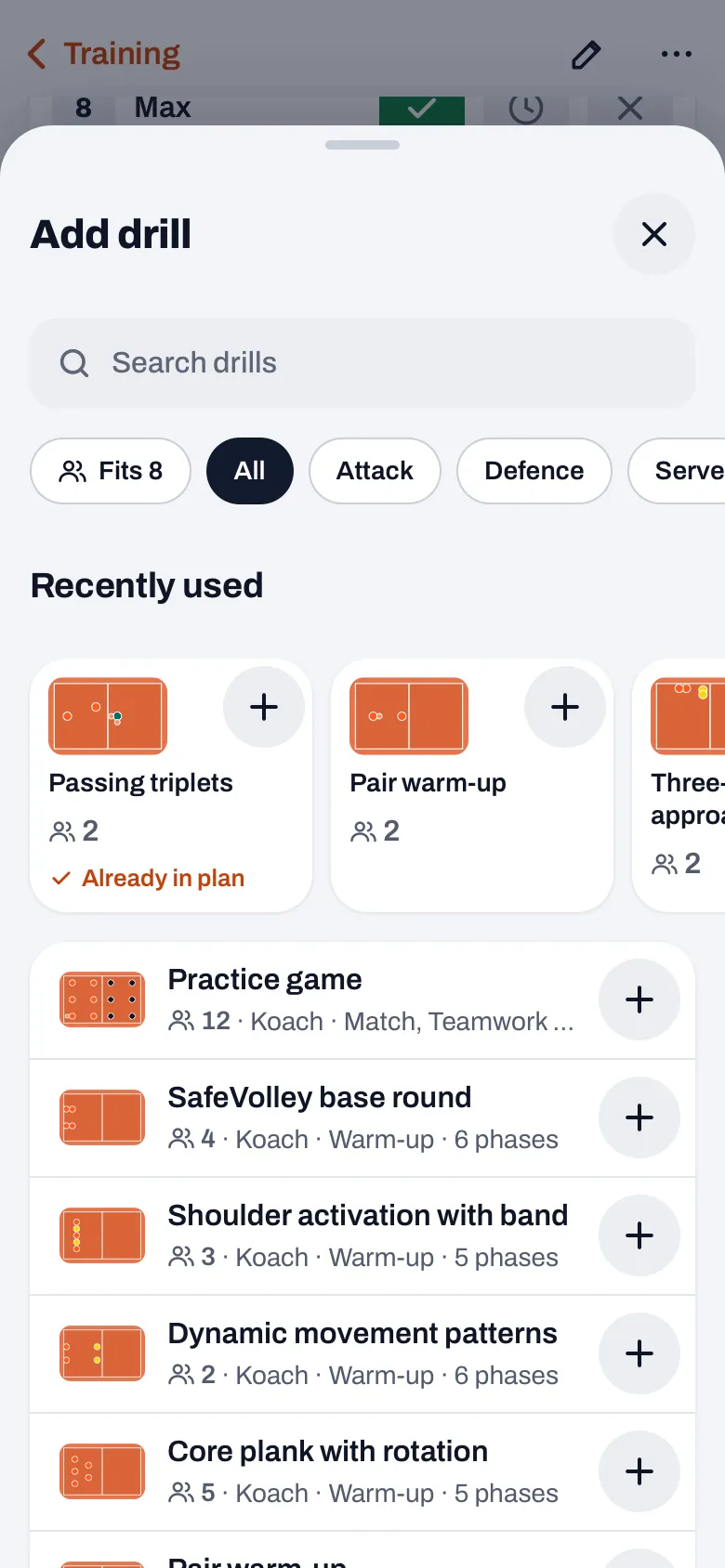
If you want to do yoga with your team, put it in as a fixed block at the end of practice. In Koach, tap + Add section under Plan, name it Yoga and choose ten minutes; with Add description you add the six poses. For the start of practice, under + Add drill you find animated warm-up drills such as Dynamic movement patterns and Shoulder activation with band. That way the warm-up and the yoga each have their own place in the same plan.
What else to set up in your first season as a coach is in starting as a volleyball coach. What Koach costs after the 14 free days is on the pricing page.
14 days free, no credit card. Add a yoga block at the end of your next practice and take the plan along every week.
Try Koach with your teamFrequently asked questions
Is yoga good for volleyball players?
As an extra, yes. In small studies, athletes became more flexible and more stable on one leg after ten weeks of yoga. In a randomized study of 26 volleyball players, the group that did yoga twice a week improved more in flexibility, balance, endurance and serving accuracy than a group doing strength exercises. The research is small, and injuries were not measured.
Which yoga poses are good for volleyball players?
Choose poses for the ankles, hips and shoulders, the joints that work hardest in jumping, landing and hitting. Good choices are downward dog, the low lunge with the arms up, pigeon, the deep squat, puppy pose and thread the needle. Hold each pose for five to eight breaths, on both sides.
Can yoga prevent volleyball injuries?
That has not been shown. In the studies with athletes, injuries were not measured. A meta-analysis of 25 randomized studies did find that strength training and balance training reduce sports injuries, and stretching does not. So do yoga alongside strength training and a good warm-up, not instead of them.
Should you do yoga before or after volleyball practice?
After practice or on a rest day. Before practice and before a match you need a warm-up that raises your heart rate and gets you ready to jump with dynamic movements and ball work. Long, relaxed poses do not belong there. After practice your muscles are warm and the poses come more easily.



Make yoga a fixed block in your plan
14 days free, no credit card. After a month your plans show how often you really did it.
Get started with KoachOr read first what the volleyball coaching app does.