
Volleyball stretches: dynamic before, static after
The short answer
Volleyball stretches before practice are dynamic, as part of the warm-up, and static ones belong after practice or at a separate time. Short static stretching barely costs jumping power, long stretching just before jumping does. Against injuries, strength training helps more than stretching.
Every locker room has its own opinion on volleyball stretches. One player hangs in a hamstring stretch for thirty seconds before the warm-up, another never stretches. Research gives a clear answer on when to do what, and that answer is milder than people often think.
Dynamic or static stretching: what is the difference?
In static stretching you take a muscle to the point where you feel the stretch and hold that position, usually for 15 to 60 seconds. In dynamic stretching you move a joint through its range of motion in a controlled way, with a bigger range on each rep: leg swings, lunges with rotation, arm circles. There is also PNF stretching, where you briefly contract the stretched muscle and then stretch further, often with a partner. That works well for mobility, but like long static stretching it does not belong just before explosive work.
| What | Dynamic | Static |
|---|---|---|
| How | Moving, 6 to 10 reps | Holding still, 20 to 30 seconds |
| When | In the warm-up | After practice or at a separate time |
| Jumping power straight after | The same or slightly better | Short: hardly any effect. A minute or longer: lower |
| Goal | Being ready for practice | More mobility in the long run |
What does research say about stretching?
Jumping power. A review by Kay and Blazevich (2012) pooled 106 studies on static stretching just before a strength or power task. Stretching shorter than 30 seconds had no negative effect, and neither did 30 to 45 seconds; only from about 60 seconds per muscle group did a drop become likely. A later review by Behm and colleagues (2016) found the same pattern: on average 1.1 percent less performance with less than 60 seconds of stretching per muscle group, and 4.6 percent less with 60 seconds or more. Important for the gym: when dynamic work followed the stretching, there was no clear effect left in those studies.
Injuries. In a meta-analysis of 25 randomised trials with more than 26,000 athletes, Lauersen and colleagues (2014) found no protective effect of stretching. Strength training and balance training did clearly reduce the number of injuries. So stretching is not injury prevention in itself; for that, look at strength training for volleyball players and at injury prevention in volleyball.
Muscle soreness. A Cochrane review by Herbert and colleagues (2011) concluded that stretching, before or after exercise, does not noticeably reduce muscle soreness in the days that follow. If you stretch after practice to feel less stiff tomorrow, you mostly do it for the feeling. That is fine, but it is not a recovery technique.
Mobility. Here stretching does work. After a single stretching session the gain is usually gone within half an hour, according to Behm and colleagues, so if you want more range for good, you stretch regularly. The position stand of the American College of Sports Medicine recommends stretching exercises for the major muscle groups at least twice a week for adults, with a total of 60 seconds per exercise.
Let a player keep their usual stretch. If someone only feels ready after a hamstring stretch, that is fine: keep it under 30 seconds per muscle group and follow it with the dynamic work and the jumps as usual. That way it costs no jumping power and you keep the debate out of the warm-up.
Dynamic stretches for the warm-up
Together, these eight exercises form the mobility part of the warm-up: after raising the temperature, before the jumping and hitting. How that part fits into the whole structure is in building a good warm-up with the RAMP method. Count on four to five minutes. Start each exercise small and make the movement bigger with every rep.
- Leg swings forward and back, with one hand on the net post or the wall: 10 per leg.
- Leg swings sideways, across in front of the standing leg: 10 per leg. Good for hips and groin, which work hard in block footwork.
- Lunge with trunk rotation: step out, rotate your trunk towards the side of the front leg, come back and switch. 6 per side.
- Lateral lunge: stand wide, shift your weight to one side and sink low, then to the other side. 6 per side.
- Inchworm: from standing, walk your hands out to a push-up position and take small steps back towards your hands. 5 times.
- Lunge with elbow to instep, also known as the world's greatest stretch: lunge, elbow to the inside of the front foot, then rotate the arm open towards the ceiling. 4 per side.
- Arm circles and cross swings: big circles forwards and backwards, then cross the arms in front of the chest and swing them open again. 10 of each.
- Calf and ankle: one foot a step back, keep the heel on the floor and push the knee of the back leg forward. 8 per side.
Start the arm circles calmly and only go full speed at the end. The hitting itself, first controlled and then fuller, comes after that; it prepares the shoulder for the spike better than any stretch.
Static stretches after practice
After practice, when the muscles are warm, static stretching is in its place. Hold each position for 20 to 30 seconds, twice per side: that gets you to the 60 seconds per exercise from the ACSM position stand. Stretch until you feel tension, not pain, and keep breathing calmly. These seven target the muscles that work hardest in volleyball:
- Calf: hands against the wall, back leg straight, heel on the floor. Then the same position with the back knee slightly bent, for the deeper part of the calf.
- Hamstring: sitting with one leg straight, bend forward from the hip with a straight back.
- Hip flexor: half kneeling, tilt the pelvis slightly and push the hip of the back leg forward.
- Front of the thigh: standing, heel to your buttock, knees side by side.
- Glutes: on your back, ankle on the other knee (a figure four) and pull the lower leg towards you.
- Back of the shoulder: pull the arm horizontally across the chest with the other hand. A regular exercise for players who hit and serve a lot.
- Chest and front of the shoulder: forearm against a door frame or the net post, and slowly turn the chest away from the arm.
That takes ten to fifteen minutes. If it does not fit after practice, do it at home on two or three evenings a week. For mobility it does not matter where you stretch, as long as you do it regularly. How stretching fits into the rest of the end of practice is in cool-down and recovery.
Who needs extra stretching work?
Not every player needs to stretch the same amount. Look mainly at players who cannot keep their heels on the floor in a deep squat, attackers with a stiff hip flexor and shoulders that rotate less far on the arm swing than the other side. For them a fixed stretching moment of a few minutes a day makes more sense than a quarter of an hour with the whole team.
Pain is a limit. If a stretch hurts instead of pulls, or a shoulder or knee has been stiff for weeks, have a physiotherapist or sports physician take a look. Stretching is not a treatment for a complaint, and with a sensitive shoulder the wrong exercise can make things worse. More about that shoulder is in shoulder problems in volleyball.
Stretching as a fixed part of your practice plan
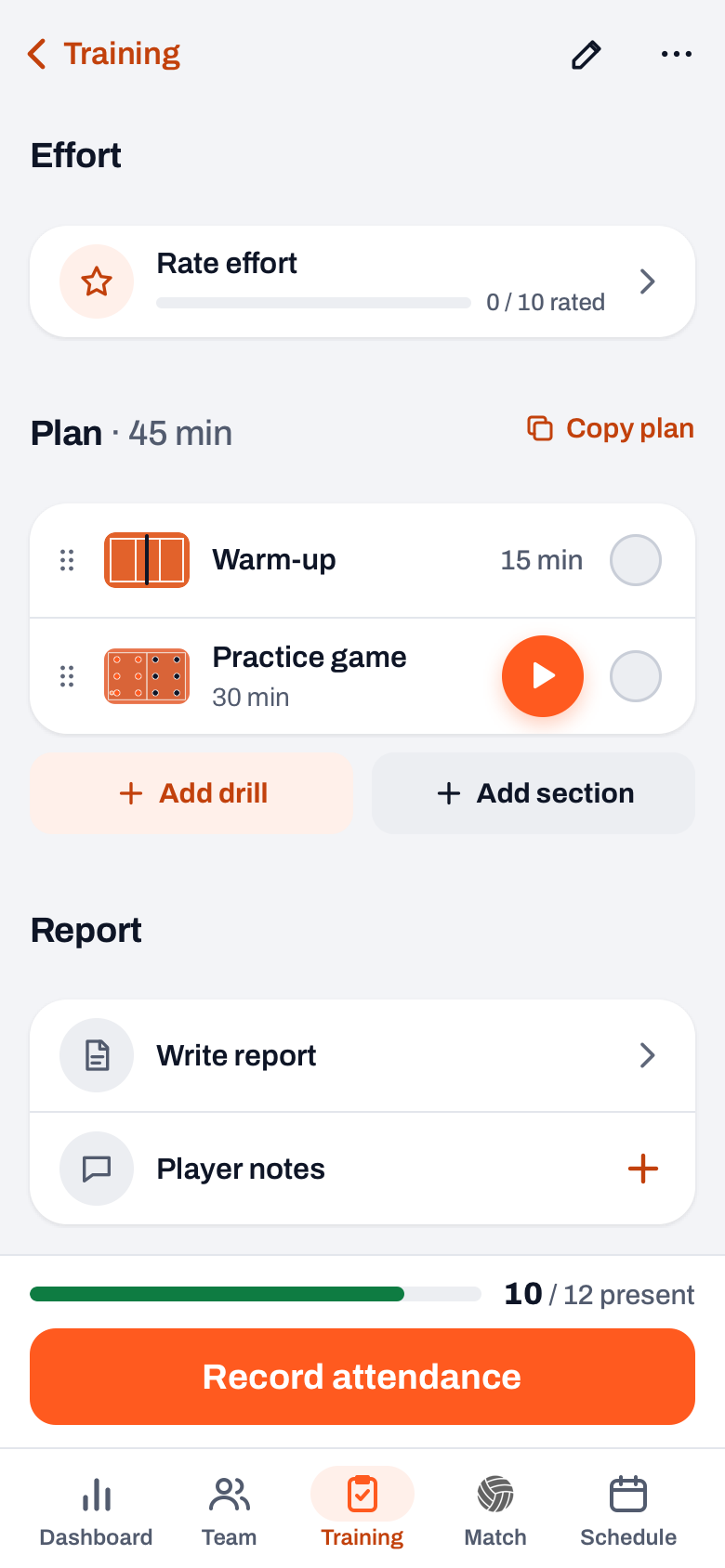
A routine only works if it is the same at every practice, even when another coach is in front of the group. In Koach you put the warm-up as the first section in the plan of a practice, with its duration. With + Add drill you pull drills from the library, such as Dynamic movement patterns (lunges with trunk rotation, carioca and skips) or Cool-down and stretch for the end. Then save the plan as a template; at the next practice you put it all back at once with Copy plan, even when a colleague takes over the session. A fixed routine like that saves a new coach in particular a lot of thinking; what else to sort out in your first season is in starting as a volleyball coach.
14 days free, no credit card. Put your warm-up with the stretching block in the plan tonight and use it all month.
Build your practice plan in KoachWhat Koach costs after the trial is on the pricing page.
Frequently asked questions
Should you stretch before playing volleyball?
Yes, but dynamically: leg swings, lunges with rotation and arm circles as part of the warm-up. Long static stretching, a minute or more per muscle group, can temporarily lower your jumping power just before jumping. Short static stretches under 30 seconds are not a problem, especially if jumping and hitting follow afterwards.
How long should you hold a stretch?
After practice or at home you hold a stretch for 20 to 30 seconds, twice per side, so you get to about 60 seconds per exercise. That is also what the American College of Sports Medicine recommends for adults, at least twice a week. Before practice, keep static stretches shorter than 30 seconds, or leave them out.
Does stretching prevent volleyball injuries?
Not demonstrably. In a large meta-analysis of 25 randomised trials, stretching had no protective effect, while strength training and balance training did reduce the number of injuries. Stretch for your mobility and how you feel, and put the time for injury prevention into strength, balance and landing technique.
Does stretching help against muscle soreness?
Hardly. A Cochrane review found that stretching before or after exercise does not noticeably reduce muscle soreness in the following days. Soreness after a hard practice or a tournament fades by itself within a few days; light movement the day after feels better to most players than sitting still.
Which stretch is good for the shoulder in volleyball?
For the back of the shoulder, pull the arm horizontally across the chest for 20 to 30 seconds. For the front, a stretch with the forearm against a door frame works. If you have pain when hitting or serving, do not stretch through that pain, but have a physiotherapist or sports physician take a look.


Make your stretching routine part of the plan
14 days free, no credit card. After a month your team does it without you having to say it.
Get started with KoachOr read first what the volleyball coaching app does.