
“He said he had signed off. I knew for a fact that he had not”
Volleyball coach Dennis Boekhout, 28, on the little clock next to an event: who signed up, when, and who changed it afterwards.
Every coach has had that Saturday. Somebody is not in the hall, he was on your list, and at the next session he calmly says he signed off days ago. You know for a fact that he did not. And there you both stand: two people who are each certain they are right, and neither of you can show a thing.
Since September, Koach records who set every sign-up and sign-off, and when. Dennis Boekhout explains where that clock sits, what the sheet actually tells you, and why he warns you about it in the same breath.
Where did this start? With one Saturday?
“With one Saturday, yes. A player was not in the hall even though he was on my list. At the next session he calmly told me he had signed off. I knew for a fact that he had not, because I had checked that list on Saturday morning before building the lineup.
“And then we both stopped talking. Because what do you say? You are right and I am right, and neither of us can show anything. That is not an argument about volleyball. That is an argument about a screen.”
Did that happen often?
“More often than I care to admit. In a youth team three hands reach for the same row: the player, his parent and me. All three are allowed to change that status, and that is exactly how it should be. You just never saw anything but the outcome.
“One Friday evening I actually took a screenshot of my own attendance list, purely so I could prove later what it said. That is when it hit me: if I have to photograph my own app to believe myself, something is wrong with my app.” [laughs]
So what is there instead now?
“A little clock. On a match, on a session and on a tournament, and next to every player in the attendance list as well. One tap and a sheet slides up with the history of that event.
“It is the same thing in the same place everywhere. That sounds dull, but it is the whole trick. You never have to work out where it lives on a tournament, because it lives where it lives on a session.”
And what do you read on that sheet?
“Under the heading History it says what you are looking at, for instance Training, 22 Sept. Below that the rows, newest first. Each row: the time, who it concerns, which status it moved from and to, and on the line underneath who did it and in what role. No reply becomes Not coming, by Demo Ouder, parent.
“That last bit is the whole point. Not what the status is now, but who set it. On that Saturday it would have ended the conversation in ten seconds, without either of us having to win anything.”
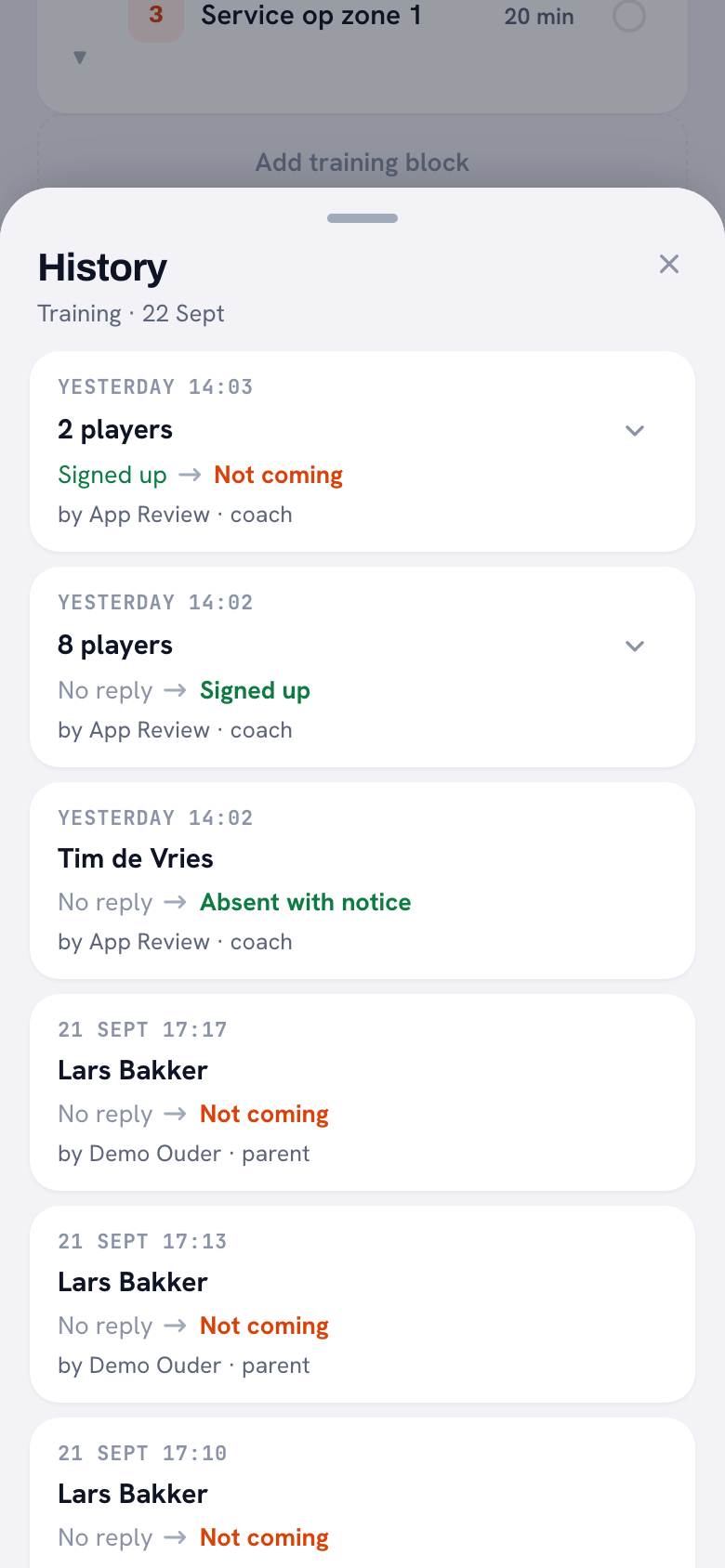
One row carries a number instead of a name.
“That is the All present button. It flips half the squad in one tap, and then you do not want eight identical rows underneath each other. They are folded into a single row with the count in it, and you open it up if you want to know exactly who was in there.
“That keeps the sheet readable. A log you have to dig through is as useless as no log at all, and that is precisely where screens like this usually fall apart.”
And when it is about one player?
“Then you tap the clock next to that player in the list. The sheet opens filtered on him straight away, with his name in the heading. His rows only, nothing from the rest.
“That is the version you need on a Tuesday evening. Not the full history of fourteen players, but the one who says he signed off.”
Can a player see this too?
“His own, yes. His team mates’, no. A member does not get that column of clocks beside the other players at all. He has one, on his own session or match, and it holds his rows and nothing else.
“I do not think that is a detail. Who signed off when is fairly sensitive in a team of sixteen-year-olds. What somebody else does is none of his business, so he should not be able to read it either.”
The sheet says two things you rarely read in an app.
“True, and I am quietly proud of those. The first one appears when there is nothing yet: No changes yet. The history only starts from the day we began recording it. Without that second sentence an empty sheet reads as nothing ever changed, and that is a claim we simply cannot make about last season.
“The second sits under the time: Time of processing. With a poor connection this can be later than the moment of tapping. In a sports hall with no signal a parent taps at a quarter to eight and it arrives at eight. You do not want an app pretending that eight o’clock is gospel.”
What should this never be used for, in your view?
“To hold something over a player. That is the one warning I attach to it, and I mean it. This is not evidence. A coach who turns up on Monday with a list of timestamps is a coach who loses his team.
“It exists to prevent an argument, not to win one. Nine times out of ten the answer is simply that something went wrong: a parent who tapped it on the wrong child, or somebody who thought he had saved it. You say that out loud and it is over.”
Did it actually settle that Saturday?
“It changed the conversation. We had exactly that case again later and we looked at my phone together. There was nothing there. He had meant to do it and never had, and he said so himself.
“That is the difference. Not that I was proved right, but that it stopped being my word against his. There is no cleverness in it at all, just a row that happens to be there.”
And what does the app deliberately not do here?
“It never nudges anybody that something changed. No notification, no Sunday morning email listing the week’s edits. It is there when you go and look, and otherwise it leaves you alone.
“And nothing in it can be edited, not even by me. The log is written by the database itself the moment something changes, not by the app. That is how a log should work: it would be worth very little if the person it describes could cross things out.”
See who signed off, and when
Koach records who signed up or off for a session, a match or a tournament, when it happened, and who changed it afterwards. Free to try with your own team.
Try Koach free