
“By March I genuinely could not remember what we agreed back in October”
Volleyball coach Dennis Boekhout, 28, on notes per player: why every one carries a date, how he words them, and what he deliberately leaves out.
Every coach knows the moment. In October you agree a player can try a month at opposite, and by March you no longer know whether that was three weeks or three months ago. Keeping coaching notes on your players is not admin for its own sake: without a date, an agreement dissolves into the noise of a season.
Dennis Boekhout keeps a dated note on every player in Koach. A conversation about how to word one, why the player never sees it, and what has no business being in there.
Where did this start? With one forgotten agreement?
“With exactly one. In October I agreed with a player that he could try a month at opposite. I wanted to look back after that month and check whether what I thought I was seeing was real. By March I genuinely could not remember what we agreed back in October. Had I ever come back to him? Had that month even ended? No idea.
“And the bad part is not that I lost something. The bad part is that he had remembered. A seventeen-year-old knows exactly what his coach promised him.”
So what were you doing before that?
“Everything, which amounts to nothing. A scrap of paper in my bag that was still in that bag after the wash. Messages to myself in the team chat, buried between the sign-ups. And mostly my memory, which I rated far too highly. I am a coach, not an archivist, I thought. Turns out you are a bit of both.” [laughs]
What does a note in Koach actually look like?
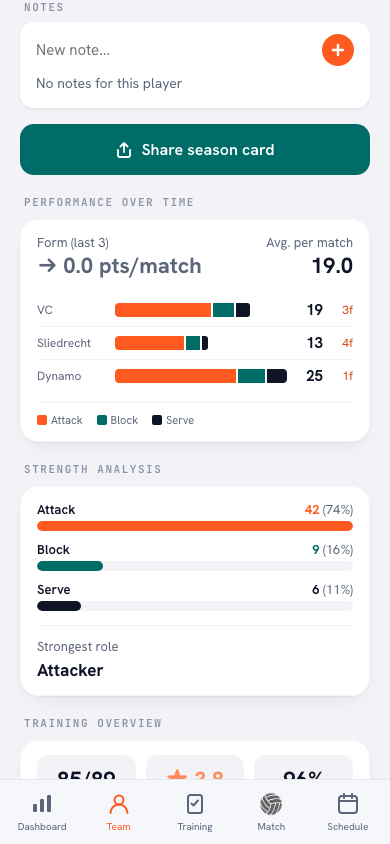
“As dull as possible, and I mean that as praise. You open a player, you type a sentence into the field, you tap the plus. That is it. The app stamps today’s date on it and the note goes to the top of his card.
“That date is half the story. One note is an impression. Three notes with months between them are a line. Only when I read back what I wrote about the same player in October, December and March do I see whether anything is actually moving — or whether I have written the same thing three times and never acted on it.”
If you edit a note later, does the date move with it?
“No, and that is deliberate. If I fix a typo, that note still belongs to the day I wrote it. Otherwise your whole timeline shifts and the story stops being true.
“You can delete one too, and undo that straight away. You do not want half a season of notes to vanish because of one mistimed swipe on the bus to an away game.”
So what belongs in a note?
“An observation or an agreement, ideally both in one sentence. ‘Jump serve is getting steadier, next step is placement’ is an observation. ‘Agreed: fifteen extra minutes of attacking at tempo every session’ is an agreement. The second kind matters most, because that is the one he holds me to.
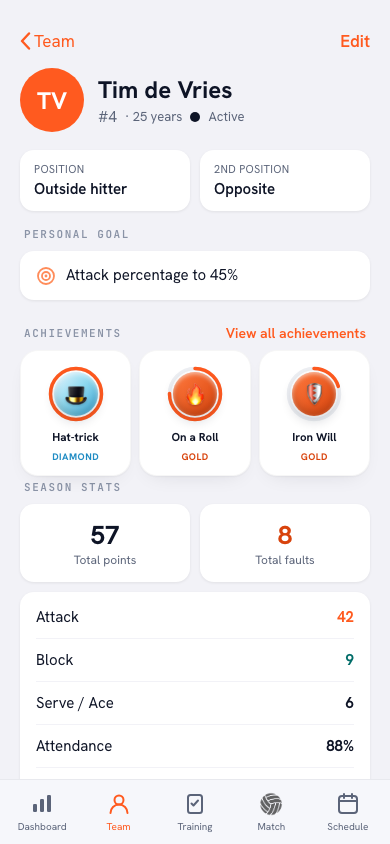
“And I hang it on the player, not on the session. A session is over; a player is still there next season. His position, his personal goal, his figures and my notes therefore all sit on one card.”
I hear you have your own test for the wording.
“I do. Would I dare read this note out loud to the player and his parents six months from now? If not, it is worded wrong. Not because the content is wrong, but because I have written down a verdict instead of an observation.
“‘Lazy’ is a verdict. ‘Third session in a row last one in, discussed it’ is an observation. I can read the second one out. The first I would never say at a kitchen table, and then it does not belong in an app either.”
And what do you never write down?
“Anything that is not about volleyball. Health, what is going on at home, a divorce, money. I hear those things sometimes, because a coach is simply an adult who turns up every week. But it stays in my head, not in an app.
“There are names and notes about children in here. That has been the top rule behind everything I built. Even our own error reports deliberately send what went wrong and never what somebody had typed in.”
Can a player see his own notes?
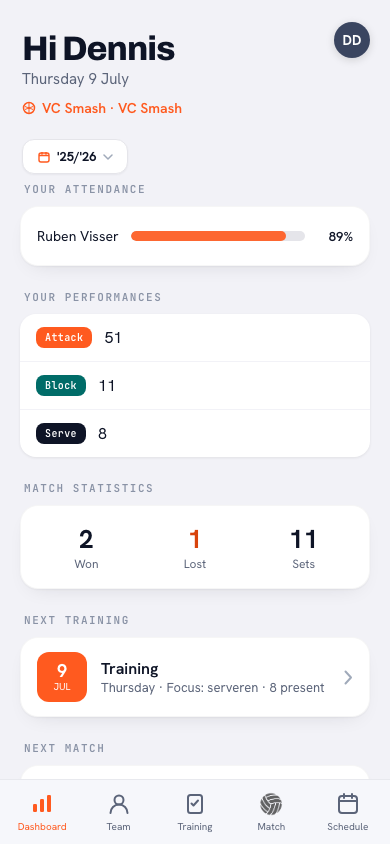
“No. Anyone attached to the team as a member — the players, in other words — does not get the notes block at all. He sees his own attendance, his points, his matches and his goal. That is his. My notes are the coach’s working material.
“That may sound sneaky, but it is the opposite. Precisely because nobody is reading over my shoulder, I dare to write down what I really think the next step is. And what he needs to know, he hears from me in the gym — not through a notification on his phone.”
And yet that went wrong once, I understand.
“It did, and I would rather tell you myself. The notes block was neatly hidden from a member, but at the bottom of that same profile sat an export button. It drops a player into a file — name, number, position, figures — and underneath that, every note with its date. So a player who opened his own card could read what I had written about him after all.
“That button is now hidden exactly like the notes block. It is the kind of mistake you make in two lines of code and only see when you log in once the way your players log in. I do that far more often now.”
What happens to your notes when a player moves to another team?
“They go with him. When you divide players between teams the app says so in as many words: the figures are kept, and your notes about a player move across to the new coach. That is exactly what you want, because otherwise every new coach starts from zero each season.
“It is also the best possible reason to take that test seriously. What you write, somebody else reads later. So write nothing you would wince at if your successor read it out loud.”
And what does the app deliberately not do here?
“It never reminds you of anything. No nudge saying that month at opposite is up. A note is a note, not a task with a tick box, and I deliberately did not try to turn it into a to-do list — people start clearing tick boxes instead of watching.
“What I do myself: before every one-to-one I open the player and read the last three notes back. It takes five minutes and it saves you the sentence ‘er, I feel like you are improving’. There is no cleverer trick behind it than that.”
Keep your agreements with the player
Koach keeps dated notes on every player, right beside their goal, their attendance and their figures. Free to try: set up your squad and write your first note after tonight’s session.
Try Koach free