
“If I stare at my screen all set, I am a scorekeeper, not a coach”
On the price of live stats: how many glances a point costs, what is allowed on screen during a rally, and when to hand it over.
The objection almost always comes down to the same thing: coaching with your phone in your hand, are you still watching the match? It is the first question coaches ask when they are weighing up live stats, and it is a fair one. Whoever taps is not looking. And that is exactly the second the ball drops.
Dennis Boekhout, who built Koach and coaches a youth team with it every week, does not dodge the price in this conversation: what it costs, how small he made it, and when he simply gives the scoring away.
The objection coaches raise first: aren’t you on your phone all match instead of coaching?
“It is a fair objection and I am not going to talk it away. Every tap costs you a look. If I stare at my screen all set, I am a scorekeeper, not a coach. That sentence became the yardstick for everything I built into live scoring.
“So the question was never ‘how much can I record?’ but ‘how little can I get away with?’ Anything that takes longer than half a second has no business in a match.”
How small did you manage to make it?
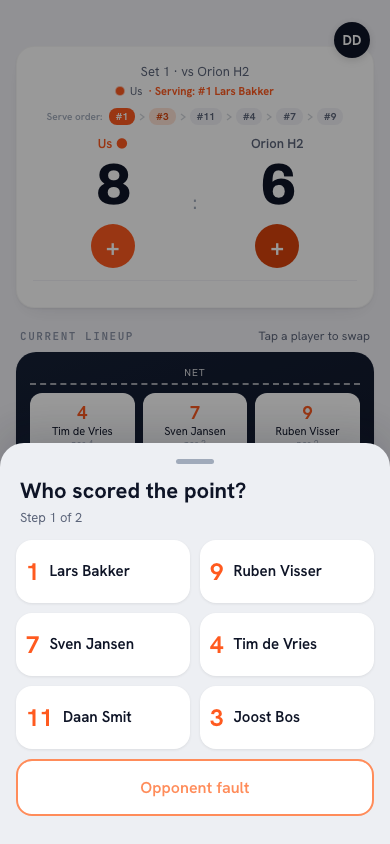
“A point for us is two choices. I tap the plus under our score, a sheet slides up with the six players on court: who scored the point? Then step 2: how it fell — attack, block or serve. Done, the sheet closes.
“And an opponent error is a single tap: at the bottom of that same sheet there is an ‘Opponent fault’ button, and the point is in. In youth volleyball that is the most common point there is, so it had to be the shortest one.”
And when the point goes the other way?
“That can be just as short. If it was simply a good ball from the other side, there is one button and nothing else — no player needed. If I do want the error on record, I pick who made it and what it was: service fault, attack fault, bad pass, too late, net fault. But that is a choice, not an obligation.
“There is always an ‘Unknown / unassigned’ option in there as well, on purpose, for the rallies you simply did not see. The score still adds up, the error just hangs on nobody. I would rather have that than pin a fault on a player who did not make it.”
So when do you tap? During play?
“Never while the ball is alive, and that is probably the most important answer in this whole conversation. I tap when the ball is dead, in those few seconds where everyone walks back and the referee points at the server. That gap is in every rally, youth volleyball included.
“If I do miss one because something is going on in the hall, I enter two points back to back. The order still holds — there is no clock attached to a point.”
What is actually on your screen during a set?
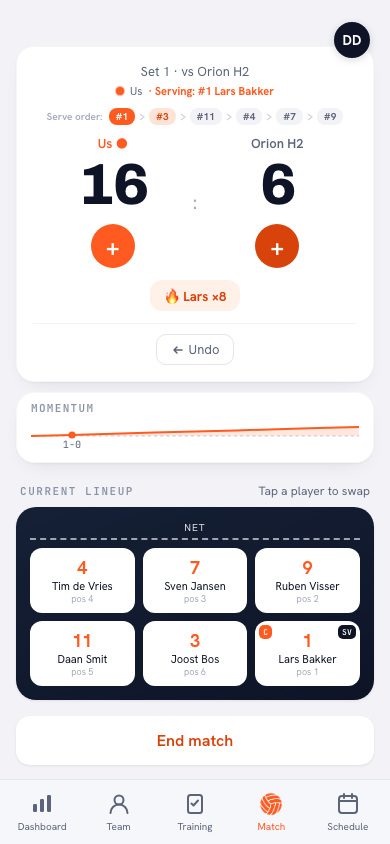
“Almost nothing, deliberately. The score, who is serving, the serve order as a row of numbers, and below that the six positions with who is standing where. There is a thin momentum line under the board too, but during a rally I only see the digits.
“One exception I left in myself: if the same player serves three points in a row, a small flame appears with his name and the count. Not because it is a statistic, but because you feel a run like that in the hall and it is good to see how far it has got.”
There are screens you never open during a match.
“Correct. During a set I open no player profile, no season figures, no graph. That is debrief material. If I am reading up on somebody’s season halfway through set two, I am doing the wrong job.
“I do open the lineup board, but only at the moments where it belongs: at a substitution and in the set break. Six substitutions a set is what the rules give you — that is six short moments, not a running conversation with your phone.”
You also hand the scoring over completely sometimes.
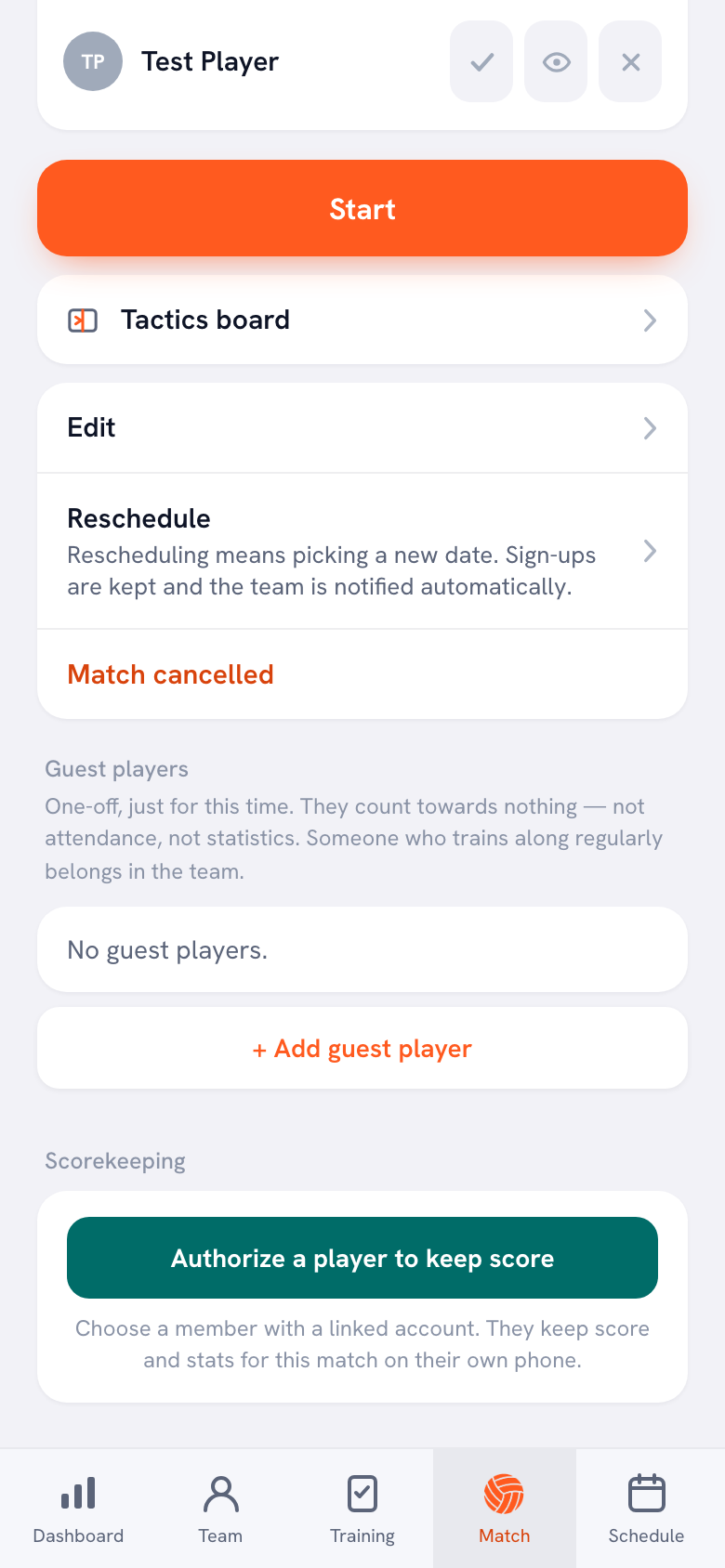
“I do, and it might be the most honest fix of all. At the bottom of the match screen there is a Scorekeeping block. There I authorise a member with a linked account: an injured player sitting it out, or someone who is not playing that night. They keep the score and the stats for that match on their own phone.
“It just lands in my app and I do nothing at all. They see a different screen from mine, by the way: two buttons, point for us and point against, and then who and how. No court, no lineup — they do not need to understand that part.”
What do you give up when somebody else does it?
“Points and faults per player still come in, so the debrief is there. What you lose is everything that depends on the court: playing time per player, the longest serving run, side-out per rotation. All of that needs to know who was standing where, and their screen does not.
“I think that is a fine trade. I would rather have most of the numbers and a coach who is watching than every last figure and a coach staring down at his hand all set.”
And when there is nobody to hand it to?
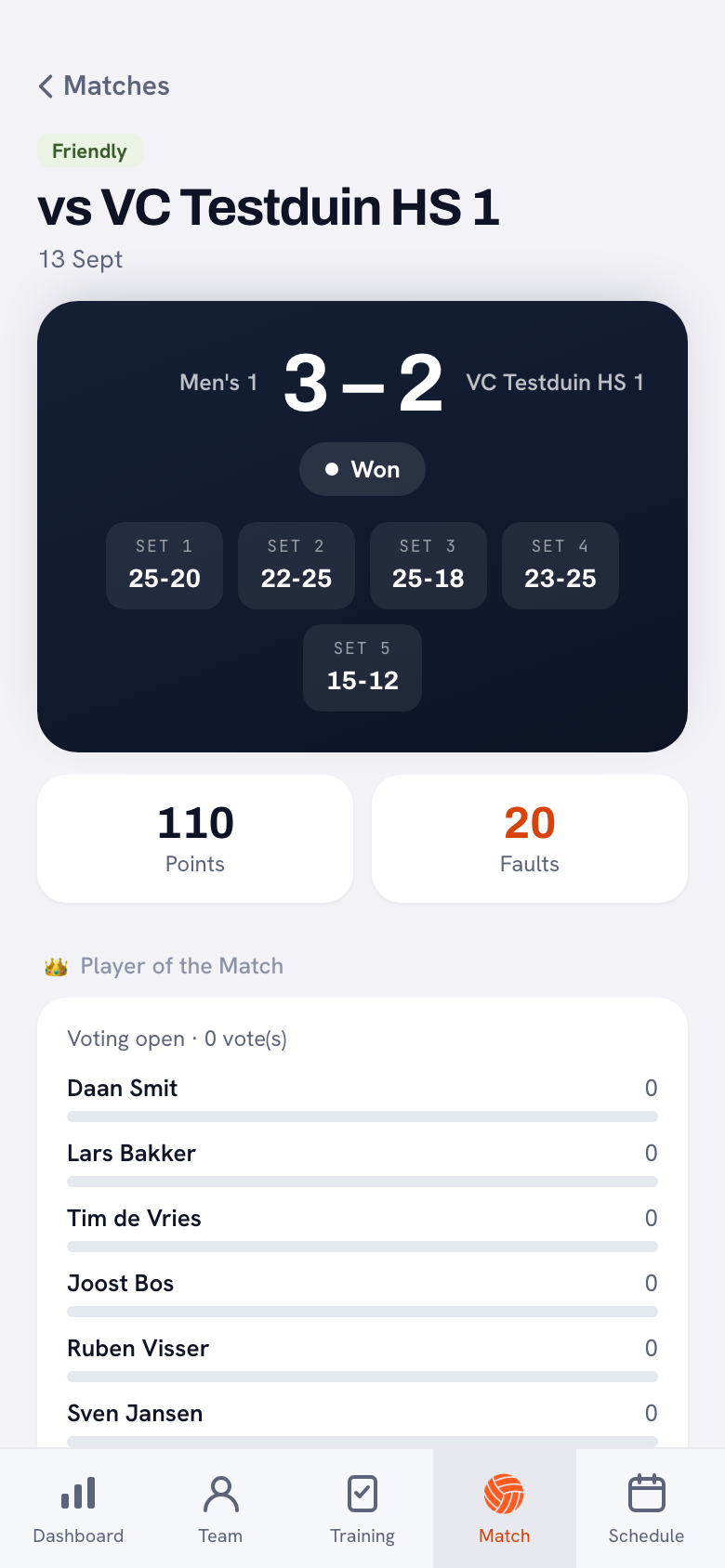
“Then I do not score live. Full stop. That is allowed, and I do it myself: at a tournament with five short matches back to back I track nothing at all. Afterwards I enter the result by hand — days later still works. You type in the set scores, and the sheet where you fill in points and faults per player opens straight after.
“You get no rally-by-rally story, no momentum, no side-out per rotation. But the match is on record, the result counts towards the season, and the player sees it on their profile. That beats a hole in your season because you did not fancy your phone that day.”
So which moment does earn the screen?
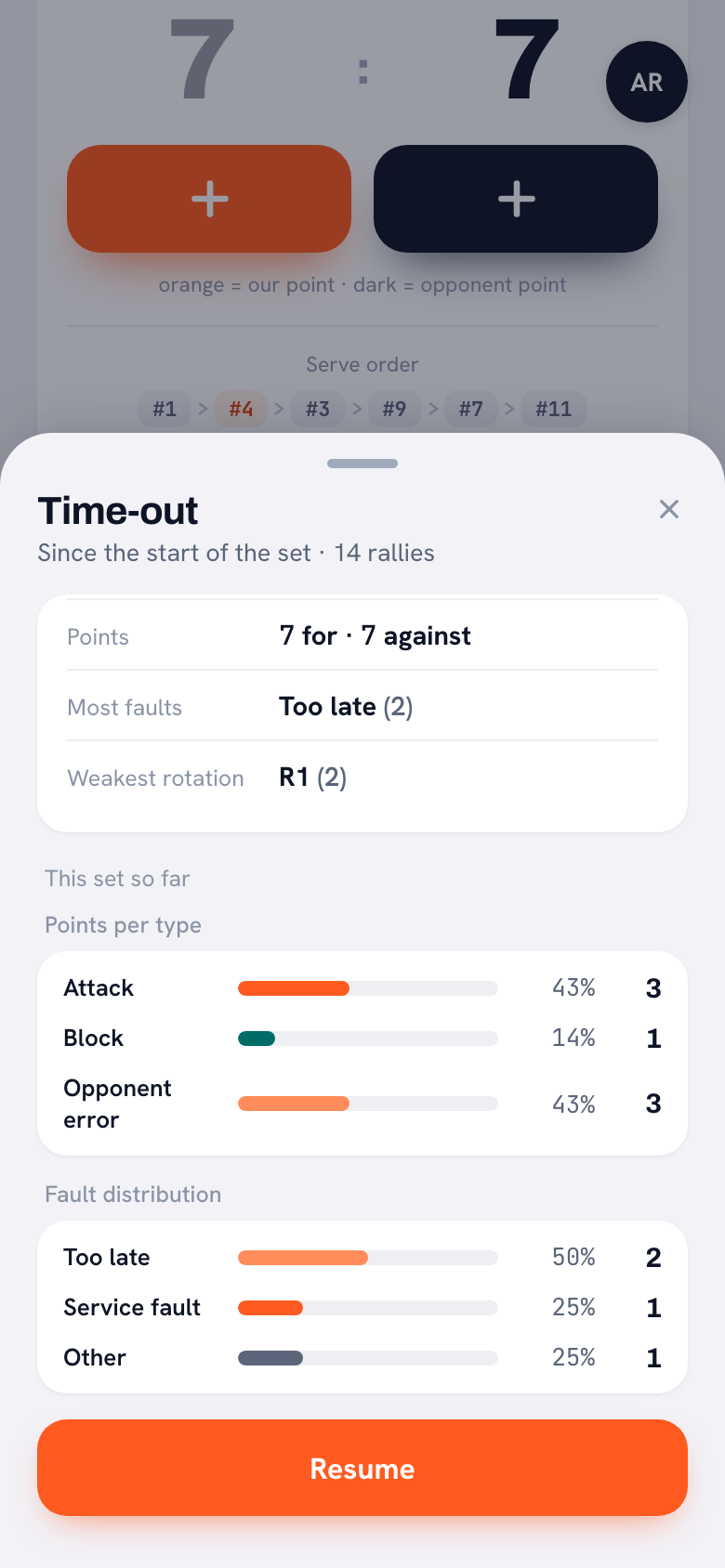
“The time-out. You get two a set and you have thirty seconds. When I take one, a card opens with what has happened since the start of the set — or since the previous time-out: how many rallies, points for and against, which fault came up most, and which rotation is running worst.
“Those are exactly the things my head does not keep reliably. I think ‘we are missing a lot of serves’ while what actually happened is two players arriving late. If I have thirty seconds to say something, I want it to be right. Then I tap Resume and the screen is gone again.”
And the set break?
“That is the second moment. Between sets I get a set-break screen: the set scores so far, who serves first, and the board to fill in the six positions again. As long as the lineup sheet has not gone in, a new starting six is not a substitution — so it does not cost you one.
“There the screen can take its time, because nobody is playing. That is the whole idea: the screen gets the moments when the ball is not in play, and nothing else.”
What would you say to a coach reading this who is on the fence?
“Do one set. Not the whole match, one set. Within twenty minutes you know whether it pulls you out of the game or not, and you walk into the set break with something to say.
“And if it still grates, hand it over or leave it alone. The app exists to give you more attention for your players, not less. If it does not do that, it is not doing its job.”
Watch the match, not your screen
Koach is free to try. Set your team up, score a single set and see for yourself whether it pulls you out of the match — or whether you finally walk into the set break with something to say.
Try Koach free