
“I rate my players after every session. They never get to see it”
Dutch volleyball coach Dennis Boekhout on the five rows of stars behind every name, and why the number they produce never reaches the player’s screen.
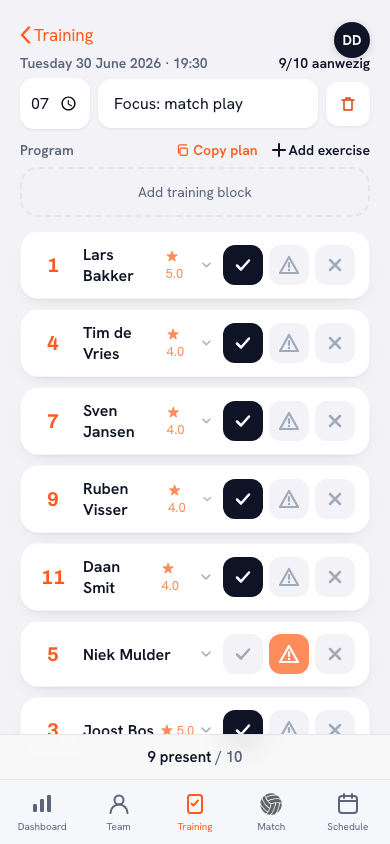
The last ball drops, the hall goes quiet, and that is when the real work starts for a lot of coaches: remembering who fought for everything tonight and who was just along for the ride. Dennis Boekhout does not trust his memory with that. Rating players in Koach is a panel of five star rows under a name — and the striking part is who never gets to see the result.
A conversation about five rows you are allowed to fill in halfway, two badges that get filtered out of a player’s medal cabinet, and the difference between a file and a memory.
You give your players a score after every session. How does that work in the app?
“It lives in the attendance list of the session. I tick someone present, and a small chevron appears behind their name. Tap the name and a panel unfolds: five rows of stars — technique, game awareness, coachability, work ethic and effort. Five times one to five stars, with the average underneath.
“It takes me twenty seconds per player at most. That is deliberate. I do it in the car or on the sofa afterwards, never during the session — during the session I need to be watching, not tapping.”
Why five rows? One score would be quicker.
“One score is a verdict on a person. Five rows are a description of an evening. That difference is bigger than it sounds. A player can sit at a two on technique and a five on work ethic, and then there is nothing wrong with the lad — then I am the one who has to do something different on Tuesday.
“It forces me to split things up as well. ‘Bad session’ is not an observation, that is a mood. The moment I have to choose between five lines, I notice it usually sits in just one of them.”
Do you have to fill in all five rows?
“No, and that matters. Only the rows you fill in count towards the average. Leave three of them empty and the average is the average of the two you did give. I have evenings where I honestly only watched work ethic; then I fill that row and nothing else.
“That was a repair, not a design. An empty row used to count as a zero, so anyone I half-rated drifted downwards on their own. The same thing happened across a season: sessions where I filled in nothing dragged the average down. Ten times present and three times rated gave the sum of those three divided by ten. Now only the rated sessions count.”
And the player never sees that score?
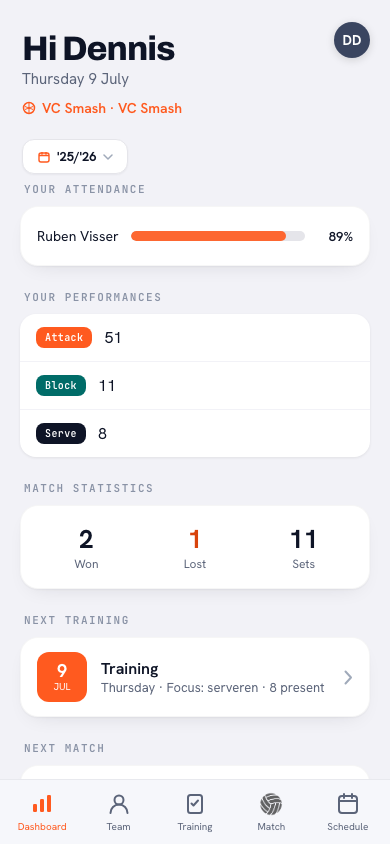
“Never. On his own screen it does not exist. The star column in the attendance list is gone, the Avg. effort tile on his profile is gone, the stars behind each individual session are gone, and the trend graph showing how his ratings moved is gone too.
“That graph was the last one we closed off, actually. The block was in place everywhere else, and that one card showed the most of all: the average and the line per session. That is how something like this leaks — never through the spot you were thinking of.”
Does that apply to parents too?
“Yes, parents sit behind the same wall. A parent account sees what the child sees and nothing more. That is not distrust of parents — it is that my note about a fifteen-year-old should not land on the kitchen table without me in the room.”
But there are badges about effort. Do those not give it away?
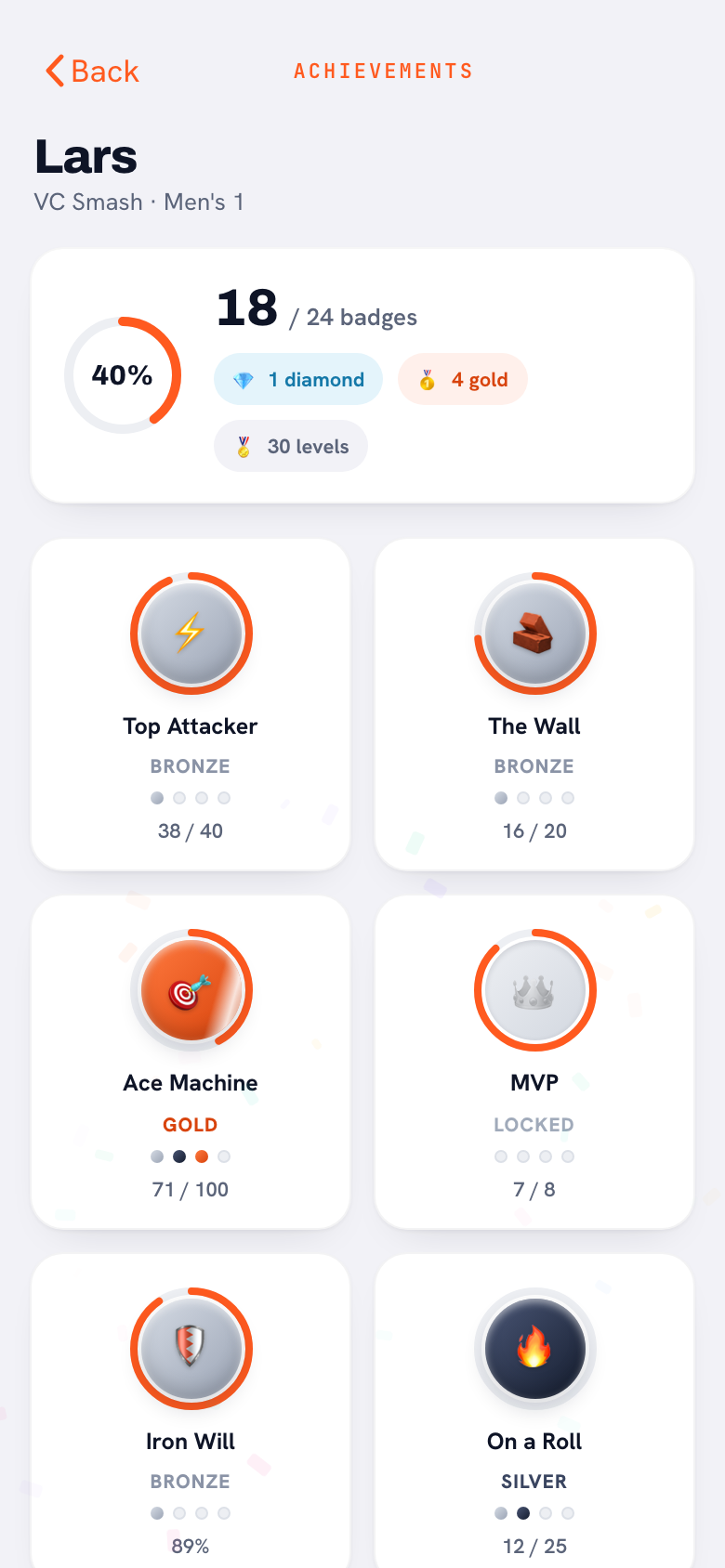
“They did, yes. Two badges come straight out of those stars: Hard Worker, with ‘avg. 4.0’ underneath it, and Riser, with ‘+0.3’. For a player those two are pulled out entirely; he and his parent simply never see those tiles.
“Removing the text was not enough, because the rim gives it away as well. Gold means 4.6 or higher, so you do not need the figure. You can spot it in the counter above the medal cabinet: mine says twenty-four badges, his says twenty-two.”
So why keep track of it at all?
“Because otherwise I lose it. That sounds daft, but it is exactly what happens. By March I cannot remember what November looked like. All I have left is the last three weeks, and I would be holding a whole-season conversation on those three weeks.
“It is not a file. A file is something you build against someone. This is a memory, and it is mine.”
So what do you actually do with it in a conversation?
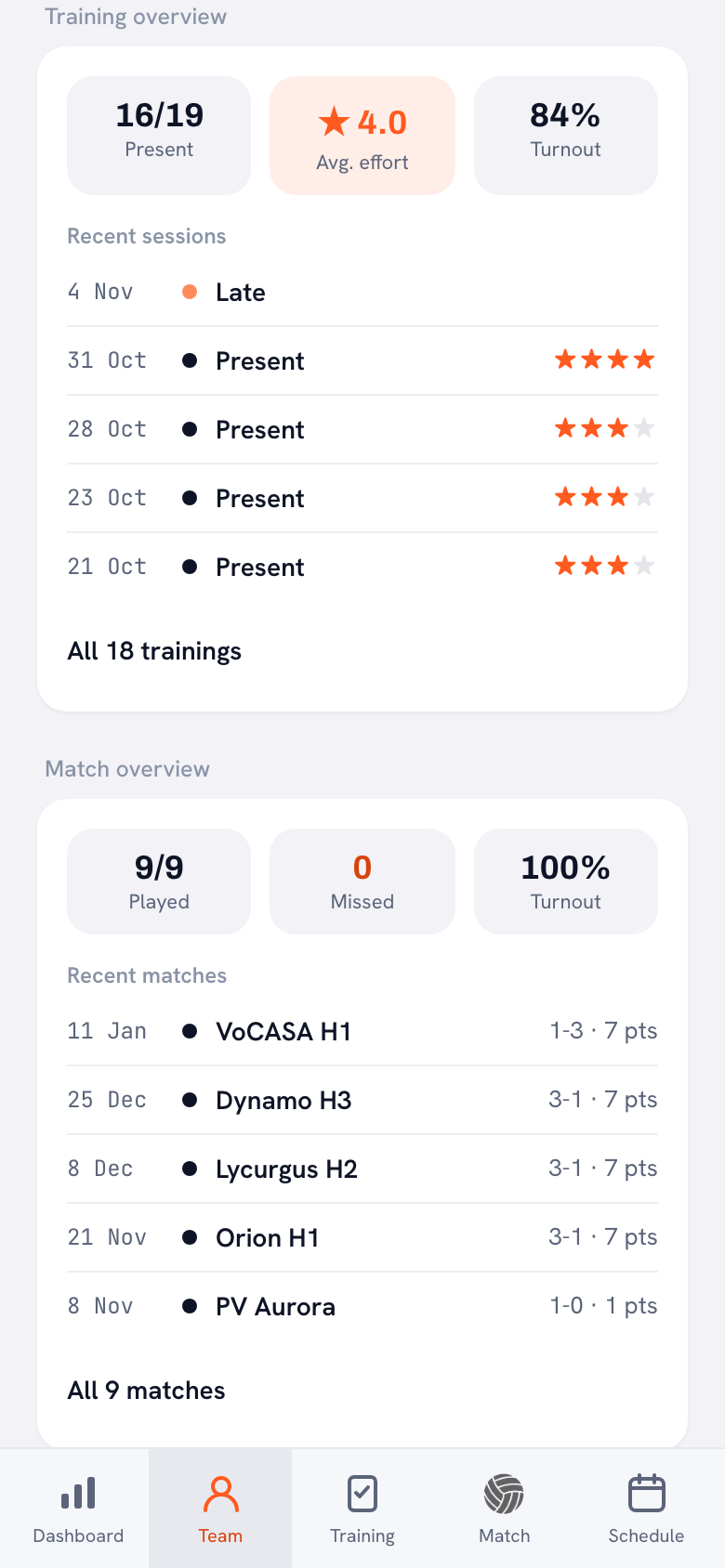
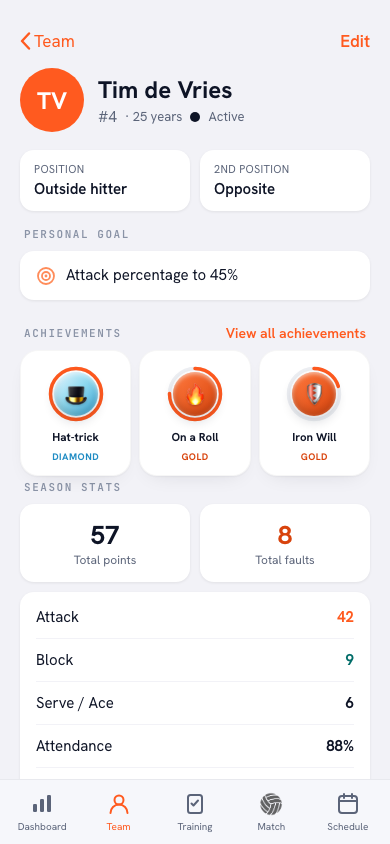
“I do not show the score, I use it to remind myself what I saw. The profile puts attendance, average effort and turnout side by side, with the recent sessions listed underneath. That is where I see that his dip in November lasted three sessions and that it turned after that.
“And then I say it in plain words. Not ‘you are on a 3.4’, but ‘after Christmas you went for the first ball of every drill, and I did not see that before’. Same insight, minus a number he cannot do anything with.”
Can you add words in that panel as well?
“No. Five rows of stars, that is all there is. That is a deliberate limit, because with a text box attached I would never have filled it in — then it becomes homework instead of five taps.
“Words go into the notes block on the player profile. That is coaches-only as well; a player opening his own card simply does not find that block there. Otherwise I would start writing differently, and that helps nobody.”
Is scoring effort not unfair? Everybody has a bad night.
“Of course. And that is exactly why one session does not count. One evening is noise: someone had an exam, someone has a cold, someone is in love. I look at the line across ten or twelve sessions.
“That is also why you are allowed to leave rows empty. An evening where I could not see it properly does not deserve a score — an empty box is more honest than a guess.”
Does the app do anything with those scores by itself?
“Arithmetic, nothing more. It averages the rows you fill in, puts the average on the profile and keeps the trend. No advice comes out of it, no conclusion, no ‘this player should be benched’. I would not trust that anyway.
“The judgement is mine and stays mine. All the app does is make sure I still know it in March, and that the player does not read it by accident.”
Rate what you see, not what you remember
Koach is free to try. Add your squad, tick off attendance and give five rows of stars after your next session — the player will never know it happened.
Try Koach free