
“If a point had cost one tap, you would still know nothing in May”
Why Koach asks for two taps in the middle of a rally, what the second tap gives back, and where a paper scoresheet stops.
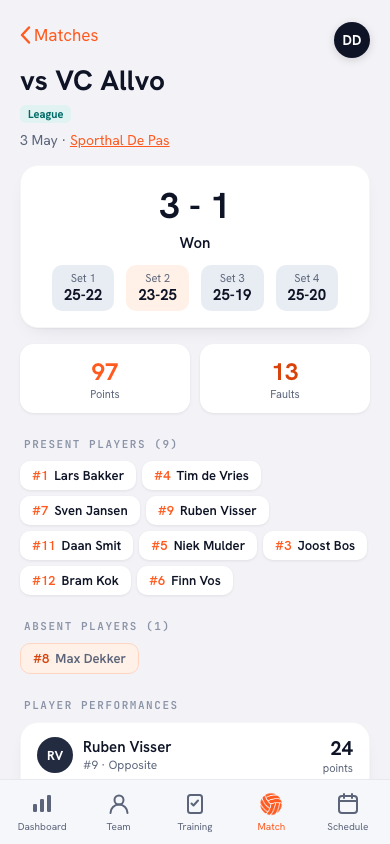
There are two ways to track volleyball stats live. You can write down 25-22, 23-25, 25-19 when it is over and be done. Or you can record every point the moment it lands: who scored, and how. The difference costs one extra tap per point — and decides whether your season still means anything in May.
Dennis Boekhout, youth coach and the builder of Koach, explains why the app turns every point into two taps, why he deliberately built in an ‘unknown’ escape hatch, and what simply does not exist without that second tap.
The app will not leave you alone after a point. Why not just a plus button and done?
“The plus button is there. You can fill a match in afterwards in Koach too: type in three set scores and save. That is allowed, and sometimes it is exactly right. It just gives you exactly one thing back: the result.
“And I already knew the result. I was standing right there. What kept me busy on Monday was something else: why did we go from 18-16 to 18-23 in the second set? That is not in 25-19. It sits in the points in between, and you lose those the moment you do not write them down.”
So the app asks for two taps in the middle of a rally. How small are they?
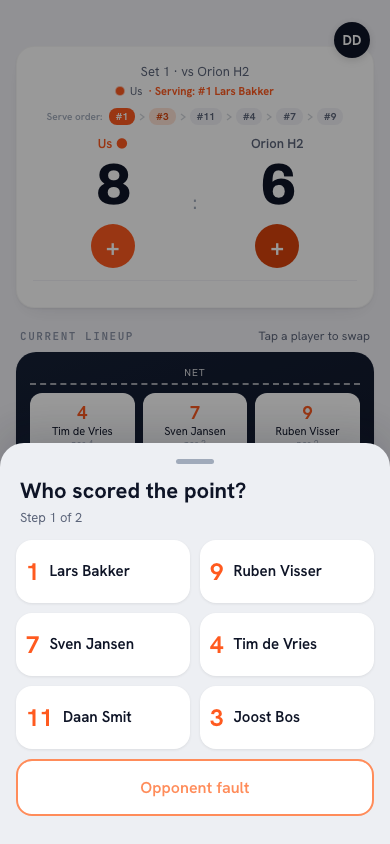
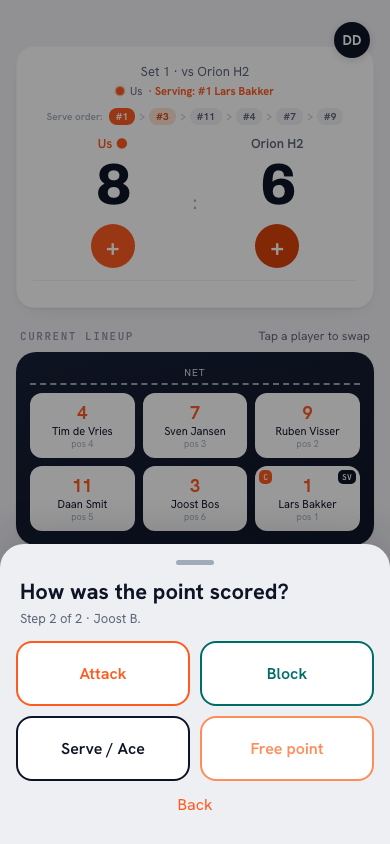
“Small enough to do standing up. The first tap is a grid with your six players on court: who scored the point. The second is how it landed — attack, block, serve. Two buttons half a thumb wide, and the score moves on.
“And that grid is cleverer than it looks. Your libero gets no block button and no serve button, because the rules allow neither. A serve point is only offered to whoever is in position 1 while we are serving. I put that in after an ace ended up on a player in position 4 during a test match. That is not a small bit of noise: that is exactly the statistic you steer on.”
And a point for the opponent? There are roughly as many of those per set.
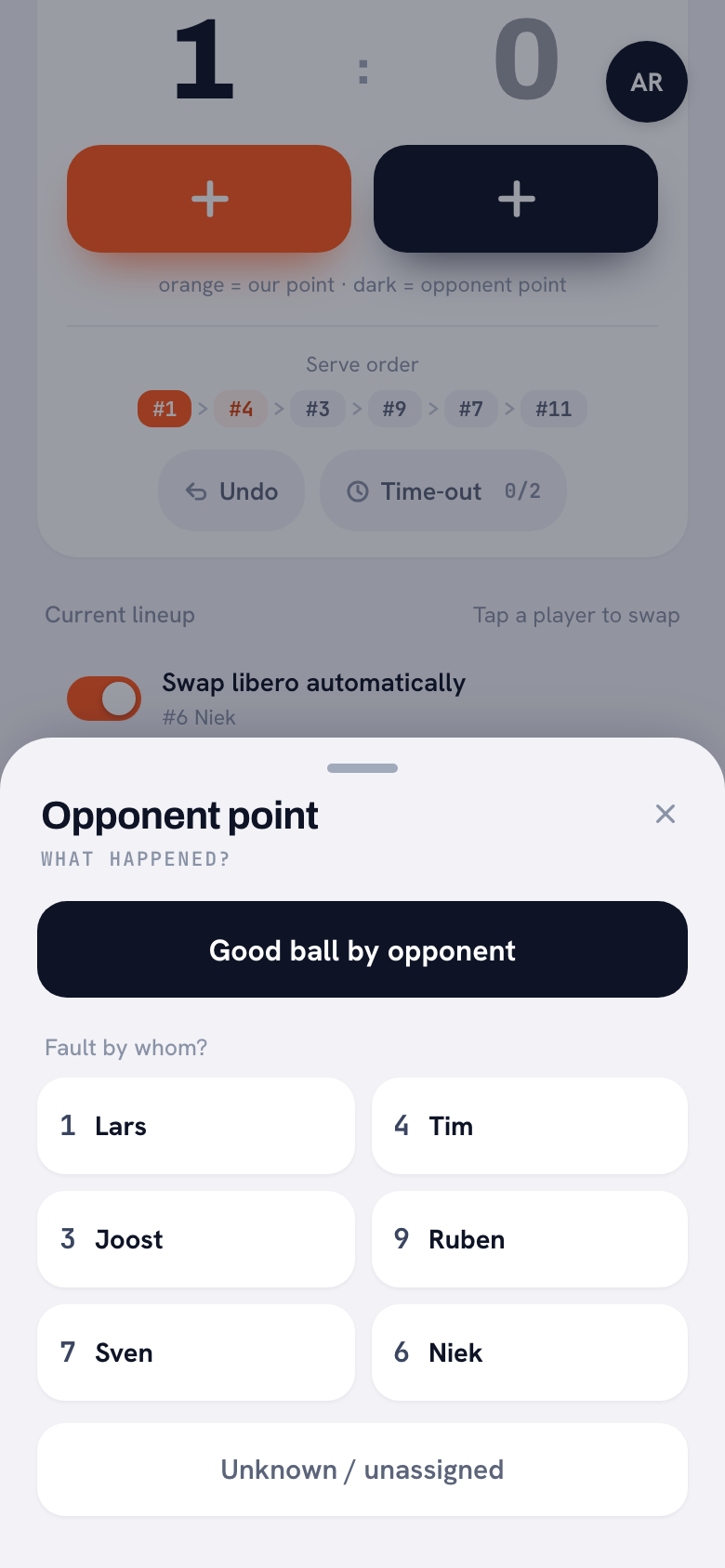
“That is where I was hardest on myself, because that is where most apps leave you hanging. A point against starts with one question: was it a good ball from them, or a mistake from us? ‘Good ball by opponent’ sits at the top as one wide button. One tap, done, because there is nothing to learn there.
“If it was a mistake, you pick who, and then what went wrong: service fault, attack fault, bad pass, too late, net fault or other. And right at the bottom there is ‘Unknown / unassigned’. That button matters as much as all the others put together.”
Why does ‘unknown’ matter so much?
“Because the alternative is lying. You do not always see it. Two players go for the same ball, it drops, and you are on the wrong side of the net to see whose it was. If the app forces you to choose, you choose something. And in February that something sits in a player’s fault distribution as if it were a measurement.
“So you are allowed to skip the player. You still record the type of fault, because that you did see. And on the match detail the app tells you itself how many faults were not assigned to anyone: they count towards the type, but not in the player list. I would rather have a number with an honest footnote than a number that adds up nicely.”
Does the arithmetic still work out?
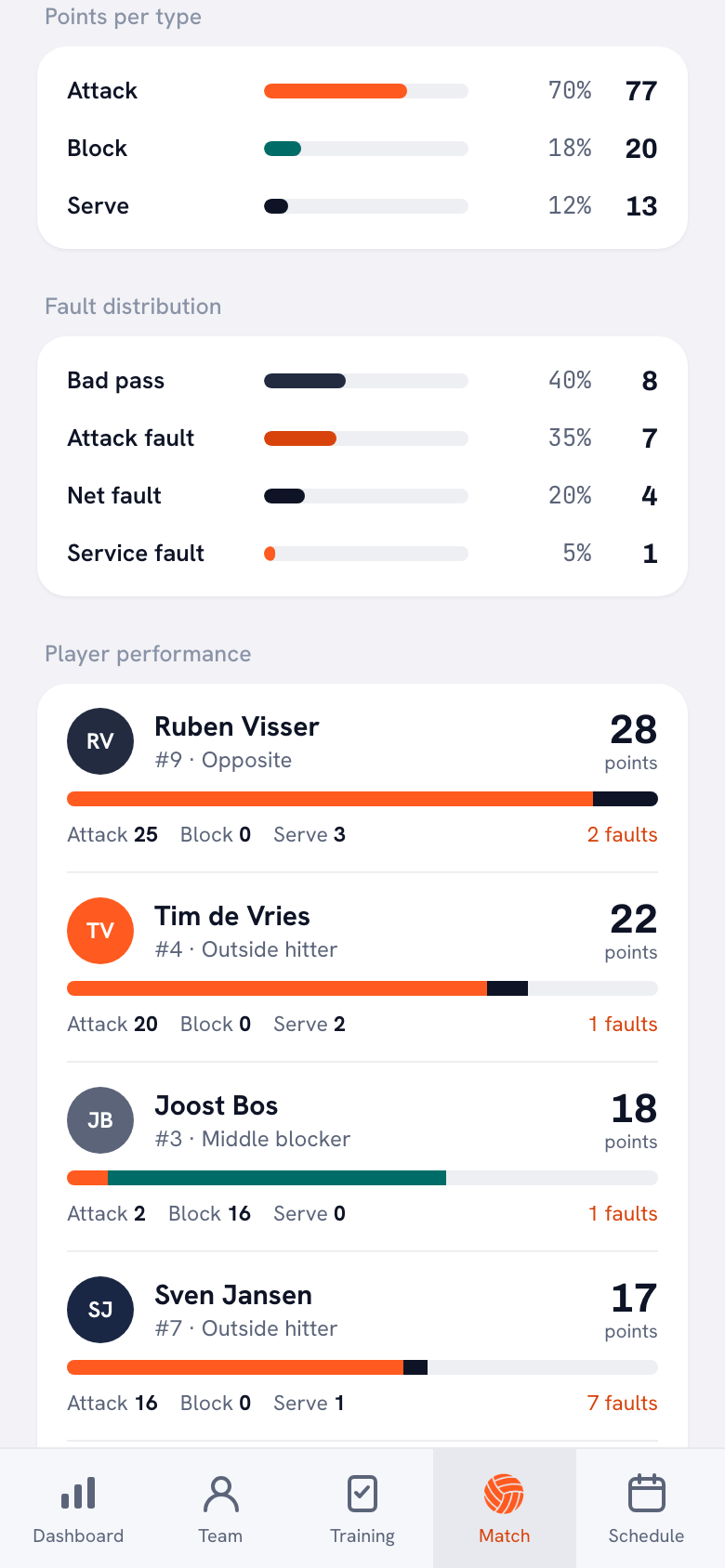
“That is exactly the test I set myself. Attack plus block plus serve plus the points that came from opponent errors has to be your set score. Not roughly. Exactly. If ‘Points per type’ lands on 23 and you won the set 25, something is broken — not in the set, but in the app.
“In older matches those opponent errors were not stored separately, so that row is missing. The app then puts one sentence underneath: that this is why the total is lower than the set score. I hesitated for a long time about showing that. But a number that does not add up, left unexplained, is worse than no number at all.”
So what does that second tap actually buy you?
“I prefer to turn it around: what does not exist without it. Your top scorer does not exist. The attack-block-serve split per player does not exist. The fault distribution does not exist, so ‘most faults’ on the time-out card does not either. Playing time does not exist, because the app has no idea who was on court when the point landed.
“And ‘Form (last 3)’ does not exist, because that is nothing more than three matches side by side. None of those are extra features I dreamed up on top. It is all the same tap, read back later.”
And if someone would rather just fill in the set scores?
“That works fine, and I am not going to look down on anyone for it. There are evenings with four substitutions, an injury and a set drifting away all at once. Then you read the set off the board and enter it at home.
“There is one thing you need to know, and the app warns you about it: if you overwrite a match that was scored live with manual figures, that replaces the per-player totals and the per-set data is gone. Momentum, playing time, the numbers per set. Gone is gone. It is about the only place where I built in a real warning.”
You often compare it to a paper scoresheet yourself.
“Because that is the fairest thing to compare it with. A scoresheet is a hundred years old, it always works, it needs no battery and nobody has to log in first. It keeps the result perfectly.
“But it keeps no flow. It does not know that you spent three sets failing to side out from rotation 2. It does not count how many rallies a substitute actually played. It records what happened, not how. That is not a criticism of paper — that is simply what paper is.”
And when you tap the wrong thing in the heat of it?
“Then you tap ‘Undo’. That button sits next to the time-out, and it puts the last point back: the score, who is serving, the court. I use it once or twice every match.
“And if it is genuinely too busy to count yourself, hand it over. You can authorise a player with a linked account to keep score; they do it on their own phone and the match simply shows up in your app afterwards. An injured player on the bench is usually the very best at it. [laughs]”
When would you say: do not bother with that second tap?
“When it costs you coaching. I mean that. A team of twelve-year-olds playing their first league season does not need a fault distribution; it needs you, watching, on the sideline. Put the set scores in and move on.
“But the moment you start steering — this player needs more balls, that rotation is stuck, this has to be better by Christmas — you need the flow. And you cannot invent flow afterwards. It only exists if you wrote it down as it happened.”
What do you see in May that you would have missed without those taps?
“Last season I saw a player whose attack points were rising and whose attack faults were rising with them. Look only at his points and that is a player in form. See both lines and it is someone hitting harder and taking more risk, and then the question is not ‘keep going’ but ‘where is that allowed and where is it not’.
“That is one five-minute conversation, in March, with two graphs next to it. That is what you do it for. Not for the numbers — for that conversation. And if a point had cost one tap, you would still know nothing in May.”
Score your next match point by point
Koach is free to try. Put your squad in, pick your lineup and track your next match live — the moment the last point lands you will see what that second tap buys you.
Try Koach free