
“In the car home you still know everything. By the next Tuesday it is gone”
Volleyball coach Dennis Boekhout, 28, on the After the session field: what he puts in it, what never goes in, and why only that team’s coaches read it.
Every coach knows that drive home. The session has just finished, you are in the car, and you still know exactly what happened: the warm-up worked, serve receive fell apart after the break, and you never got round to serving into zones 1 and 5. A week later none of it is left.
In Koach every session carries a block called After the session: a text field only that team’s coaches ever see. Dennis Boekhout coaches a youth team himself and built the app. A conversation about four short lines, and why they have to stay that short.
Where did this come from?
“From the car. I drive home after a session and it is all still sitting in my head. The warm-up worked, serve receive fell apart after the break, we never even touched serving into zones 1 and 5. At that moment I can still tell you who walked in late.
“And the following Tuesday I am standing in the gym and it is gone. Not half gone, completely gone. So I start with the same warm-up as last week, because I cannot think of anything better. I ran whole months like that.”
So you never did anything with it?
“I did, in my head. I always thought: I will never forget this. That is the best joke a coach tells himself.” [laughs]
“Sometimes I messaged myself on the way home. So at half past ten at night there was ‘receive!!’ sitting in my own chat, and a week later I had no idea whether that was praise or a complaint. A stray word without the evening around it tells you nothing.”
Where exactly is that field?
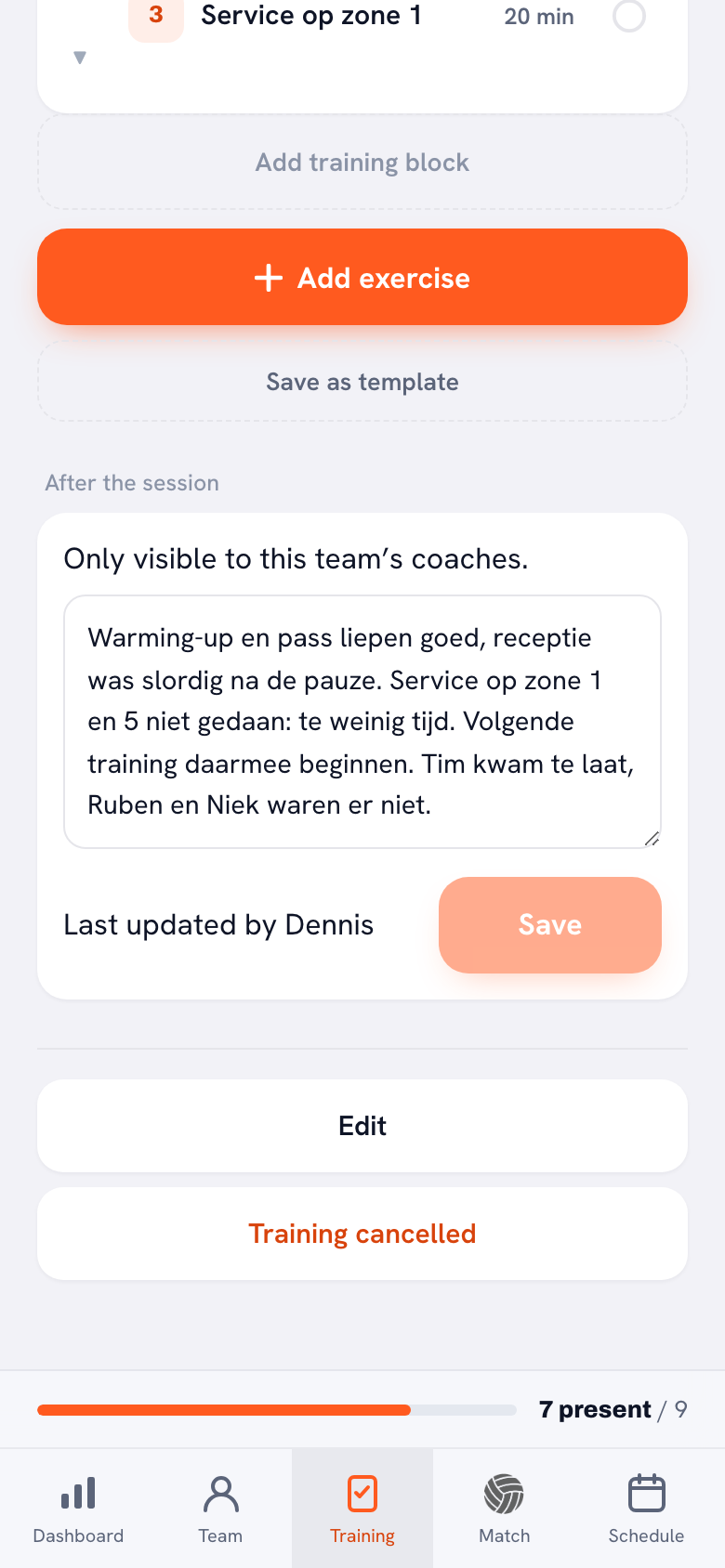
“At the bottom of the session, under the programme. You scroll down past your blocks and there is a heading: After the session. Below it one line of explanation, an empty text field and a Save button. That is all.
“It sitting there rather than in some menu is not an accident. You only reach it once the session has happened: you walk down your blocks, you mark off what you did, and at the bottom you type your four lines. The whole movement is: I am done, I scroll on, I tap Save.”
What do you put in it?
“Three things, in this order. What worked. What was left. And what I start with next time. That is the whole recipe, and the app says as much in the empty field.
“That third line is the only one that really earns its keep. ‘Serving into zones 1 and 5 not done, not enough time, start there next session.’ That is something I can use on Tuesday. The first two are history; they only become fun at the end of the season.”
How long should a report be?
“Four lines. Seriously. If I turn it into half a page, I write it once and never again, because then it feels like homework. And homework lasts exactly as long as your enthusiasm, so about a fortnight.
“That is why the field is only five rows tall. That is deliberate. A small box invites a short text, and a short text is one you genuinely read back a week later. A wall of text you scroll straight past.”
And what has no business being in there?
“A verdict on a child. ‘Tim arrived late’ is a fact and it can go in. ‘Tim has lost interest’ is my reading of a Tuesday evening, and that stays out. A week from now I will not know whether I thought that because he was tired or because I was.
“And anything going on at home. A divorce, an ill relative, money. You hear those things as a coach, because you are the adult who turns up every week. But it is not about the session. My test is simple: would I say this sentence out loud with his parents standing there? If not, I do not type it.”
Who actually reads it?
“Only the coaches of that one team. It says so right above the field: only visible to this team’s coaches. Players do not see it, parents do not see it. And it is not merely hidden in the screen; it is locked down in the database, because otherwise it is a promise rather than a rule.
“I kept that circle deliberately narrow. The moment somebody from outside is reading along, you start writing for that somebody. Then it says ‘we worked hard’ instead of ‘serve receive fell apart after the break’. The first is a report for show, the second is working material.”
Underneath the field it says ‘Last updated by’. Why does that name matter?
“Because almost nobody runs a team on their own. There are two of us on my team. He takes Saturday, I take Tuesday. When I read on Wednesday that serve receive was sloppy, my first question is not what it said but who thought so.
“That name is captured at the moment you save. So it does not change later if somebody switches role or leaves the team. It sounds like a detail, but it is the difference between ‘somebody thought’ and ‘my fellow coach thought’. Only the second one is something I can ask about on Saturday.”
How is this different from a note on a player?
“The report is about the evening, the note is about a person. That sounds glib, but it decides both what you write and where you find it back later.
“‘Serve receive fell apart after the break’ belongs to that session. ‘Agreed he can try a month at opposite’ belongs to that player, because in March I want to read it on his card and not on some random Tuesday in October. Put an agreement like that in the report and it is unfindable within three weeks.”
So how do you use it the week after?
“At the top of the Training tab there is a card with the previous session: the date, what it was about, how many players were there and how much of your programme you marked off. One tap and you are inside it, with your own report underneath.
“That is all it does. Nothing reminds you to fill it in, and nothing turns it into a monthly report. I write four lines in the car, and on Tuesday I read them back before I walk into the gym. That is the entire trick, and it is enough.”
Four lines after the session
In Koach you write your report under every session, visible to your team’s coaches only, right beside how much of your programme got done. Free to try: set up your team and write your first report after tonight’s session.
Try Koach free