
Beach volleyball shots: cut shot, poke, high line and rainbow
The short answer
The four beach volleyball shots are the cut shot (short and sharp cross-court), the poke or pokey (with the knuckles), the high line (high over the block down the line) and the rainbow (deep over the defender). You choose based on where the defender is. An open-handed tip with loose fingers is a fault on the sand.
Beach volleyball shots are often your first attacking weapon on the sand: you jump lower than indoors and two defenders cover a half court of eight by eight meters. This article shows how to hit the cut shot, the poke, the high line and the rainbow, when to choose which and what the rules forbid.
Why shots matter so much on the sand
A shot is a controlled, placed attack: not hard, but exactly where nobody is standing. Indoors it complements the hard swing. On the sand it is often the main thing, for three reasons:
- You jump lower. Sand gives way at take-off, so part of your power disappears into it. You get less far above the net and cannot hit as steeply.
- There are only two defenders. If one blocks, the other defends almost a whole half court alone. There is always an open spot; the only question is where.
- A hard ball is often an easy ball. A well-positioned defender simply digs a hard ball hit straight at them up high. A soft ball into an open spot is one they have to chase first.
Indoors the soft attacks are called the tip, the poke and the roll shot; they are covered in poke, tip and roll shot. On the sand they work differently, because the rules are stricter there.
What is allowed on a shot in beach volleyball?
Under the FIVB's Official Beach Volleyball Rules 2025-2028, an attack is a fault if you complete it with an open hand where your fingers direct the ball, or with fingertips that are not rigid and closed (rule 13.2.3). So the indoor tip, pushed over the block with soft fingers, is not allowed on the sand. What is allowed:
- a short, clean hit with your hand, even when you slice across the ball, as in the cut shot;
- placing the ball with your knuckles, the poke;
- placing the ball with straight, closed and rigid fingertips, the cobra.
If you play the ball over the net with an overhand pass, it has to travel straight forward or straight backward relative to your shoulders; the only exception is when you were trying to set your partner (rule 13.2.5). The other rules at a glance are in the beach volleyball rules.
The cut shot: short and sharp cross-court
The cut shot is a short, sharp cross-court ball that drops just behind the net, close to the sideline. It works against a defender who is playing deep, because they have to cover a few meters forward and sideways in a few tenths of a second.
- Approach as for a hard swing. Same approach, same arm swing. If you hold back during the approach, you give away the cut and the defender comes forward.
- Turn your hand at the last moment. At contact your palm faces the sideline where the ball has to go, and you slice across the ball instead of hitting through it. A right-handed player attacking from the right turns the hand inward and follows through with the little finger down; on the left side they turn it outward and follow through with the thumb down.
- Keep it low. The ball goes low over the net and drops straight away. A high cut is an easy ball for a defender who reads it early.
The common mistake: taking too much room. Every meter further from the net gives the defender more time, and a cut that gets too long is just a soft ball into the court.
The poke and the cobra: placing without an arm swing
With the poke, which many players call the pokey, you contact the ball with your knuckles. Bend your fingers at the middle joint so the middle segments of your index and middle finger form a flat surface, and tap the ball away short and firm. It is a hit, not a push: the ball must not rest in your hand.
The poke is your answer when the set comes tight to the net and there is no room for an arm swing. You play it short over the block, into the shadow behind the hands, or tight past the block into an open spot. The cobra does the same with straight, closed fingertips. It is more precise, especially for a deep ball, but only legal if your fingers really stay rigid and together.
The high line: high over the block down the line
The high line is a high, soft ball down your own line, over the blocker's hands, that drops deep in the corner. It works when the blocker takes the line and the defender is cross-court: the line behind the block is then empty, and the defender has to come all the way across.
- Contact from underneath. Contact the back and underside of the ball with the heel of your hand, as a short hit without your fingers directing it, and snap your wrist forward so the ball gets topspin. That spin makes it drop after the block, so it stays inside the end line.
- Aim for the corner. Close to the sideline and deep. A high line into the middle of the court is one the defender will still run down.
- Just high enough. The ball has to clear the blocker's fingers by a little. The higher it goes, the more time the defender gets.
The rainbow: deep over the defender
The rainbow is a high arcing ball that drops over the defender deep into the court, often in the back corner. It is your answer to a defender who plays shallow or comes forward early because they expect a cut or a poke. The technique is similar to the high line, but the contact is further under the ball and the arc is higher. The risk is length: with the wind behind you a rainbow easily blows past the end line, and an arc that is too high gives the defender time to run back.
Which shot do you choose?
Don't look at the blocker, look at the defender, and hit the ball where they are not. Your partner helps by calling just before your attack which side is open; how that works is in beach volleyball strategy.
| What you see | Shot |
|---|---|
| Block on the line, defender deep cross-court | Cut shot short cross-court, or high line over the block |
| Defender comes forward early | Rainbow deep over them |
| Tight set at the net, no room for an arm swing | Poke short over or past the block |
| No block, both defenders deep | Cut shot or a short poke |
Take the wind into account as well. With the wind behind you the high line and the rainbow carry further, so aim shorter or choose a cut. Into the wind a high ball hangs and drops shorter.
Hide your shot until contact. Use the same approach and the same arm swing for every shot as for a hard swing. A defender who can read from your approach what is coming is already there. Change your hand, not your whole movement.
How to train your shots
- Standing, at targets. Put three targets in the sand: a towel for the cut just behind the net by the sideline, one in the deep line corner and one in the deep cross-court corner. Your partner tosses, you hit each shot standing. Ten per target, and count the hits.
- With a two-step approach. Same targets, now with an approach through the sand and a jump.
- With a blocker. Before the set the blocker shows whether they will take the line or the cross-court, and you choose the shot that goes with it.
- With a defender who moves. The defender only picks a spot at the last moment, your partner calls what is open, and you play there.
- Two against two, shots only. A hard swing is not allowed and a shot into an open spot counts double. It is the same idea as the indoor drill Tips and roll shots only, but on the sand with the cut and the poke instead of the tip.
A full sand session for a team is in beach volleyball drills, and if you are on the court without a partner, you will find drills in training beach volleyball alone.
Practicing shots with your indoor team
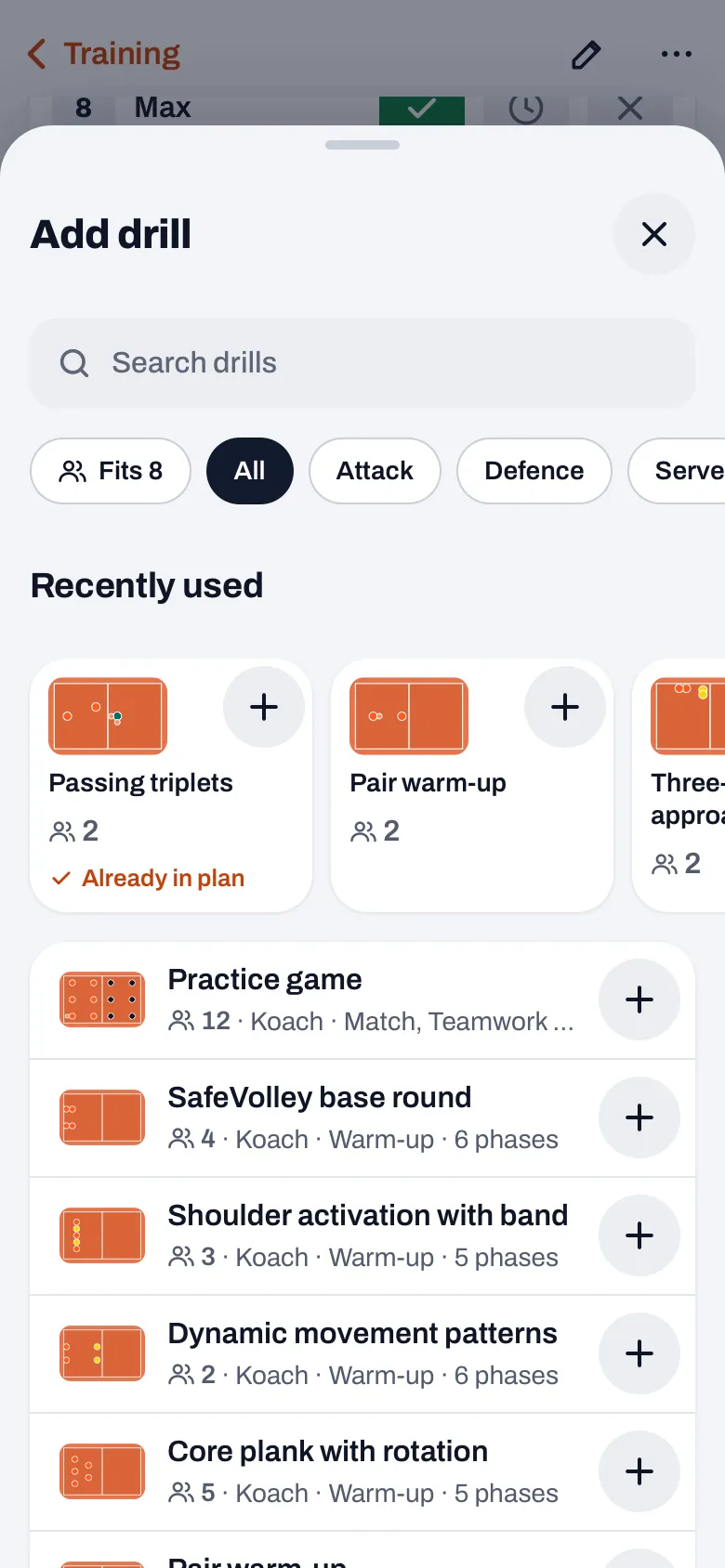
Koach is made for indoor volleyball, and you cannot score an official beach match with it. If your team goes onto the sand in summer, you can put the shots in your practice, though. With + Add drill you search the drill library for an attacking drill, such as Tips and roll shots only, and add it to your plan. In the same way you add a Practice game, which you use to track the two against two: choose Expert with Attack as the focus, and you rate every attack, from 0 Error through Free ball, Easy dig, Covered and Tough to 5 Kill. That shows you for each player what share of their attacks became a point. Which shot it was, the app does not know; so play one type of shot per round, and the round scores tell you what works. What Koach costs after the trial is on the pricing page.
14 days free, no credit card. Put your next sand session in your plan and see in the two against two which shots score.
Try Koach at your practiceHow the attack relates to the other fundamentals is in learning volleyball technique.
Frequently asked questions
Can you tip in beach volleyball?
Not the way you do indoors. An attack with an open hand where your fingers direct the ball, or with soft fingertips, is a fault on the sand. You may place the ball with your knuckles (the poke), with straight, closed and rigid fingertips (the cobra) or with a short, clean hit of your hand, as in the cut shot.
What is a pokey in beach volleyball?
The pokey, also called the poke, is a shot with the knuckles. You bend your fingers so the middle segments form a flat surface and tap the ball away short and firm, over or past the block. It is allowed because you do not direct the ball with your fingertips. You use it mainly on a tight set close to the net, when there is no room for an arm swing.
What is the difference between a high line and a rainbow?
The high line goes down your own line, just over the blocker's hands, and drops deep in the corner behind the block. The rainbow is higher and goes over the defender deep into the court. You choose the high line when the block takes the line and the defender is cross-court, and the rainbow when the defender is playing shallow.
Which shot should a beginner learn first?
Start with the poke and the high line. The poke takes little technique and gets you out of trouble on a tight set at the net. You learn the high line with the same arm swing as a hard hit, only softer and with topspin. The cut shot is harder, because your hand only turns at the last moment; add it once the other two work.
Put your sand session in your plan
14 days free, no credit card. After a week you see which shots score.
Get started with KoachOr read first what the volleyball coaching app does.