
Groin strain in volleyball: sudden strain or lingering groin pain
The short answer
A groin injury in volleyball is either an acute strain or groin pain that comes on slowly. You feel a strain at one moment, often in a wide lunge or a dive: stop right away. Groin pain that lasts for weeks and gets worse with effort, have it checked. When you are back is decided by the person treating you.
Groin trouble in volleyball starts in one of two ways: a groin strain, felt as a sharp twinge in a wide lunge for a ball, or a nagging groin that has been flaring up at the end of practice for weeks. Those are two stories with a different approach. Here you read how to recognize them, when to stop and what the way back looks like.
What can go wrong in the groin
The groin is the area where your abdomen meets your thigh. A lot of structures come together there: the muscles on the inside of your thigh (the adductors, which pull your leg inward), the hip flexor, the lower part of the abdominal wall and the pubic bone. Groin pain can come from any of them, and also from the hip itself.
Because groin pain in athletes was named in such confusing ways, 24 international experts agreed on a fixed classification in Doha in 2014 (Weir and colleagues, British Journal of Sports Medicine, 2015). They distinguish groin pain related to the adductors, the hip flexor, the inguinal canal or the pubic bone, plus groin pain coming from the hip, and other causes. A healthcare professional makes that distinction with questions and a physical examination. You do not need to know it; it does help to understand that "groin pain" is not a diagnosis.
You also often hear terms such as pubalgia. The Doha group actually advised against terms like "athletic pubalgia" and "sportsman's hernia", because it is not clear what they mean and they are used in very different ways. If a player gets such a label, feel free to ask which part of the groin it refers to.
How a groin injury happens in volleyball
According to the Doha group, groin problems are common in ice hockey and in football codes that involve a lot of kicking. Volleyball is not mentioned there, but the game does have movements that load the groin heavily. The adductors are stretched and tensed at the same time when your leg goes far out to the side and you have to brake or push yourself back. On the court that happens, for example, in:
- a wide lunge to the side for a defensive ball, where your foot slips away;
- a dive in which the trailing leg shoots far out;
- a quick sideways push-off when moving along the net to block;
- a slippery floor or a wet spot that suddenly lands you in a split position.
On top of that comes the familiar pattern of any overuse: a lot of the same movements in a short time, such as the first weeks of the season or a tournament weekend. Stiff, achy muscles in the days after a hard practice are usually ordinary muscle soreness; the difference from an injury is in sore muscles after volleyball.
Acute strain or long-standing groin pain: the difference
| What you notice | Acute strain | Long-standing groin pain |
|---|---|---|
| Onset | At one moment, during one action | Often gradual, sometimes after one moment; the pain stays |
| Feeling | A sudden twinge; then pain, tenderness or weakness, sometimes swelling or a bruise | Nagging, and worse with effort |
| What you do | Stop right away and have it checked | Reduce the load and have it checked if it persists |
Sources: the Doha classification (acute means a sudden onset, with a clear moment; long-standing only says how long the pain has lasted, not how it started; in the typical patterns of groin pain, the pain gets worse with effort) and the NHS on sprains and strains.
When to stop right away
A player who feels a twinge in their groin during a lunge or a dive stops. Do not let them "walk it off" or stretch to see if it is okay. Cooling it for the pain is fine; what else you do in the gym is in volleyball first aid. According to the UK's National Health Service (NHS), you get help the same day for severe pain, swelling that keeps increasing, or if someone cannot stand on the leg or can barely walk a few steps. With an audible crack, an odd position, or a leg that is numb or tingling, go straight to the emergency department or call the emergency number (112 in the European Union, elsewhere your country's number).
Not every pain in the groin is a sports injury. The US National Library of Medicine (MedlinePlus) also names an inguinal hernia, the hip, and less often a problem with a testicle, a kidney stone or an inflammation as causes. With sudden pain in one testicle or a swollen scrotum, the player goes straight to a doctor or the emergency department: according to MedlinePlus, a twisted testicle is an emergency. Burning pain, blood in the urine or groin pain without a clear reason also belong with a doctor, not with the coach.
Don't ask whether it hurts, ask during which action. Lunge, dive, sprint, push-off or climbing stairs: the answer helps you adapt practice, and it is exactly what a physiotherapist or sports physician wants to know.
The way back: pain-free first, then lunges and dives
How long a groin strain lasts depends on how severe it is. A study in Qatar followed 81 male athletes with an acute adductor injury, including soccer players, futsal players, handball players and five volleyball players (Serner and colleagues, 2020). They followed a supervised exercise program with set criteria. For the milder and moderate injuries, half were back in full team training within 18 days; for the most severe, in which the muscle or tendon had torn off completely, that was 78 days. Within a year, 8 percent got injured again. Those who were pain-free before their return when the muscle was pressed, when contracting against resistance and when stretching, got injured again less often: 5 versus 21 percent. It was an exploratory study with mainly soccer and futsal players; the researchers themselves write that the results should be applied with caution to other sports and to women.
About strains in general, the NHS says most feel better after two weeks and a severe strain can take months. For groin pain that has been lingering for weeks or months, there is no fixed timeframe: a physiotherapist or sports physician works out where it comes from and sets up an exercise program.
For you as a coach that means:
- The person treating the player decides the steps. Ask which movements are allowed now. A player can, for example, already pass and set in place before they may lunge wide, dive or push off quickly to the side again.
- Pain-free comes before the calendar. A player who is needed on Saturday but still has pain in a sprint or a lunge is not ready yet.
- Watch the next day. If the groin is more sensitive again after a practice, the step was too big. Report it to the person treating the player.
If symptoms persist, get worse or you are in doubt, send the player to a family doctor, sports physician or physiotherapist. This article gives no treatment advice and makes no diagnosis.
What you can do as a coach in the long run
The general side of preventing injuries is in injury prevention in volleyball. For the groin, one exercise has been studied well, though in soccer: the Copenhagen adduction exercise. You lie on your side, supported on your forearm, with your top leg on a bench or held by a partner, and lift your hips by pressing the inside of that top leg against the support. In a study of 35 Norwegian teams of male semi-professional soccer players, 18 teams did this exercise three times a week in the preseason and once a week during the season, in three levels from light to hard. In an average week of the season, 13.5 percent of the players in those teams had groin problems, against 21.3 percent in the other teams (Harøy and colleagues, 2019).
Start with a light variant, in which the top leg is supported at the knee instead of the ankle: a shorter lever makes the exercise lighter. Let players with groin pain do the exercise only if the person treating them agrees. More on strength work alongside court practice is in strength training for volleyball players, and what else you arrange as a new coach in starting as a volleyball coach.
In Koach: injury, build-up and the exercise in your plan
Koach does not make a rehab plan; the physiotherapist does that. What you do is keep track of who is not fully taking part. On the player profile, tap the pencil (Edit player) and under Status set the player to Injured. When you prepare a match, they then appear grayed out with that label at the end of the bench, they get no nudge or reminder to sign up, and teammates see Absent for them.
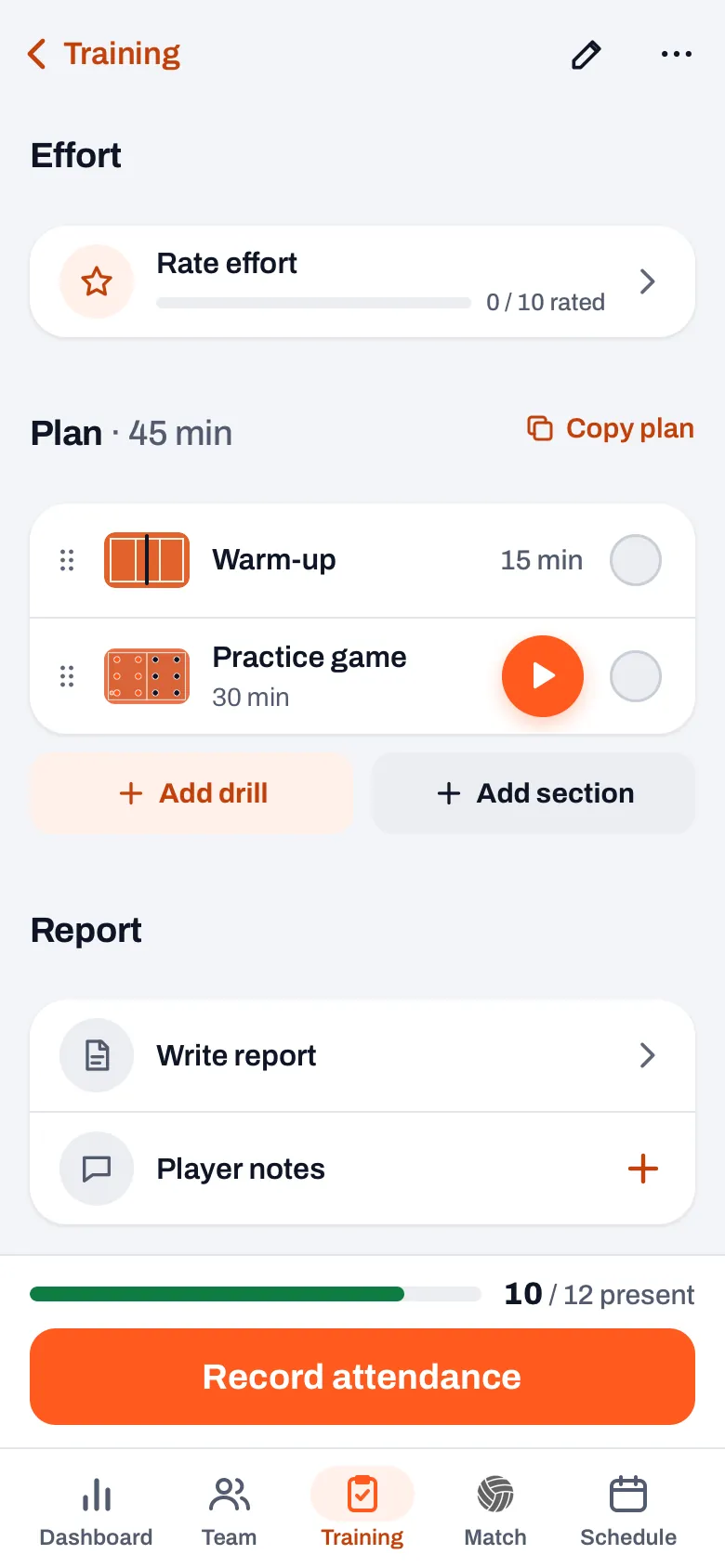
At the practice, under Report in Player notes, you write which movements they skipped and which step the physiotherapist has cleared. If you want the adduction exercise as a fixed part of practice, put it in the plan with Add section, with a name, a duration and the explanation in the description. With Copy plan you bring it back at the next practice. The Injured status has no end date: when the player is fully back, you set them back to Active yourself.
14 days free, no credit card. Add your team tonight and keep track of who is injured and how the build-up is going.
Try Koach with your teamWhat Koach costs after the trial is on the pricing page.
Frequently asked questions
How long does a groin strain take to heal?
That depends on the injury. In a study by Serner and colleagues (2020) of 81 male athletes with an acute adductor injury, half of those with mild and moderate injuries were back in full team training within 18 days; for the most severe it was 78 days. The NHS says most strains feel better after two weeks, but a severe strain can take months. With long-standing groin pain, the person treating you decides the build-up.
Can you play volleyball with groin pain?
Not after a sudden twinge during an action: then you stop and have it checked. With nagging groin pain that has been there for a while, you can sometimes keep practicing in an adapted way, but only in consultation with a physiotherapist or sports physician. Pain that increases during practice or the day after is a sign it was too much. Playing on painkillers only hides the problem.
What is pubalgia?
Pubalgia is a catch-all term for pain around the pubic bone and groin in athletes. In the Doha agreement (published in 2015), an international expert group advised against terms such as athletic pubalgia, because they are used in very different ways. They classify groin pain by where it comes from: the adductors, the hip flexor, the inguinal canal, the pubic bone or the hip. A physiotherapist or sports physician determines which one it is.
Is groin pain always a muscle injury?
No. According to MedlinePlus, groin pain can also come from an inguinal hernia, the hip, a problem with a testicle, a kidney stone or an inflammation. With sudden pain in one testicle or a swollen scrotum, go straight to a doctor or the emergency department; a twisted testicle is an emergency. Burning pain, blood in the urine or groin pain without a clear reason should also be looked at by a doctor.
Keep track of who is injured
14 days free, no credit card. Your team's injuries and agreements in one place.
Get started with KoachOr read first what the volleyball coaching app does.