
Sore after volleyball: why it happens and when to train again
The short answer
Being sore after volleyball comes from small damage in muscles that were loaded in an unusual or braking way, such as when you land from a jump. The soreness only shows up after a while and fades on its own within a few days. Light training is fine; heavy jump training waits until the pain eases.
Being sore after volleyball comes with the first weeks of the season, a long tournament day and every new drill. Here you read where that pain comes from, where volleyball players feel it, how to tell it from an injury and when you simply train again.
Why are you sore after volleyball?
Muscle soreness that only shows up after practice is called delayed onset muscle soreness, or DOMS. According to the review by Hotfiel and colleagues (2018), it is caused by unaccustomed exercise or by eccentric loading: a muscle working while it lengthens, like your thigh braking when you land. That causes small damage in the muscle fibers and a local reaction to it. The symptoms come on with a delay and, according to the same authors, are at their worst 48 to 72 hours after the exercise.
For a long time lactic acid was named as the cause. In the review by Cheung, Hume and Maxwell (2003), lactic acid is still in the list of possible explanations, but Hotfiel and colleagues write that current understanding points mainly to that damage in the muscle cells. Cheung and colleagues also name when soreness is most common: at the start of the season, after a period of less training, and when you do a new type of exercise for the first time.
Volleyball is full of braking movements. You land after every jump, you sink low in the ready position, you brake in a lunge toward a dig, and your hitting arm brakes after every spike and serve. Anyone starting again after the summer, or doing a blocking series for the first time, feels it in the days after.
Where volleyball players feel sore
| Where | What causes it in volleyball |
|---|---|
| Calves | Pushing off and landing, lots of footwork on the balls of the feet |
| Front of the thighs | Landing after jumps, staying low in the ready position, braking |
| Glutes and hamstrings | Lunges toward a dig, approach and takeoff |
| Shoulder and upper back | Braking the hitting arm after a spike or serve |
| Core and abs | Rotating and extending in the swing, diving and getting back up |
Which muscles do the work in which skill is in the muscles used in volleyball. Two complaints look like muscle soreness but are something else. Painful, discolored forearms from passing are bruises; those are covered in volleyball bruises. And a muscle that seizes up during a match is a cramp: see muscle cramps during sports.
Muscle soreness or injury? How to tell the difference
Muscle soreness and injury pain can both ache quite a bit. The difference lies in when, where and how it hurts.
| What you notice | Muscle soreness | Possibly an injury |
|---|---|---|
| Onset | Later, after practice or the next morning | At one moment: a jump, a landing or a dive |
| Location | Spread through the muscle, often on both sides | One spot, one side, or at a tendon, joint or bone |
| Feeling | Stiff and tender, especially on the first steps | Sharp with one particular movement, sometimes with swelling |
| Once you are warm | Gets better | Stays the same or gets worse |
| After a few days | Fades | Stays, or gets worse |
That soreness eases once you get moving is also described by Cheung and colleagues: movement is what relieves the pain best, although the effect is temporary. Because the peak lies between 48 and 72 hours according to Hotfiel and colleagues, you can use this as a rule of thumb of your own: if the pain is not better but worse after the third day, if it sits in one spot or if you are unsure, treat it as an injury. Do not play through it, and with persistent or severe symptoms see your doctor, a sports physician or a physiotherapist.
A rare but serious exception: extreme muscle pain and weakness after hard exercise, together with dark, red or cola-colored urine. That can point to rhabdomyolysis, in which muscle tissue breaks down. Contact a doctor in that case, advises MedlinePlus from the US National Library of Medicine.
Can you train when you are sore?
Yes, lightly. Cheung and colleagues advise athletes who train every day to scale back the intensity and duration of training for one to two days after a session that caused significant soreness, or to focus on training the least sore parts of the body. They add a reason that matters for volleyball: muscle soreness temporarily reduces range of motion, strength and the ability to absorb shock. Anyone who does a full jump session on stiff thighs lands less smoothly, and according to the authors those changes in movement can increase the risk of another injury if you go back to full load too soon.
- Fine: a calm practice with technique, passing and setting, or light movement such as cycling or walking.
- Not just yet: a blocking or attacking series with lots of jumps, heavy strength training for the same muscles, or a jump test.
The good news: the same load causes less soreness next time. That is called the repeated bout effect: one session with braking load protects the muscle against damage the next time, as McHugh (2003) describes. So the soreness of the first week says little about the weeks after.
For the coach: the first two weeks of the season
Cheung and colleagues advise introducing braking and new exercises gradually over one to two weeks at the start of the season, or when they are new halfway through. In practice that means: no full blocking and attacking evening in the first week, new jumping drills first in small amounts, and no jump test yet. After a tournament day, you make the next practice lighter. How to spread heavy and light across a week is in planning a training week.
Tell your team in advance. Say in the first practice that soreness is part of the start of the season. Players who know that worry less about stiff legs, and they report pain in one spot sooner.
What helps against muscle soreness, and what hardly does?
- Stretching. A Cochrane review (Herbert, de Noronha and Kamper, 2011) found that stretching before exercise reduced soreness a day later by an average of half a point, and stretching afterwards by one point, on a 100-point scale. You will not notice that.
- Cooling, ultrasound and homeopathy. Cheung and colleagues found no effect on soreness for any of these; massage gave mixed results.
- Light movement. That relieves the pain the most, although the effect is temporary (Cheung, 2003).
What does help recovery in general, such as an easy cool-down jog, sleep, food and drink, is in cool-down and recovery. A cool-down is a pleasant way to finish, but it does not prevent soreness.
Building your practices in Koach
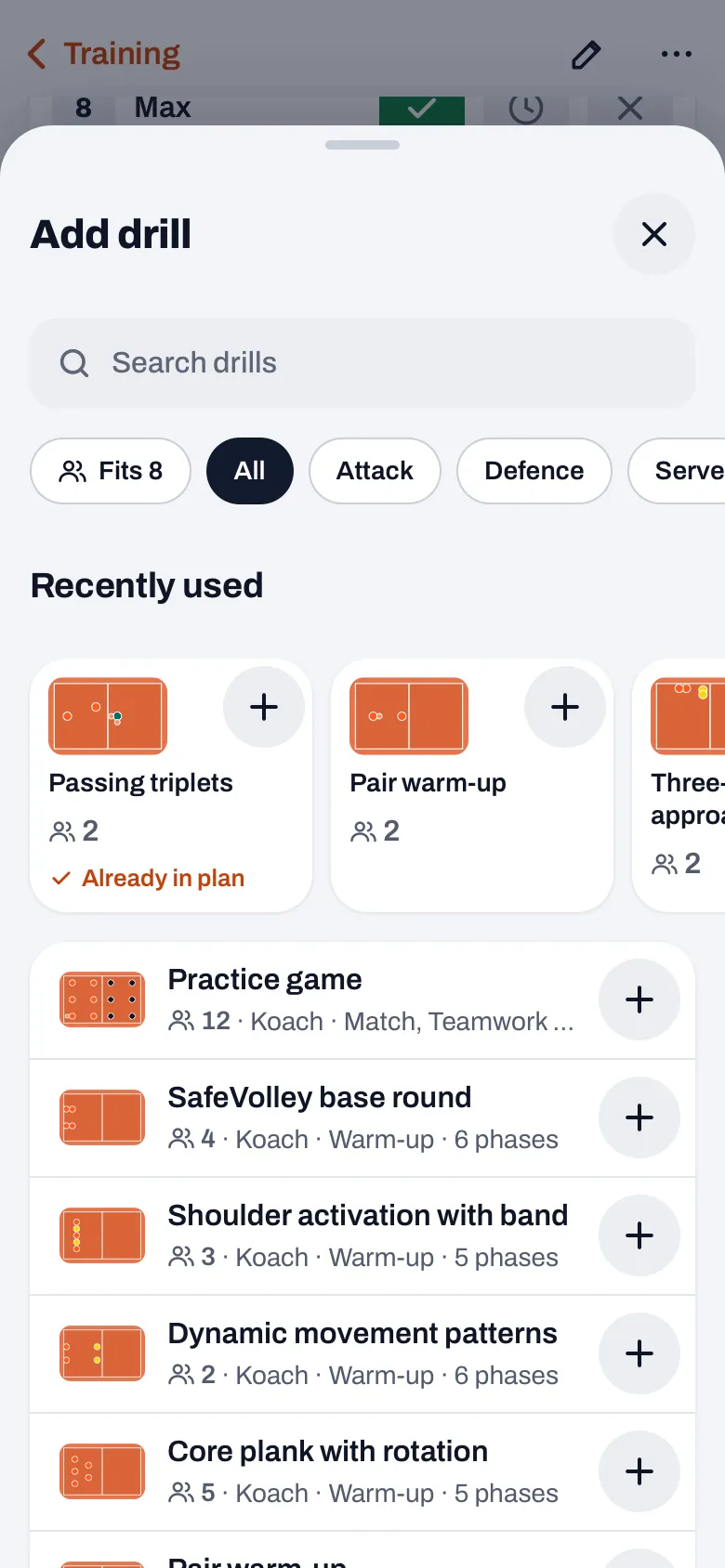
Koach does not measure muscle soreness. What you do in the app is build the practice from parts with minutes, so you see how much time that evening goes into jumping. After a tournament day or in the first week of the season, you choose a calmer drill in Add drill, for example a passing drill in pairs instead of an attacking series, and with Copy plan you take over the plan of an earlier, lighter practice. If you are a new coach, starting as a volleyball coach helps you on your way.
14 days free, no credit card. Put your first practices of the season in tonight and see how long each part takes.
Plan your practice in KoachWhat Koach costs after the trial is on the pricing page.
Frequently asked questions
How long does muscle soreness last after volleyball?
Delayed onset muscle soreness only shows up after practice and, according to a review by Hotfiel and colleagues (2018), is at its worst 48 to 72 hours after the exercise. After that it fades on its own. A rule of thumb of our own, based on that peak: if the pain is not better but worse after the third day, or if it sits in one spot or on one side, have it checked by your doctor or a physiotherapist.
Does being sore mean the practice was good?
No. Soreness mainly says that the load was unusual or braking, such as lots of landings or a new drill. If you do the same practice again next time, you usually get less sore while the training still works: that is called the repeated bout effect. So you do not measure a good practice by how stiff you are the next day.
Does stretching help against muscle soreness?
Hardly. A Cochrane review from 2011 found that stretching before or after exercise reduced soreness a day later by an average of half a point to one point on a 100-point scale, a difference you do not notice. Stretching can be a pleasant way to finish. What relieves the pain most is gentle movement, although that effect is temporary.
When should you see a doctor about muscle soreness?
A rule of thumb of our own: if the pain is not getting better but worse after the third day, if it sits in one spot or on one side, if there is swelling or if you can no longer make a certain movement, it is probably not ordinary soreness. Then see your doctor, a sports physician or a physiotherapist. If you have extreme muscle pain with dark or cola-colored urine, contact a doctor.
Ease into the new season
14 days free, no credit card. Plan your practices and see how long each part takes.
Get started with KoachOr read first what the volleyball coaching app does.