
Muscles used in volleyball: explained skill by skill
The short answer
The main muscles used in volleyball are in your legs, your trunk and your shoulders. Calves, thighs and glutes power the jump and absorb the landing, the trunk transfers the force, and the shoulder, chest and lats make the swing. Forearms, wrists and fingers join in when passing, setting and blocking.
Which muscles are used in volleyball? Almost all of them, but not all equally hard. The work runs in a chain, from the calf that pushes off to the wrist that contacts the ball. Below you read per skill which muscles do the work, why you are sore where you are sore after a tournament, and so what to train.
The overview: legs, trunk and shoulder do the work
Volleyball is a sport of short, explosive actions: jumping, landing, moving a few meters, hitting. Almost every action starts in the legs and ends in the hands. These are the muscle groups that do the work:
| Muscle group | What it does in volleyball |
|---|---|
| Calf muscles (gastrocnemius and soleus) | The final push on takeoff, absorbing the landing, quick small steps |
| Front of the thigh (quadriceps) | Straightening the knee in the jump, braking on landing, staying low for passing and defense |
| Glutes and back of the thigh (hamstrings) | Extending the hip in the jump; the gluteus medius keeps your knee straight when landing and moving sideways |
| Inner and outer thigh | A wide stance, shuffling sideways, lunging and diving |
| Trunk: abs, obliques, back | Rotating in spike and serve, landing stable, carrying force from the legs to the arms |
| Shoulder: deltoid and rotator cuff | Lifting and aiming the arm, keeping the head of the upper arm in its socket, slowing the arm after the swing |
| Muscles around the shoulder blade | Letting the shoulder blade move with the arm swing and the block |
| Pecs and lats | Pulling the arm forward and down in spike and serve |
| Back of the upper arm (triceps) | Straightening the elbow in the swing, the set and the block |
| Forearm, wrist and fingers | The wrist snap in the attack, the hands in set and block, a still platform in the pass |
The jump: from calf to arm swing
A jump is three joints extending one right after the other: hip, knee and ankle. The glutes and hamstrings extend the hip, the quadriceps extends the knee, and the calf muscles give the final push from the ankle. The arms swing up with it and help you get higher; anyone who keeps their arms still jumps lower. The trunk keeps everything in one line, so the force from the legs does not leak away on the way up.
On landing the same muscles work the other way round: they brake while they lengthen. That is harder work than it seems, and it is why after an evening of lots of blocking you mainly feel your thighs and calves. Landing softly, with your knees over your toes, spreads that load over the whole chain. How to train the jump itself is in jumping higher in volleyball.
The spike and the serve: a chain from legs to hand
A hard spike does not come from your arm alone. The movement runs like a whip from big to small: first the legs and hips, then the trunk rotating, then the shoulder, the elbow and finally the wrist. Research with elite players showed that the handball throw, the tennis serve and the volleyball spike share that sequence (Wagner and colleagues, 2014).
- Trunk. The obliques and the back muscles rotate the upper body open as you draw back and then powerfully back again. A strong trunk gives the swing its speed.
- Shoulder. In a muscle activity study with fifteen professional and college players spiking and serving (Rokito and colleagues, 1998), the front deltoid and the supraspinatus held the upper arm up and in place throughout the spike. As the arm was drawn back, the infraspinatus and teres minor rotated it outward, while the muscles at the front of the shoulder braked that movement and rotated the arm inward during the acceleration. In the serve the researchers saw the same pattern, only less intense.
- Chest and back. The pecs and the lats pull the arm forward and down. That is where the power behind the swing comes from.
- Arm and wrist. The triceps straightens the elbow just before contact, and the wrist flexors give the ball its final downward snap.
After contact the arm has to be stopped in a fraction of a second. That is mainly done by the muscles at the back of the shoulder and around the shoulder blade. You barely notice them in the swing itself, which is why they are often forgotten in training, while they work hard on every spike and serve. How to spot shoulder overload is in shoulder problems in volleyball.
Passing and defense: mainly legs and trunk
In the forearm pass your arms do almost nothing. The work is in the legs: the quadriceps and glutes keep you low, the inner and outer thigh muscles give you a wide stance and a quick step to the side. The shoulders and the muscles around the shoulder blade keep the platform still, and the trunk stops you from being pushed backward when a hard ball comes in. The forearms themselves are mainly the contact surface. The red marks and bruises beginners get there are usually a matter of technique, not weak muscles; see volleyball bruises on your arms.
Defense and diving ask the same, but lower and faster. In a dive the shoulders, the pecs and the arms catch your body, and the trunk keeps the landing under control.
Setting and blocking: fingers, wrists, triceps and calves
In the overhead set your fingers and wrists briefly cushion the ball and push it away again: the flexors and extensors of wrist and fingers first brake and then push. The triceps straightens the elbows, the front deltoid brings the arms up, and on a long set the legs supply a large part of the power. That last part is often forgotten. A set that comes only from the arms asks too much of the fingers and wrists.
In the block, the calves, quadriceps and glutes take you up, often several times per rally and usually without an approach. The deltoid and the muscles around the shoulder blade push your arms up and over the net, the trunk keeps you upright so you do not fall into the net, and firm wrists and fingers make sure the ball bounces back instead of pushing your hands back.
Feel where the work is. Do five jumps with your arms still at your sides and five with a full arm swing. You feel the difference straight away, and it shows that the jump is a chain: every link that joins in counts.
What does this mean for your training?
Train the chain, not single muscles. Big exercises such as squats, lunges, a weighted hip hinge and rows hit the muscles that work together in the jump and the swing in one movement; a program is in strength training for volleyball players. Three areas often get too little attention in volleyball players:
- The calves and ankles. They work in every jump and landing, but rarely make it onto the program.
- The back of the shoulder. It brakes every swing. Band exercises where you rotate the arm outward are the standard for that; a series is in resistance band exercises for volleyball.
- The trunk. Not just abs, but staying firm against rotating and bending; see core exercises for volleyball.
Muscle soreness one or two days after a hard practice or a tournament is normal, especially after lots of jumping or after a break. Pain in a joint, pain that comes back every practice or that does not ease after a few days is something else: have it checked by a doctor, sports medicine doctor or physiotherapist. If you coach a team and have just started, starting as a volleyball coach shows how to give injury prevention and recovery a place from the first practice.
Giving strength work a fixed place in your training week
Fifteen minutes of strength or core work after the warm-up only lasts if it comes back every week. In Koach you put it in a practice plan as a section, with the exercises in the description. With Copy plan you take over the plan of an earlier practice, including that block. An exercise players do at home you send with Homework on that drill: whoever gets it sees it on their own dashboard in the app.
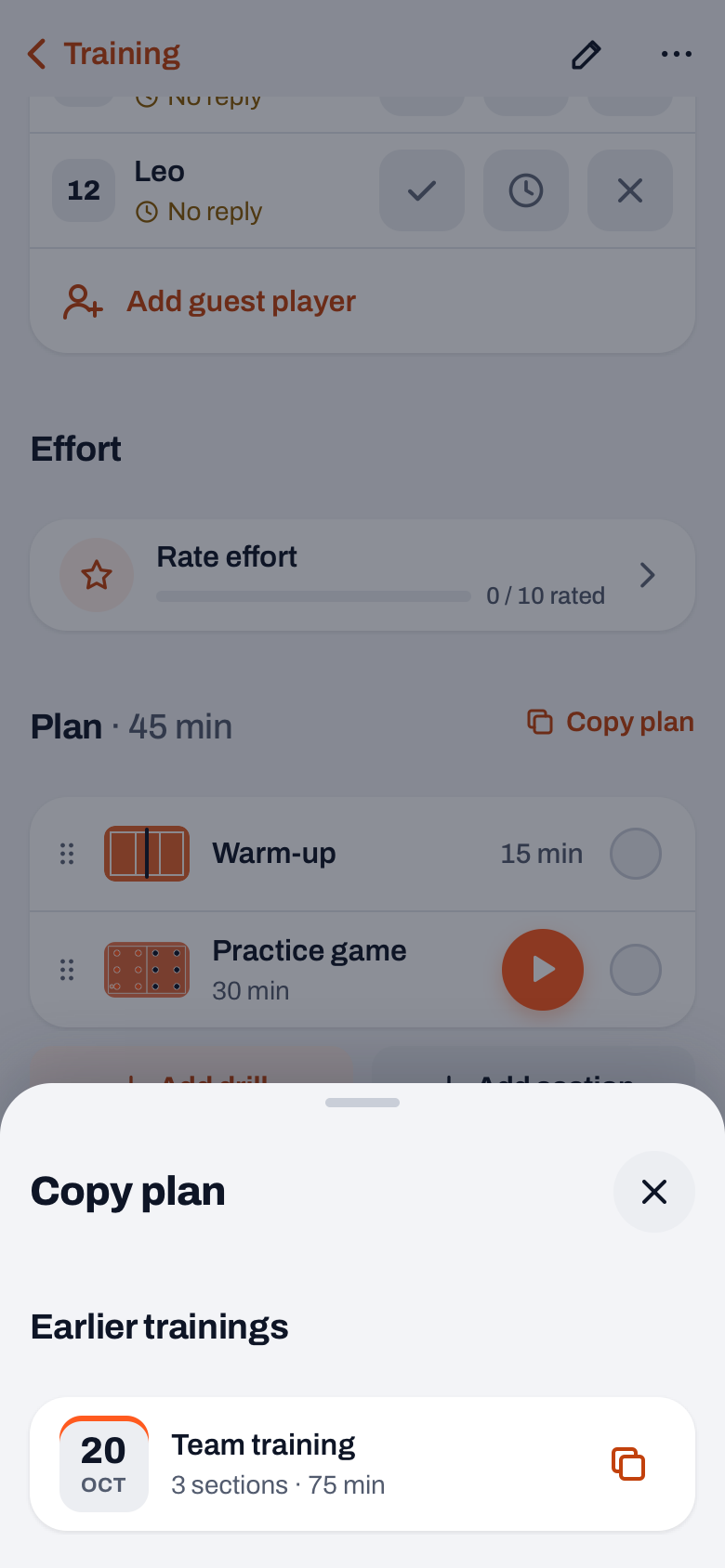
What Koach costs after the 14 free days is on the pricing page.
14 days free, no credit card. Put fifteen minutes of strength work in your practice plan and bring it along every week with Copy plan.
Plan your practice in KoachFrequently asked questions
Does volleyball work your abs?
Yes, but mainly as stabilizers. In the spike and the serve the obliques rotate the upper body, and on every landing the abdominal and back muscles keep your trunk firm. Visible abs will not come from it on their own; core training alongside volleyball makes your swing stronger and your landing more stable.
Why do my forearms hurt after volleyball?
Usually that is not muscle soreness but tenderness where the ball hits: in the pass your forearms take the ball. For beginners, after a long passing session or with an overinflated ball that is normal and fades within a few days. If it keeps coming back, look at your platform and the contact point.
What muscles should you train for volleyball?
The big groups that work together in the jump and the swing: legs and glutes, the trunk, and the shoulder with the muscles around the shoulder blade. Give the calves and the back of the shoulder extra attention too, because they work hard on every landing and swing and are missing from many programs. Two short sessions a week with big exercises are enough for most club players.
Why do my calves hurt after volleyball?
Your calves work in every takeoff, landing and small step, and in blocking often several times per rally. After a tournament or a summer break, soreness there is normal and fades within a few days. Pain in one spot of the calf, or pain that comes on suddenly during a jump, should be checked by a doctor, sports medicine doctor or physiotherapist.


Give strength work a fixed place in your week
14 days free, no credit card. Copy your strength block into every practice.
Get started with KoachOr read first what the volleyball coaching app does.