
Muscle cramps during sports: causes and what to do courtside
The short answer
Muscle cramps during sports are sudden, painful contractions of a muscle, usually in the calf, hamstring or thigh, often towards the end of hard exercise. According to recent research, fatigue plays the main role, not just fluid loss. Stretch the muscle gently until the cramp lets go.
Muscle cramps during sports show up in volleyball at predictable moments: in the fifth set, in the third match of a tournament day or at the first practice after the summer. This is what happens according to sports medicine, what you do courtside and how to prevent cramp next time.
What is a muscle cramp during exercise?
Sports physicians speak of exercise-associated muscle cramps: a painful, involuntary contraction of a skeletal muscle during or shortly after exercise. That is how a review in the Journal of Athletic Training (Miller and colleagues) describes it, which brings together the research on cause, treatment and prevention. Cramp mainly affects muscles that work hard and cross two joints, such as the calf, the hamstrings and the front of the thigh; the foot can cramp too. According to the information from the UK National Health Service (NHS), a leg cramp lasts from a few seconds to ten minutes, and the muscle can stay tender for a while afterwards.
This article is about cramp during or just after sport. Cramp that comes on at night or at rest is a different story; with persistent complaints, see your doctor about that.
What causes cramp? Not just drinking too little
For a long time the explanation was simple: you sweat out fluid and salt, and then the muscle cramps. As the only cause, that explanation does not hold up in the research. According to the review by Miller and colleagues, fluid loss through sweat is only a small factor for most athletes. Cramp arises from a combination of factors, with fatigue in the main role: in a tired muscle the signal to contract gets stronger and the brake on it weaker, and then the muscle no longer lets go.
The risk factors that keep coming back in the research:
- Having had cramp before. Whoever cramps more often has the highest chance of a next time.
- Harder or longer than you are used to. A higher pace or a longer effort than you have trained for. That is why cramp often comes towards the end of a match.
- Heat. Cramp is more common in summer, but according to the review it is not linked to body temperature and can occur in any weather.
In volleyball that translates into recognizable moments: the fifth set of a long match, the last matches of a tournament day, the first weeks of the season when the body is not yet used to the jumps and dives, a substitute who suddenly plays three full sets, or a cup match against a stronger opponent in which the pace is higher than in practice. Eating little and sleeping badly make it worse. Fluid and salt do matter for players who sweat heavily and saltily, in a hot gym or on a long tournament day. So drinking well remains sensible; how much is in volleyball player nutrition.
What to do courtside when a player cramps
Gentle stretching is, according to the review, the fastest, safest and most effective approach. This is how you handle it:
- Take the player out of the game. Playing on with a cramped calf does not work, and a player who lands on one leg risks more than a point.
- Stretch the muscle gently, without forcing it. Calf: leg straight and pull the front of the foot towards you, or stand and put your weight on the cramped leg with the heel on the ground. Hamstring: lie on your back and have the straight leg lifted. Front of the thigh: heel towards your buttocks, standing with support or lying on your side. Foot: pull the toes up.
- Hold until the cramp lets go. Then massage lightly and walk calmly.
- Let the player drink if they want to. Water or a sports drink, without forcing it.
- Do not give medication. According to the review, only with a doctor's approval. Quinine, including in tonic water, is not recommended.
Can the player go back in? If the muscle is relaxed and pain-free and they can push off and land again without the cramp returning, they can try. The risk of a new cramp stays raised for a while, even after the muscle has let go. If the cramp comes back, the match is over for that player.
The rules help here. Under the FIVB Official Volleyball Rules, a player who cannot continue because of injury or illness is substituted. Preferably use a regular substitution for that: a starting player may leave the game once per set and re-enter once, in their own position in the line-up (Rule 15.6.1), so your cramping player can come back later in the set. If a regular substitution is no longer possible, Rule 15.7 allows an exceptional substitution, but a player replaced that way may not take part for the rest of the match. If you have nobody at all to substitute, the player gets a one-time recovery time of three minutes (Rule 17.1.2). Whether something counts as an injury is up to the referee, and leagues can have their own substitution rules for youth and lower divisions. The regular rules are in the volleyball substitution rules.
Agree on a fixed spot and a fixed helper. A player with cramp goes to the same spot along the sideline, and the team manager or a substitute helps with stretching. Then you are not pushing on a calf yourself while you need to sort out a substitution.
Such an agreement is easiest to make at the start of the season, together with the other practical matters from your first season as a volleyball coach.
When it is not an ordinary cramp
An ordinary cramp lets go when you stretch. If it does not let go, or the picture does not fit, do not treat it as cramp:
- Stretching does not help, or the cramp lasts longer than ten minutes.
- The muscle stays hard, swollen or painful once the cramp is over, or stretching actually hurts more. If it felt like a blow or a kick to the calf, it is more likely an injury than a cramp: stop and have it checked.
- The player becomes dizzy, confused or nauseous, vomits, faints or has dark urine afterwards. Stop immediately and call for medical help.
- The cramp keeps coming back, also at rest or at night, or comes with numbness or swelling in the leg.
With persistent or severe complaints, and with cramp that keeps coming back, see a doctor, sports physician or physiotherapist. This article gives general information and no diagnosis.
How to prevent muscle cramps during sports
Because cramp can have a different cause for each player, prevention starts with a question: when do you get cramp? After an hour and a half, only at tournaments, only in a hot gym, or after a week of little sleep? The review recommends tailoring the approach to those personal risk factors. For a volleyball team that comes down to:
- Train for match load. Also train in long blocks at match pace and with jump series, not only in short drills. Build up the load over a few weeks after the summer; see conditioning for volleyball players.
- Strength and jump training where fatigue is the problem. The review names this as a measure for athletes whose cramp is triggered by fatigue.
- Rest after hard days. After a tournament day or a long match, do not schedule a hard practice the next day.
- Eat and drink well. Enough carbohydrates on match day, and on a long tournament day small portions between matches; the schedule is in what to eat before a volleyball match. Drink during the breaks, and do not take extra salt or supplements on your own initiative.
- Spread the playing time on long days. Substitute deliberately on a tournament day, so the same six players do not play everything.
- Do not count on stretching beforehand. In the studies from the review, stretching as preparation had no effect on cramp. Dynamic stretching in the warm-up is useful for other reasons; see volleyball stretches.
Do magnesium, tonic water or pickle juice help?
What the review by Miller and colleagues says about the remedies that go round every locker room:
| Claim | What the research says |
|---|---|
| Cramp comes from drinking too little | A small factor for most athletes; fatigue weighs more |
| Magnesium prevents cramp | A Cochrane review (2020) found no clinically meaningful effect against a placebo in older adults with muscle cramps; for cramp during sport there are no good studies |
| Tonic water or quinine helps | Not recommended: little effect and a risk of side effects |
| Pickle juice works | In one small study cramp disappeared faster with a small amount than with water, probably through a reflex and not because of the salt |
Do not give youth players supplements against cramp. If cramp keeps coming back, that is a question for the doctor or sports physician, not for the sports shop.
Cramp and your substitutions during the match
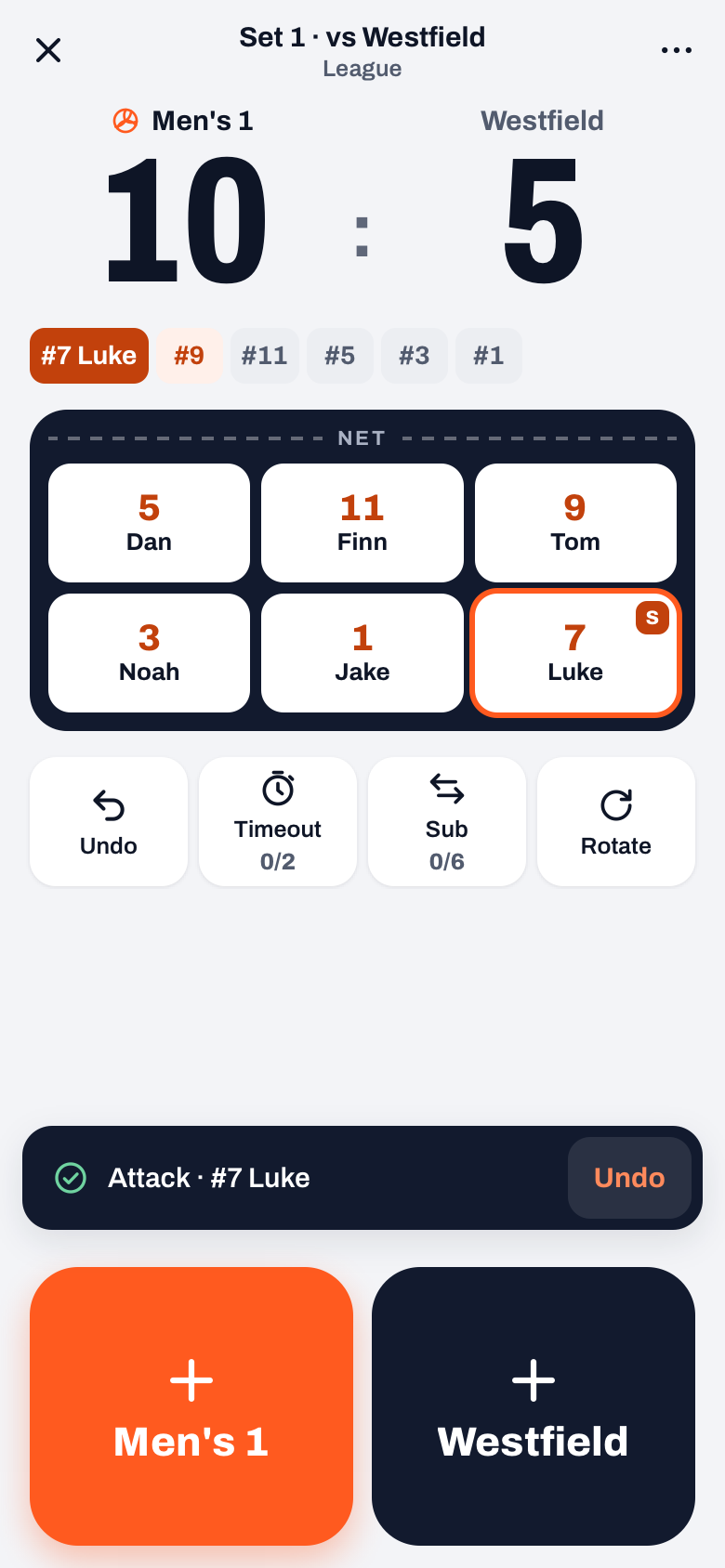
Koach does not prevent cramp, but it helps you keep track in the moment. On the live screen the Sub button shows how many substitutions you have already used in this set, so you see at a glance whether you can still substitute your cramping player normally. After a match you tracked live, you see under Players, in the Playing time block, the number of rallies and sets per player: handy for spreading the load on a tournament day. And if a player cramps more often, write it down after practice as a player note with Follow up switched on, so you see a pattern before you talk to the player or parents.
What Koach costs after the 14 free days is on the pricing page.
14 days free, no credit card. Score your next match live and see afterwards who played how many rallies.
Try Koach in your next matchFrequently asked questions
How do you get rid of a cramp fast?
Stretch the cramped muscle gently and without forcing it, and hold that until the cramp lets go. For a calf cramp you pull the front of the foot towards you with a straight leg, or you stand and put your weight on the leg with the heel on the ground. Then massage lightly and walk calmly. According to sports medicine research, gentle stretching is the fastest and safest approach.
Why do you get cramp at the end of a match?
Because fatigue is the main cause. In a tired muscle the signal to contract gets stronger and the brake on it weaker. That is why cramp often comes in the last set, on a long tournament day or in the first weeks of the season, when you play harder or longer than your body is used to. Whoever has cramped before has a higher chance of a next time.
Does magnesium help against cramp?
Probably not. A Cochrane review found no clinically meaningful effect of magnesium against a placebo in people with ordinary muscle cramps, mostly older adults, and for cramp during sport an effect has not been shown. Do not take supplements on your own initiative, and do not give them to youth players. If you cramp often, discuss it with your doctor or a sports physician.
Can you keep playing after a cramp?
If the muscle is relaxed and pain-free and you can push off and land again without the cramp coming back, you can try. The chance of a new cramp stays raised for a while. If it comes back, stop for that day. If the muscle stays hard or painful, or it felt like a blow to the calf, have it checked.


Keep your substitutions and playing time in view
14 days free, no credit card. After a tournament day you see who played the most.
Get started with KoachOr read first what the volleyball coaching app does.