
Volleyball player diet: what to eat on a training day
The short answer
A good volleyball player diet on a training day: three regular meals with carbohydrates and protein, a small snack one to two hours before practice and something with protein within two hours after it. Spread your drinking over the day. Most players do not need supplements.
A volleyball player diet is not a diet in the strict sense but a plan. You often train in the evening, your day is full of school or work, and the question is not which superfood to eat but when to eat what. This article is about an ordinary training day; match day has a schedule of its own.
What does a volleyball player need?
Volleyball is a sport of short, explosive actions with breaks in between: jumps, short sprints, dives, and then standing still for a moment. The fuel for those actions comes mainly from carbohydrates. Muscle recovery needs protein. And everything rests on an ordinary, healthy base: according to the World Health Organization's guidance, at least 400 grams of fruit and vegetables a day, less than 10 percent of your energy from free sugars and less than 5 grams of salt.
For athletes there are more precise guidelines. The best known is the joint position of the American and Canadian dietetic associations and the American College of Sports Medicine: Nutrition and Athletic Performance (2016). It works in grams per kilo of body weight per day. The third column is our own translation to volleyball.
| Load | Carbohydrates per day | In volleyball, for example |
|---|---|---|
| Light: low intensity or mainly technique | 3 to 5 g per kg | Recreational team, one or two practices a week |
| Moderate: about 1 hour a day | 5 to 7 g per kg | Competitive team with three or four practices a week |
| High: 1 to 3 hours a day, moderate to vigorous | 6 to 10 g per kg | Elite level with daily practice and strength work |
For protein the same position gives 1.2 to 2.0 grams per kilo per day, spread in portions of about 0.3 grams per kilo: after a practice and otherwise every three to five hours. According to the authors you can usually get that from ordinary food.
A worked example for an adult player of 70 kilos on a competitive team: 5 to 7 grams of carbohydrate per kilo is 350 to 490 grams a day, and 1.2 to 2.0 grams of protein per kilo is 84 to 140 grams. Per meal or snack, 0.3 grams of protein per kilo is about 21 grams. You do not need to track those numbers. They show that carbohydrates are the main part, and that protein needs to be spread over the day instead of eaten in one big portion in the evening.
These guidelines are written for adult athletes. For young players the rule is: eat healthily and enough, no counting grams. A growing child needs energy to grow as well as to play sport. If a player has diabetes, an allergy, a prescribed diet or a troubled relationship with food, their doctor or dietitian decides what applies, not this article and not the coach. If a player is often exhausted, loses weight without trying or has ongoing complaints, that belongs with a doctor or sports physician.
A training day: how to spread your food
The biggest mistake on a training day is not what you eat, but the long gap. If you have lunch at 12:30 and practice at eight, you walk into the gym on an empty tank. The position gives 1 to 4 grams of carbohydrate per kilo in the 1 to 4 hours before exercise lasting more than an hour: the closer to practice, the smaller and easier to digest.
Say you practise from 8:00 to 9:30 pm. Two set-ups work in practice:
| Time | A: dinner first | B: dinner after practice |
|---|---|---|
| 7:30 am | Breakfast | Breakfast |
| 12:30 pm | Lunch | Bigger lunch |
| 4:00 pm | Snack | Snack |
| 5:30 pm | Dinner, normal and not greasy | Small meal, such as sandwiches |
| 7:00 pm | Banana or a slice of bread with jam | Nothing, or a banana |
| After 9:30 pm | Yogurt, milk or a sandwich | Hot meal with protein |
Set-up A suits players who are home in time, set-up B players who go straight from work or school to the gym. Both provide fuel during practice and protein afterwards. If your practice starts at 6:00 pm, lunch is your last big meal beforehand: have a solid snack around 4:00 pm and your hot meal after practice.
What is on the plate does not have to be special. Bread, pasta, rice, potatoes, oats and fruit provide carbohydrates; dairy, eggs, fish, meat, legumes and tofu provide protein. If you eat vegetarian, dairy, eggs and legumes also get you enough protein, as long as you spread them over the day. On match day the start time decides everything; that schedule is in what to eat before a volleyball match. How much energy a practice uses is in calories burned playing volleyball.
Pack your snack in the morning. The snack before an evening practice is the one most often skipped, because by five o'clock nobody thinks of it anymore. Put a banana or a sandwich in your sports bag in the morning, next to your water bottle.
After practice: protein within two hours
Muscles recover best when protein comes in during the first hours after practice. The position gives 0.25 to 0.3 grams of protein per kilo, for most athletes 15 to 25 grams, in the 0 to 2 hours after exercise. You do not need a shake for that: a meal or snack with dairy, egg, fish, meat or legumes does the job, and if your dinner falls after practice, that simply is your recovery meal. Add carbohydrates, especially if you train again the next day.
What else counts after practice, with sleep first, is in cool-down and recovery and in sleep and sport.
How much should you drink around practice?
According to the same position, you drink 5 to 10 millilitres per kilo of body weight in the 2 to 4 hours before practice; for someone of 70 kilos that is 350 to 700 millilitres, spread out. During practice the goal is to lose no more than 2 percent of your body weight in fluid. For an ordinary practice of an hour and a half, water is enough for most players.
If you want to know how much you sweat, weigh yourself once just before and after a practice, without wet clothes. Say you are 0.8 kilos lighter: then you drink 1.0 to 1.2 litres over the following hours, because the position advises 1.25 to 1.5 litres per kilo lost. A simpler check without scales is the colour of your urine: pale yellow is good, dark means you are behind.
Supplements, sports drinks and energy drinks
For club volleyball there is little reason to use supplements; the position itself says protein needs can usually be met from ordinary food. For young players supplements are not on the table. If an adult player is still considering something, have them discuss it with a sports dietitian. An energy drink is not sports nutrition, and caffeine late in the evening costs you sleep, and with it your recovery.
Knowing when you train is half the plan
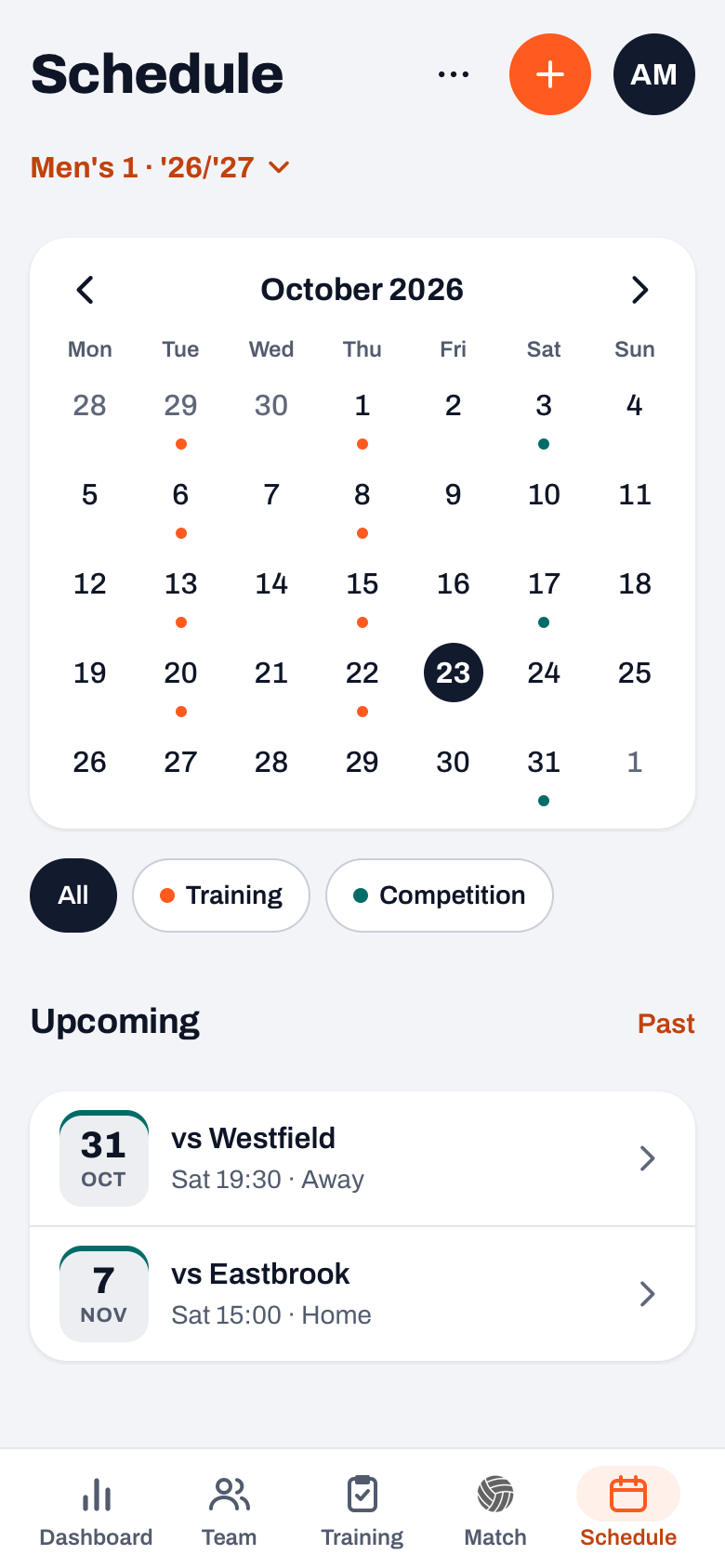
An eating plan for a training day starts with the question of what time practice is, and ideally you know that at breakfast, not at half past six in the evening. In Koach all your team's practices and matches are in the schedule, and with Sync calendar you put them in your phone's calendar. Then you see in the morning that you train at eight and know how to plan your day. Coaches add the practices for the whole season in one go; players and parents see them automatically. If you are a coach looking for a foothold in your first year, read starting as a volleyball coach.
14 days free, no credit card. Put your practices for the whole season in the schedule and let your players see them on their phones.
Try Koach with your teamWhat Koach costs after the trial is on the pricing page.
Frequently asked questions
How much protein does a volleyball player need per day?
For adult athletes the position of the American College of Sports Medicine and the dietetic associations gives 1.2 to 2.0 grams of protein per kilo of body weight per day. For someone of 70 kilos that is 84 to 140 grams. More important than the total is how you spread it: about 0.3 grams per kilo per meal or snack, including after practice. You can usually get that from ordinary food.
What is the best thing to eat after volleyball practice?
Within two hours, a meal or snack with protein and carbohydrates, such as yogurt with muesli, sandwiches with cheese or egg, or a hot meal with pasta or rice and meat, fish or legumes. Drink water with it to replace the fluid you lost in the gym.
What should you eat before an evening practice?
Make sure you do not walk into the gym after a gap of six hours or more. Eat a normal, not too greasy meal early in the evening and have something small one to two hours before practice, such as a banana or a slice of bread with jam. If you go to practice straight from work or school, eat a smaller meal beforehand and your hot meal afterwards.
Do volleyball players need supplements?
Usually not. With ordinary meals and snacks you get the carbohydrates and protein you need for volleyball. For young players supplements are not on the table. If an adult player is still considering something, a sports dietitian is the right person to discuss it with.
How much should you drink at volleyball practice?
In the hours before practice, drink about 5 to 10 millilitres per kilo of body weight, spread out, and take a few sips regularly during practice. According to sports nutrition guidelines the goal is to lose no more than 2 percent of your weight in fluid. If you weigh yourself before and after, drink 1.25 to 1.5 litres per kilo lost afterwards.


Know in the morning when you train
14 days free, no credit card. Your practices go straight into your phone's calendar.
Get started with KoachOr read first what the volleyball coaching app does.