
How many calories does volleyball burn? Per hour and on sand
The short answer
How many calories does volleyball burn? The Compendium of Physical Activities lists recreational volleyball at 3 METs, a competitive indoor match at 6 METs and beach volleyball at 8 METs; one MET is about 1 kcal per kilogram per hour. At 70 kilograms an hour of volleyball burns roughly 210, 420 or 560 calories (kcal). These remain estimates.
How many calories volleyball burns depends on how you play, for how long and how much you weigh. With the values from the Compendium of Physical Activities you can work it out yourself in a minute, for a match, a practice or an afternoon on the sand. Here are the numbers, the formula and why the result stays an estimate.
How many calories does volleyball burn per hour?
The numbers in this article come from the Compendium of Physical Activities, a scientific list of the energy cost of more than a thousand activities. The 2024 version was made for adults aged 19 to 59. Energy cost is given in METs: a multiple of what your body uses at rest. According to the Compendium, one MET is 1 kcal per kilogram of body weight per hour, roughly what you use sitting quietly.
For volleyball the Compendium gives these values:
- Volleyball, non-competitive, general play (code 15720): 3.0 METs. Think of recreational play or a relaxed game.
- Volleyball, competitive, in a gym (code 15711): 6.0 METs. A league match.
- Beach volleyball, in sand (code 15725): 8.0 METs.
Multiply those values by your weight and you get the energy use per hour. Rounded to whole kilocalories:
| Weight | Recreational (3 METs) | Indoor, competitive (6 METs) | Beach (8 METs) |
|---|---|---|---|
| 50 kg | 150 kcal | 300 kcal | 400 kcal |
| 60 kg | 180 kcal | 360 kcal | 480 kcal |
| 70 kg | 210 kcal | 420 kcal | 560 kcal |
| 80 kg | 240 kcal | 480 kcal | 640 kcal |
| 90 kg | 270 kcal | 540 kcal | 720 kcal |
These are gross numbers per hour: they include what your body would have used in that time without any sport.
How to work it out yourself
The formula follows directly from the definition of a MET:
kcal = METs × body weight in kg × duration in hours
Say you weigh 65 kilograms and play a league match in which you are on the court for an hour and a half. Then it is 6 × 65 × 1.5 = 585 kcal. If you want to know what the volleyball costs you on top of resting, subtract 1 MET: 5 × 65 × 1.5 = 487.5, rounded 488 kcal. The difference, 97.5 kcal, you would also have used sitting on the couch for that same hour and a half.
If you spend part of the match on the bench, count that time as rest. Say the same player sits out one set of half an hour and plays for an hour: 6 × 65 × 1 = 390 kcal on the court, plus 1 × 65 × 0.5 = 32.5 kcal on the bench, together 422.5, rounded 423 kcal.
A whole week works the same way. Say you weigh 75 kilograms, practice twice for an hour and a half and play a match in which you are on the court for an hour. The match is 6 × 75 × 1 = 450 kcal. If you count the practices as recreational, together they are 2 × 3 × 75 × 1.5 = 675 kcal; if they are as intense as a match, 2 × 6 × 75 × 1.5 = 1350 kcal. So that week costs you between 1125 and 1800 kcal of volleyball, counted gross.
Count the time you actually play. Not the time from packing your bag until you are home again, but the minutes on the court. An hour in the gym with twenty minutes of explanation and waiting is not an hour of volleyball.
Practice, match or sand: where is the difference?
A practice
The Compendium has no separate value for a volleyball practice. How intense a practice is depends on how it is built: an evening with long lines and lots of explanation is closer to the recreational 3 METs, a practice with short lines, defensive series and intense game forms closer to the 6 METs of a match. Say you weigh 70 kilograms and practice for 90 minutes. Then your energy use lies between 3 × 70 × 1.5 = 315 kcal and 6 × 70 × 1.5 = 630 kcal. How much of a practice is really playing time is in how long a volleyball practice should be. How the coach builds up the load with jump and speed work is in conditioning for volleyball players.
A match
For a match you use the 6 METs of competitive indoor volleyball. A match consists of short rallies with short breaks in between, and the 6 METs is a value for that activity as a whole, not for the rallies alone. What you do subtract yourself is the time on the bench and the breaks between sets.
Beach volleyball
Sand comes out at 8 METs, higher than indoors. That matches what you feel: every step and every jump costs more in soft sand, and with two players per team you are involved in almost every rally. If you play on a hot day, drink in time, even when you are not thirsty.
Why the number differs from person to person
A MET value is an average. The Compendium uses the same resting energy use for everyone, while your own resting energy use depends on your age, sex, height and weight. For a personal estimate the authors therefore describe a corrected MET, based on your own data. On top of that, how hard you work plays a part: how many rallies, how many jumps, and which position you play.
- Children and teenagers up to 18. For them there is a separate Youth Compendium of Physical Activities, with values based on the child's own resting energy use. So the adult formula does not simply apply to them.
- Aged 60 and over. For this group the authors of the Compendium have a separate list, the Older Adult Compendium, which works with a lower resting energy use. Volleyball is not in it, so for older players the formula above is a rough estimate.
- Sports watches and apps. They calculate with your heart rate and your data. That is an estimate too, not a measurement.
What does this mean for eating and drinking?
Above all, the formula shows that a player who practices three times a week and plays at the weekend clearly needs more energy on those days. If you eat too little, you notice it in your legs in the last set. What to eat on a training day and when is in volleyball player nutrition, and the schedule for match day in what to eat before a volleyball match.
If you want to lose or gain weight on purpose, do not use these numbers as a diet, but talk to your doctor or a sports dietitian. Do not let youth players eat less on their own initiative to lose weight. And if you lose weight without meaning to, or often feel dizzy or exhausted after practice, see your doctor or a sports physician.
Your practice time in Koach
Koach does not count calories and does not measure heart rate. What the app does track is how long a practice lasts and which sections it consists of. The plan of a practice shows the duration of each section, with the total time at the top. As a player you see that plan with your practice, and on your dashboard how many practices you attended this season. With those minutes and the formula above you make your own estimate.
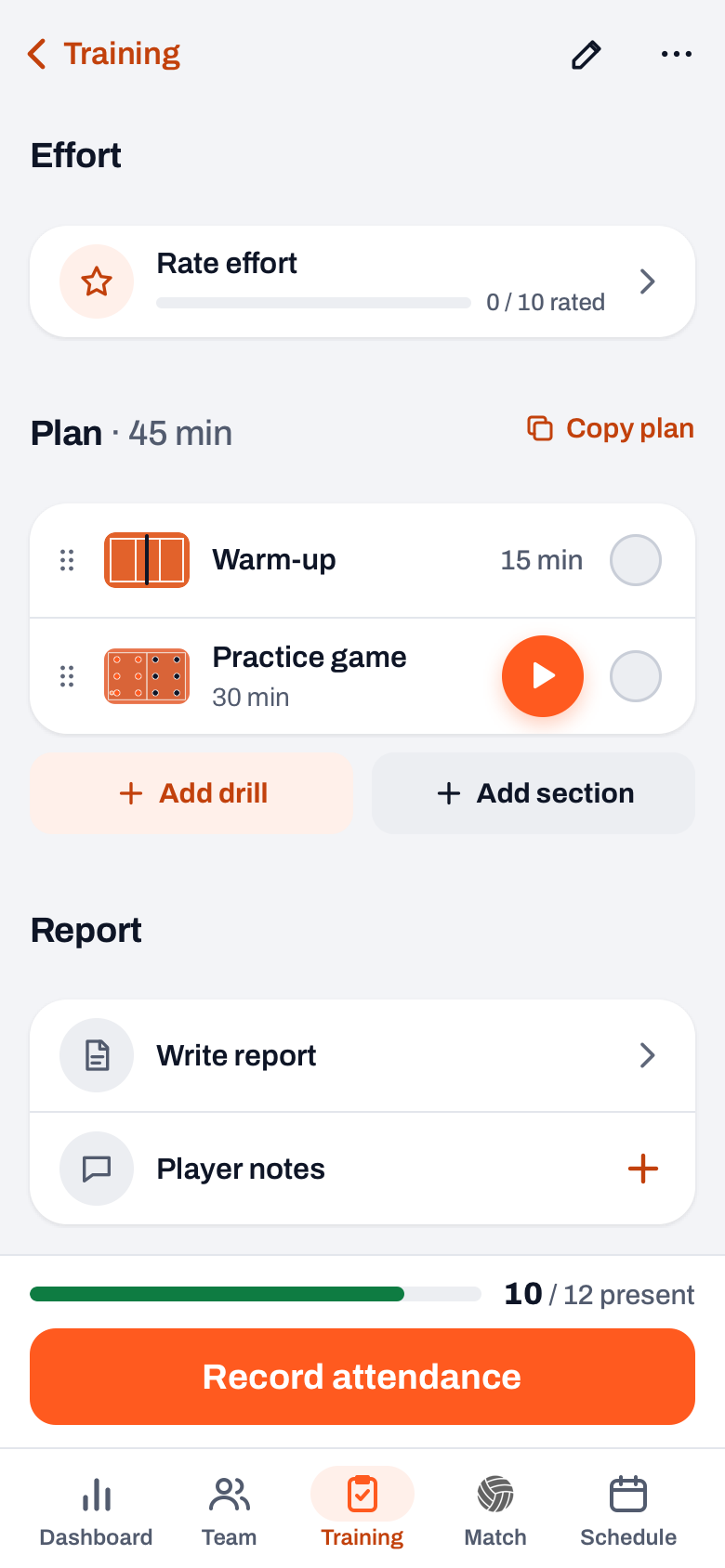
For the coach that plan is mainly a way to spread the load: no heavy blocks back to back, and game forms in which everyone takes part. If you are new to coaching, you find the basics in starting as a volleyball coach. What Koach costs after the trial is on the pricing page.
14 days free, no credit card. Put your practices in Koach with the duration of each section, and your team sees what is on the program.
Plan your practices in KoachFrequently asked questions
How many calories do you burn in an hour of volleyball?
That depends on your weight and how you play. The Compendium of Physical Activities gives 3 METs for recreational volleyball and 6 METs for competitive indoor volleyball. One MET is about 1 kcal per kilogram per hour, so someone weighing 70 kilograms burns roughly 210 kcal per hour playing recreationally and 420 kcal in a league match.
Do you burn more calories playing beach volleyball than indoors?
According to the Compendium of Physical Activities, yes: beach volleyball in sand is listed at 8 METs, competitive indoor volleyball at 6 METs. For someone weighing 70 kilograms that is roughly 560 against 420 kcal per hour. Moving and jumping in sand costs more, and with two players per team you are involved in almost every rally.
Is volleyball good for losing weight?
Volleyball costs energy and counts towards what you use per day, especially if you practice several times a week. Whether you lose weight depends mostly on what you eat and on your whole day. If you want to lose weight on purpose, talk to your doctor or a sports dietitian, and never let youth players eat less on their own initiative.
How many calories does a child burn playing volleyball?
For children you cannot simply use the adult formula. There is a separate Youth Compendium of Physical Activities, with values per age group based on the child's own resting energy use. For a child who plays sport, what matters most is eating and drinking enough; counting is not necessary.



Plan your practices with the minutes included
14 days free, no credit card. Your team sees in advance what is on the program.
Get started with KoachOr read first what the volleyball coaching app does.