
How to keep bench players engaged: give them a real job
Every team has them: the players who turn up twice a week and get five points of court time on Saturday. They rarely say anything, they rarely complain — they simply quit in March. Staying involved doesn't happen by itself for them; it is something you organise.
Why bench players drift away — and when
Drifting away happens in stages, and they are easy to recognise. First the effort disappears in the warm-up. Then comes the first missed practice with no clear reason. Next the player stops taking his own errors seriously ("doesn't matter anyway") and finally you get the message that he needs a break for a while. There are usually six to eight weeks between stage one and stage four. That is your window — after that you are talking to someone who has already given up.
The underlying cause is rarely the playing time itself. Players accept a reserve role surprisingly well, as long as they have three things: an honest explanation of why, a visible route into the six, and the feeling that they are needed for something on Saturday. Take away one of those three and five minutes on court becomes a humiliation instead of a contribution.
Be honest about the role, not vague
The biggest mistake is comforting vagueness: "you're definitely part of this, we need everyone." Players would rather have a sharp truth. At the start of the season, have a short role conversation with every player and say it as it is: "Right now you are the second outside hitter. I'm counting on you for a serving run, for a rally where we need defence, and in the fourth set if it's going well. What I want to see before you start is a more stable pass under pressure." That is concrete, honest and gives them something to work with. Then turn that development point into a personal goal, so it doesn't stay a one-off conversation.
Five jobs that turn the bench into a role
- Serve scout. One player notes per opponent who breaks down under pressure. Gives you concrete serving targets in the third set.
- Attack scout. Tracks the opponent's main hitter: which direction, and which shot after a bad pass?
- Block caller. Calls the opponent's approach from the bench ("middle's coming!") — legal, useful and surprisingly instructive for the player himself.
- Warm-up keeper. Responsible for tossing and hitting between sets, so whoever comes on isn't serving cold at 22-22.
- Substitution tracker. Keeps track of which subs have been used and which rotation is coming up — see also the substitution rules, because that is where teams without a second referee go wrong most often.
Rotate those jobs every match. A fixed role feels like a consolation prize after three weeks; a rotating job feels like teamwork.
Playing time: the conversation not to postpone
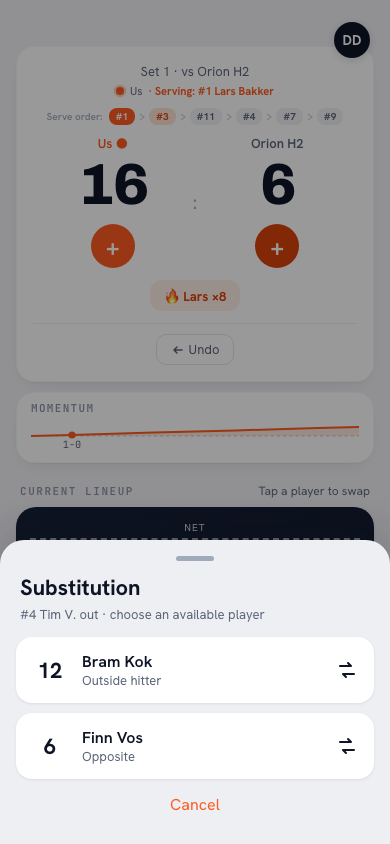
The playing-time overview in Koach tells you who has been sitting for three matches, usually before they tell you themselves. That signal is your cue for a five-minute conversation, not for a guilty conscience. Say what you see ("you've hardly played for three matches and that doesn't match what we agreed"), explain what the reason was and agree when it changes. Alongside that, work with one simple rule you announce in advance, for example: everyone plays at least one set per match, or everyone who came to every practice starts at least once every three matches. How to handle that in practice without weakening your team is in dividing playing time fairly.
You earn your bench back at practice
Whoever plays least on Saturday should get the most touches on Tuesday. That isn't consolation, it is logic: that player hasn't had the match minutes to learn from. A few practical choices: let bench players start the game-based drills instead of finishing as ball feeders, deliberately put them in the strongest six for part of the session, and give them the position you need them in on match day. Avoid the classic pattern where the starters play six-on-six and the rest feed balls — that is the clearest possible signal that there are two categories of player.
With youth teams the rules are different
In youth teams playing time is not a reward but a development tool. A thirteen-year-old who plays twenty percent of the minutes develops measurably slower than his teammates — and that gap widens every season. With youth, an even split is therefore the rule rather than the exception, and you explain to parents beforehand how you handle it. It also helps to deliberately decouple winning and losing from the lineup at youth level: a coach who lets the title decide who plays produces players who quit as soon as they are no longer the best.
The simplest check: does every player know before the match when they are going on? If so, you have a bench. If not, you have six spectators in tracksuits — and sooner or later they drop out.
Frequently asked questions
Do I have to give everyone equal playing time?
In youth teams a near-equal split is the standard, because playing time there is learning time. In performance-focused senior teams playing time may differ, provided you explain in advance what you select on and then actually stick to the arrangements.
How do I keep a bench player warm during a match?
Get the bench moving between sets and give whoever is likely to come on a short hitting or serving run in the warm-up area. A player who has been cooling down for twenty minutes and then has to serve at 22-22 starts with a handicap that has nothing to do with volleyball.
What do I do with a player who complains openly about playing time?
Take it seriously and have the conversation in private, not on the sideline. Start with what he sees, then give your reasons with concrete examples, and end with one agreement he can influence. Complaining in front of the group is something you address as behaviour, separately from the subject.