
The Bench Player: What to Do With Someone Who Barely Plays
After the match there is one player in the changing room who is the only one still dry. They are at every practice, they come along to every match, and today they played two rallies. Getting a bench player onto the court looks like a question of substitutions, but a player who sits on the bench week after week loses more than a few rallies. This piece is about that player — not about their parent, not about your policy and not about the numbers, but about what you do give them this week.
What almost never playing does to a player
They get changed, join the warm-up and sit down. Somewhere in the second set they are on court for two rallies, and then they sit down again. They say nothing about it, and that is what makes it difficult.
What happens over those months is not only that they miss minutes. The first thing to disappear is the reason to prepare. A player who knows they probably won't play watches the opponent differently and sits on the bench differently. If they do have to go on, they come into a rally cold — and everyone sees it isn't working, the player first of all.
The second is that the gap feeds itself. Playing is the most demanding form of training there is: there is someone on the other side who is not cooperating, there is a score attached and you have to choose instead of just execute. A player who gets a few sets of that per season improves more slowly than the rest — and so your reason not to pick them gets a little stronger every week, without you having decided anything new.
The third happens most quietly: they drift away. Not with a conversation, but with a cancellation for one practice, then a second, and at the end of the season no re-registration.
Is it actually true? Check before you explain
Before you explain or promise anything: is the picture right? A coach's memory is unreliable here, and in both directions. You remember the set in which the player was on court, because it cost you effort. The player remembers the three matches in which they weren't, because those went on for a long time. Neither is lying and neither is a count.
In Koach the count is under the match itself: in the Playing time block you see a bar per player with the number of rallies and sets, and the coach dashboard shows the same over the season, with the number of matches it was measured in underneath. That list has the least playing time at the top, with the question of whether that player should start next time. How that measurement works exactly and what does and does not count is in the article on tracking playing time.
Two things determine what you can do with it. First: rallies and sets are counted, not minutes. That is a deliberate choice, and it means you have the conversation about rallies, not minutes. The second is more awkward: the measurement only exists for matches you scored live. If you only start counting on the day the complaint comes, you have nothing to show for the months before.
Don't confuse two lists while you are at it. Attendance is about who was there, playing time about who played. A player who is at every practice and almost never plays is at the top of one list and at the bottom of the other — and precisely that difference is worth the conversation.
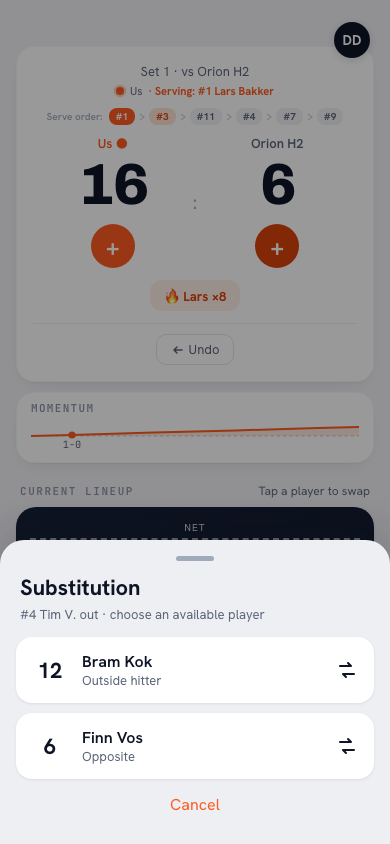
Four moments when your bench player can play without it costing the match
Most coaches wait for the moment when there is nothing left at stake, and that moment often doesn't come. These four you have in almost every match.
- The set that is already decided. With a big lead or a big deficit, a substitution no longer changes the result, but it does change what that player does for the rest of the season. Agree a threshold with yourself before the set starts, for example a gap of eight points, so you don't have to weigh it up again in the moment.
- The start of a set instead of the end. Coming on at 22-22 is the hardest assignment there is; starting a set is the easiest. A player who plays the first half of set two generally gets more balls than someone who comes on briefly three times, and under normal pressure.
- Their own part of the rotation. Bring them in where they can do the most — often the serve and the back row — and substitute them back out before they reach the front row. That is not an emergency measure, just coaching. How many substitutions you have per set and who may come back for whom is in the substitution rules; count them in advance, or you will be out of substitutions just when you need one.
- The match that carries less weight. Every season has a few: a cup match, a friendly, an opponent that is much stronger or much weaker. Don't field your strongest six out of habit there, but the people who otherwise don't play — and say beforehand that you are doing so.
What these four have in common: you decide on them before the match, not during it. During the match you always win the argument for not doing it.
What your bench player does do during the match
A player who sits out the whole match does nothing for the whole match — unless you give them something. That is not a consolation prize; it is the difference between watching and belonging.
- One watching assignment, concrete and small. Where does their number seven serve to? Which direction does their outside hitter choose when the pass is too far off the net? One question per set, and after the set you ask for the answer.
- Staying warm. A player who sits still for two sets in a cold gym is not ready to come on. Have them move and touch a ball at every change of set, so that a substitution is not a risk you would rather avoid.
- A task that has to do with the game. Keeping track of something small for the team is fine; fetching the water bottle is not.
Afterwards, note in two lines what you saw when they were on court. That takes a minute and it is exactly what you will have forgotten in six weeks; how to keep that light is in keeping player notes.
Don't promise minutes you don't control. A promise like 'next week you'll play a set' depends on injuries, attendance and the score on match day. Promise what you can deliver: that you keep track of it, that you tell them in advance and that you explain if it turns out differently.
The conversation with the player — not with their parent
The order matters more than the words: have this conversation with the player before their parent has it with you. Not in the changing room and not between two drills, but for five minutes before or after a practice, on the side.
Three sentences are enough. What I see: you are here every week and you play little, and I know that. What it comes down to right now: one concrete thing, in behaviour and not in character — the first step on the pass, serving under pressure, the approach that starts too late. And when we look again: name a moment, for example in four matches' time.
What you don't do is soften the conversation until it says nothing. "You're important to the group" without a second sentence sounds like a rejection with a bow on it. Be honest about the outcome too: it may be that they will play little in the coming weeks as well. The difference is that they will then know why.
If the parent brings it up first after all — and that happens — that is a different conversation. What you put on the table then and in which order is in the interview about the parent who says their child plays too little. For what happens on the sideline during the match, parents on the sideline is the place.
At practice they are not a substitute
The bench is a match phenomenon. At practice it shouldn't exist — and yet it happens without anyone noticing: the same player feeds the balls, stands at the back of the line and plays in the game form on the side that is one short.
Three things keep that fair. Rotate the feeding role every drill, so nobody does it twice in an evening. Put them in the stronger half in the game form rather than the weaker one, because that is where they learn more and it costs you nothing. And give them a second position: a player who can also cope in someone else's spot is suddenly usable on match day in situations where you now have nothing. How to build that up without wrecking their first position is in learning a second position.
Also assess them on what they show at practice rather than only on what they did in the match. You record effort and work ethic per practice, and over weeks they give a line that has nothing to do with playing time; see rating player effort. Seeing their own progress instead of only hearing your judgement helps this player more than anyone — see badges and milestones as motivation and the app from the player's point of view.
When it is no longer a substitution question but a policy question
There is a point at which this is no longer about this one match. Three signals point that way: the same player is at the bottom of the list all season and the gap to the player above is large; you cannot explain in one sentence how you divide playing time; or you notice that at every substitution you are weighing up again what you should have decided much earlier.
Then it is a policy question, and you don't solve that with one extra substitution. How to divide playing time and why fair is not the same as equal is in dividing playing time fairly. If it goes deeper — structurally more players than places, or a difference in level that has become too big — the question lies in how the squad is put together; see putting a squad together.
And there is an outcome that is rarely said out loud but is sometimes the right one: that this player would play more and learn more in another team or at another level. That is not getting rid of them, provided you suggest it yourself and explain it before they have already drifted away.
Try it yourself in Koach
What really changes this subject is making it something you can show. Score one match live in Koach and you have the rallies and sets per player; after a series of matches you see who is structurally at the bottom, rather than who last spoke to you. That doesn't make the conversation easier — it does make it a conversation about the same thing. The trial lasts fourteen days, and the first match you score already shows what the block looks like.
Frequently asked questions
How much should a bench player play at a minimum?
There is no general standard for that. What does exist differs per federation, per level and per age group, and sometimes it is not written down but agreed within the club. So first check what applies to your competition and then make your own agreement — and announce it in advance, because a standard that only comes up when someone complains sounds like an excuse.
Should everyone play the same amount in youth volleyball?
With the youngest players, dividing equally is defensible, because playing is the most important way of learning there and the result matters least. As players get older and the level rises, that usually shifts towards dividing on the basis of what someone shows at that moment. Both are defensible; what doesn't work is quietly shifting from one to the other halfway through the season without saying so.
What do I say to a player who asks why they are not playing?
Give one concrete reason in behaviour, not in character, and say straight away when you will look again. So not 'you need to be a bit more fired up', but for example 'you start your approach too late; we'll work on that over the next four practices and then I'll look again'. If you can't put that one reason into words, that is the real answer: then it is a choice you haven't explained yet, not even to yourself.
Can a player see how much they have played?
Their own playing time, yes. In Koach a player with their own account sees their own bar with rallies and sets under a match that was scored live, not those of teammates. The season overview for the whole group is only on the coach dashboard. What parents get to see in the app is in the explanation of the app for parents; in all cases there is only something to see for matches that were scored live.



Try it yourself in Koach
Less admin, more coaching.
Get started with KoachOr read first what the volleyball coaching app does.