
“That parent was right. He was only wrong about the number”
Dutch volleyball coach Dennis Boekhout on the conversation every youth coach gets, and what changes once playing time is something you can show rather than remember.
The hall is nearly empty, the bags are already by the door, and then a parent comes over. My child gets no playing time. Every youth coach has that conversation sooner or later, and almost nobody has an answer that goes further than a feeling. Dennis Boekhout coached from memory for years, and it went wrong every single time.
A conversation about playing time you can show instead of estimate, about rallies as a fairer unit than minutes, and about the times the parent across the table turned out to be completely right.
How does a conversation like that usually start?
“Never during the match. Always afterwards, when the hall is nearly empty and the parent has waited until I am standing on my own. That is a signal in itself: he has been saving it up for weeks. And then it comes out in a single sentence: my child gets no playing time.
“So there I am with my bag over my shoulder, supposed to say something sensible about three matches, of which I can still picture the last set and a half at best.”
What did you used to say?
“Something kind. ‘He got a decent run on Saturday’, or ‘he was on for the whole third set last week’. It was not a lie, but it was not an answer either. It was my memory against his, and nobody wins that one.”
Why does memory fail you there?
“Because a coach remembers moments, not time. I know exactly which substitution I nearly made and why I did not make it in the end. What I do not know is how many balls that lad missed out on because of it.
“And a parent remembers the mirror image: the rallies his kid spent on the bench. Two honest memories that contradict each other. You are not going to talk your way out of that.”
So what do you put on the table now?
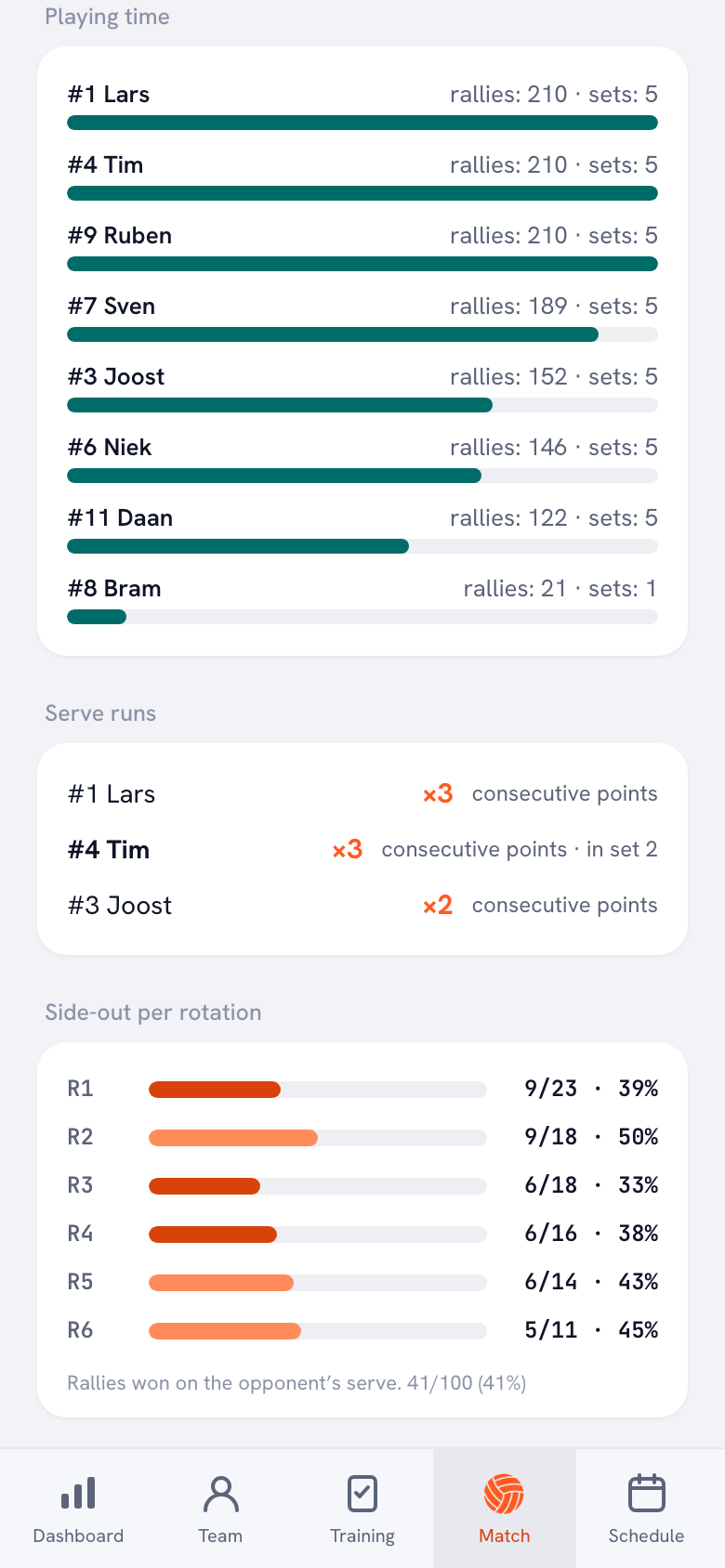
“The Playing time block underneath a finished match. One bar per player, and behind it how many rallies he was on court and in how many sets. No opinion, no estimate, just what the app counted while I was scoring.
“In the match I have open here, the top three sit on 210 rallies across five sets, and at the bottom somebody sits on 21 rallies in a single set. Nobody needs that explained. You can see it.”
Why rallies rather than minutes?
“Because volleyball has no clock. One set goes 25-9 and is done in twenty minutes, the next one grinds all the way to 31-29. Whoever was on court for that second set played through twice as many balls as someone who played the first. In minutes it would look almost equal.
“Rallies count what a player actually lived through. The sets beside them tell you how often he was on court when a set started. Put those two numbers side by side and you know fairly precisely what kind of match it was for him.”
One match does not tell you much, though.
“No, and that is exactly what the conversation is about. So the same measurement sits on my home screen as well, added up across every match this season that I scored live. Underneath it says how many matches it was measured in, so I know how much weight to give it.
“And the list runs the other way round from what you expect: least playing time at the top, with a small label on the first names asking whether they should start next time. So I do not have to invent anything. My running order is already there.”
So is that parent right or not?
“Usually both. About the order he is almost always right: his kid really is at the bottom. About the size of it he is almost never right. ‘He never plays’ turns into ‘he has played about a third of the rallies the regular six have played’.
“That is the sentence that turns the conversation. That parent was right, he was only wrong about the number. And you can say that out loud, because both halves are true.”
Does the number make the conversation easier?
“No. [laughs] I thought it would, and it does not. It makes it honest, which is something else. What the number does is take away the argument about the facts. We no longer have to squabble over whether it was a lot or a little.
“What is left is the real question: why is my kid at the bottom and what does he have to do to move up. That is a coaching question. Harder, but at least I can answer it.”
And when the parent is simply right?
“Then I am standing there holding my own screen, and it is telling me I was wrong. That has happened. You think you are sharing it out fairly, and then you see the same name at the bottom four matches running. Not out of ill will — in a tight set you reach for the players you trust.
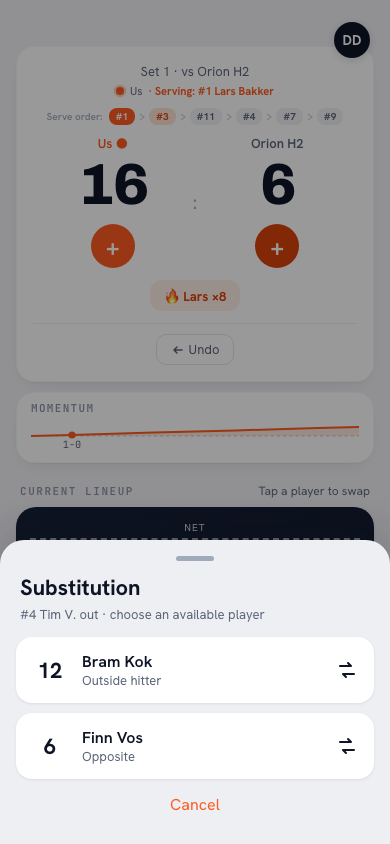
“The substitution sheet shows during the match who is still on the bench and available, with name and position. I have learned to look at it at 16-6 and not at 22-24. Save it for the end and it never happens at all.”
There is an attendance list in the app too. Is that not the same thing?
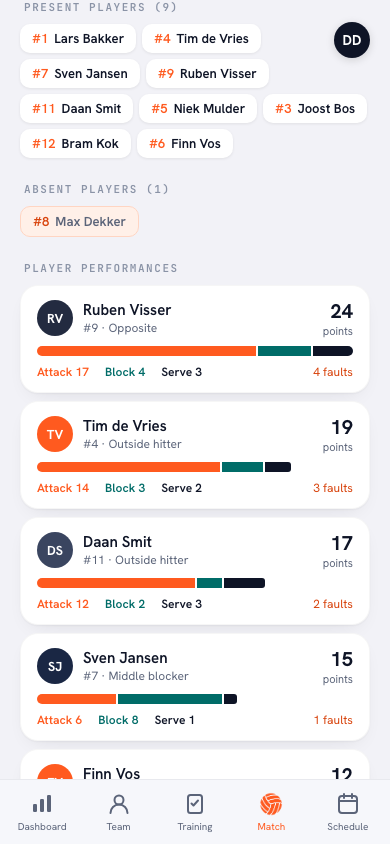
“No, and that is exactly where the misunderstanding sits. Attendance says who was there, playing time says who played. On a finished match the app lists the players who were present and, underneath them, the ones who were absent, with the count beside each group.
“In this match nine were there and one was not, and right below that list come the player performances. A kid who is there every Saturday and hardly plays is a completely different conversation from a kid who misses half the matches. Mix those two lists up and you end up talking past each other.”
Do you open the conversation with those numbers?
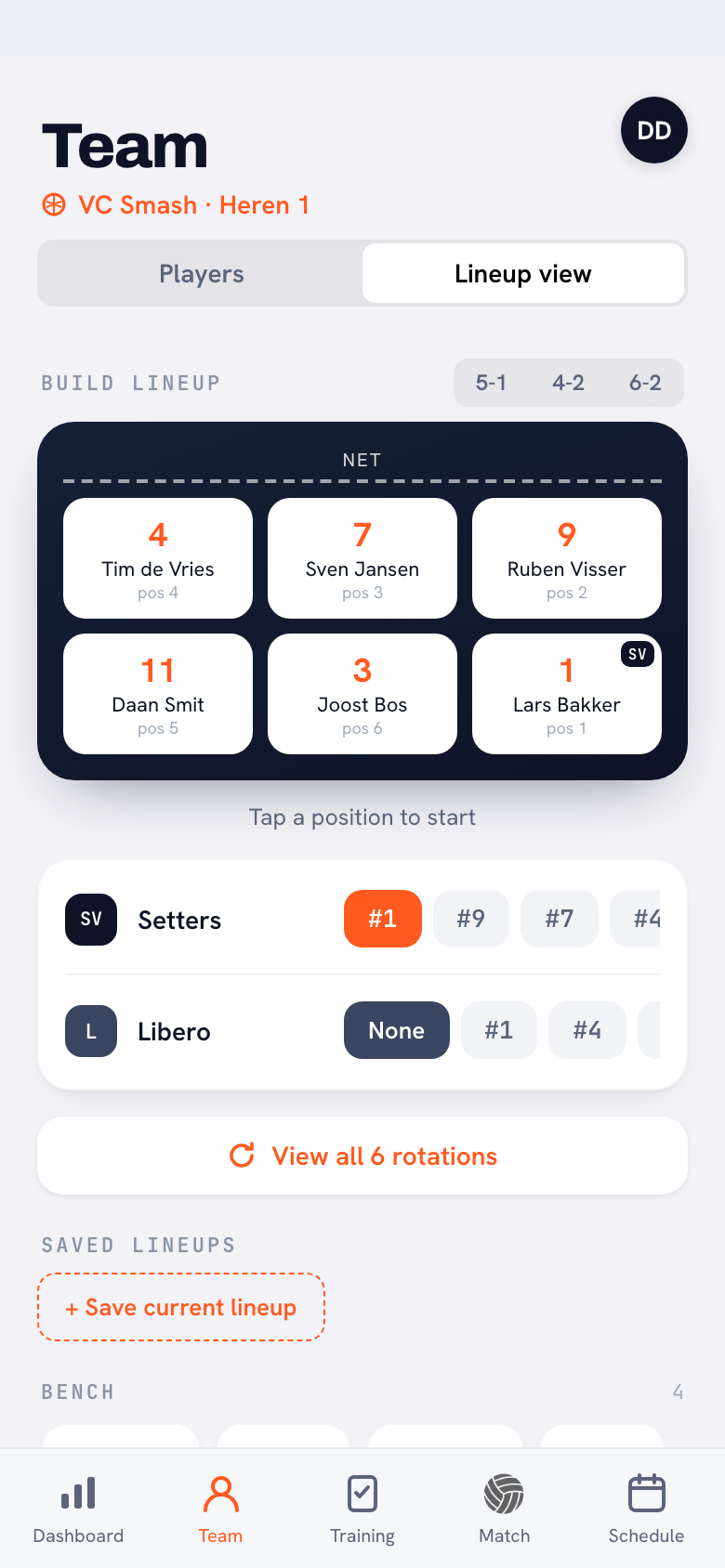
“Never. I start with the lineup, because every playing-time question starts there. I show which system we run, who is setting, who the libero is and which six start. The moment a parent sees that, he understands it is not a lottery.
“The number comes after that. In that order it is an explanation. The other way round it feels like evidence you use to shut someone up, and then you have lost the conversation even though you are right.”
What would you tell a coach who has this conversation coming next week?
“Score one match live before it happens. One. Then the next time you have something other than your memory, and that helps more than you would think. And never promise a parent minutes. Promise that you will look, and that you will show them what you see.”
Show playing time, do not estimate it
Score one match live in Koach and you get the rallies and the sets for every player. The next time a parent asks, you start the conversation with a screen instead of a feeling.
Try Koach for free