
Sports club member retention: the signs before members quit
The short answer
Members rarely quit without warning: first attendance drops, the team shrinks or the coach checks out. Member retention in a sports club means spotting those signs during the season and having someone reach out within a week. Koach Club shows them per team, from what coaches already record.
You can't fix member retention in your sports club at the point of cancellation, because by then the decision has been made. This article is about the weeks before that: why players and coaches drop out of a volleyball club, which signs you can see coming, who needs to see them and what to do when they show up.
Why players and coaches quit a club
Almost nobody cancels their membership after one bad night. A cancellation is usually the end of a few weeks or months in which something has been slipping. For member retention in a sports club, that is good news: it means there is time between the first sign and the decision. The reasons you hear afterwards come up again and again:
- Time. College, a job, a family or a second sport. Practice night gets competition, and the absences start landing on the same night every week.
- The team. Friends who quit, a group that gets too small to be fun, or a placement that puts someone at a level where they don't feel at home.
- Playing time. Someone who spends the least time on the court week after week easily loses their connection to the group.
- The coach. A coach who leaves can take some of their players with them. And a coach who is running on empty shows it in their practices before they say it in a conversation.
- The atmosphere. Friction in the group or a tone that doesn't fit. It is on no list, but you see it in who stops coming.
Some of this is out of the club's hands: if someone moves away, they move away. But the team, the playing time and the coach are things the club can influence, as long as someone notices in time. For youth players moving up to the adult teams, the details are in keeping youth players, and how it looks from the parent's side in my child wants to quit volleyball. Why volunteer coaches drop out and how to keep them is covered in finding coaches who stay.
What are the warning signs before a member quits?
The problem is rarely that the signs are missing. They are scattered: in the coach's attendance list, in a group chat, in the head of a parent on the sideline. Put them side by side and you often see one or more of these six things first:
- Attendance drops. Not one missed night, but a trend: someone who goes from every practice to every other week.
- Someone misses three in a row. Twice is the flu or an exam. Three times in a row is a pattern, and if nobody calls, a player soon figures out that nobody noticed.
- The coach stops preparing. A coach who always had a practice plan and no longer does, or who lets their report slide, is often too busy or has had enough. That is a sign about the whole team.
- Nothing is on the schedule anymore. A team with no practice planned is a team where something has stopped.
- The coach writes down a concern. "Not sure she'll keep playing next season" is the kind of line a coach will jot down, but rarely passes on to anyone.
- The team gets small. In a small group every absence instantly becomes someone's problem: with no subs, one injury means you can't put six on the court.
None of these six proves that someone is about to quit. They are questions. But they are questions you can ask halfway through the season, while the cancellation only arrives at the end.
We set up Koach Club together with you. Club has no free trial: leave your details on the club page, and we will get in touch and show you what the signals and the team log can do for your club. Want to see attendance per player for yourself first? Start free for 14 days with one team, no credit card needed.
Book an intro call Try the app with one teamCancellations, membership list or attendance: what do you see, and when?
A club has roughly four sources for noticing that members are drifting away. The main difference between them is the moment you see something.
- The cancellation and an exit conversation. Reliable, but too late: the decision has been made. Still useful for learning why people leave; ask one standard question with every cancellation.
- The membership list by birth year. Counted once a year, it shows at which age you lose members. Strong for policy, but not for the people who are wavering right now.
- The coach's attendance list. This is where the earliest signs are, but only that coach sees them, and nobody adds them up.
- Signals in a club app. The same attendance, added up per team for someone who looks across all the teams.
The middle column is what every club already has, the right column is what Koach Club adds (as of October 2026).
| What you want to know | Membership records and cancellations | Attendance in Koach Club |
|---|---|---|
| Who cancels their membership | Yes | No, Koach does not replace your membership records |
| When you find out | After the decision | During the season, as soon as attendance drops |
| Who missed three practices in a row | No | Yes, by name |
| Whether a coach is still coping | No | A hint: they no longer write a practice plan or report, when they used to |
| Why someone quits | Only if you ask | No, reasons for absence stay with the coach |
| What it takes | One standard question with every cancellation | Coaches who fill in attendance |
How Koach Club shows those signs per team
Koach is an app for volleyball coaches; with the Club plan, the club gets a club section on top. For member retention, three parts matter, and all three use what coaches already record: who was there, what got done and what they write down about players.
Attendance per player, for the coach
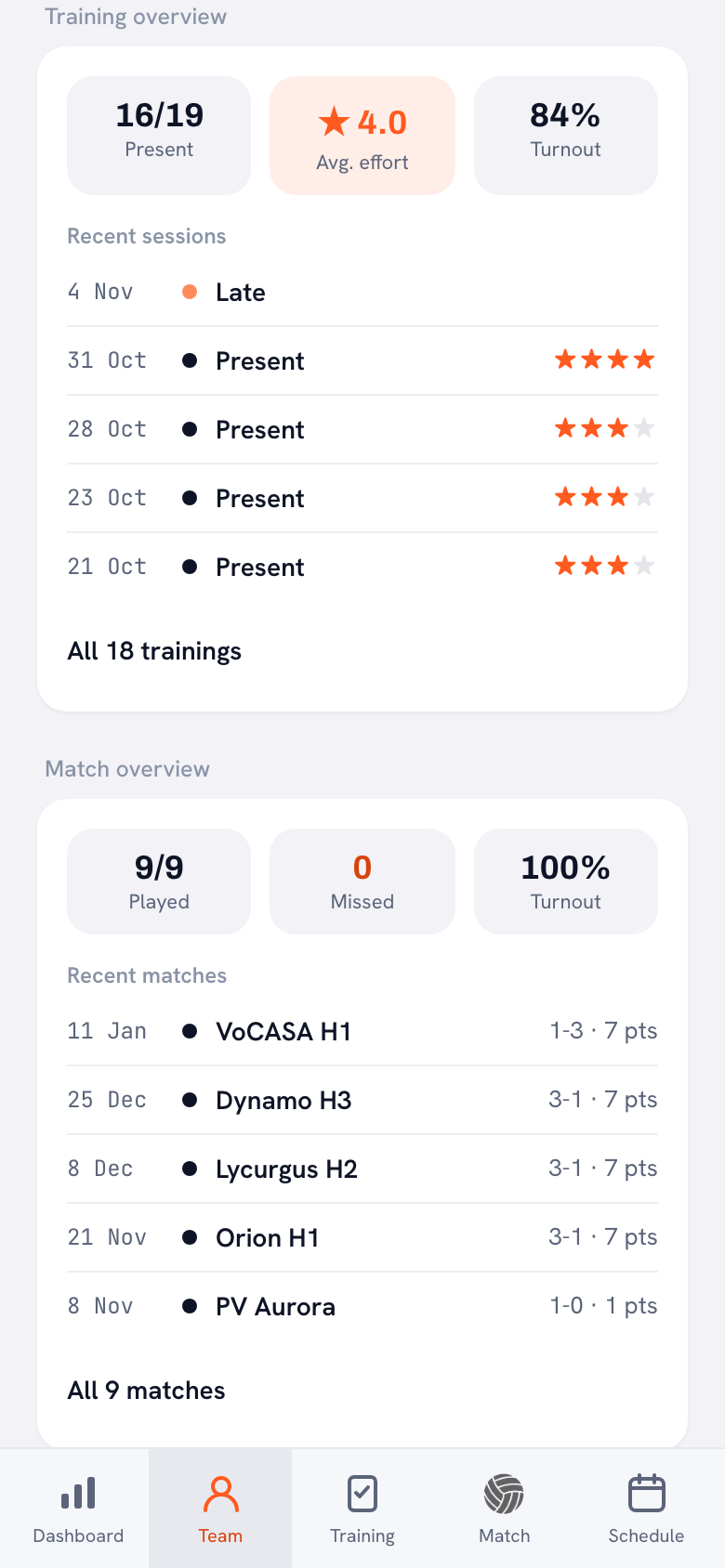
After every practice, the coach taps who was Present, Late or Absent. The player's profile then shows the Training overview with their Turnout and recent sessions. Players and parents mark themselves absent, with a reason if they want to give one. So the coach is the first to see who is slipping away. This part is also included in the regular Coach plan.
The signals block: what stands out in each team
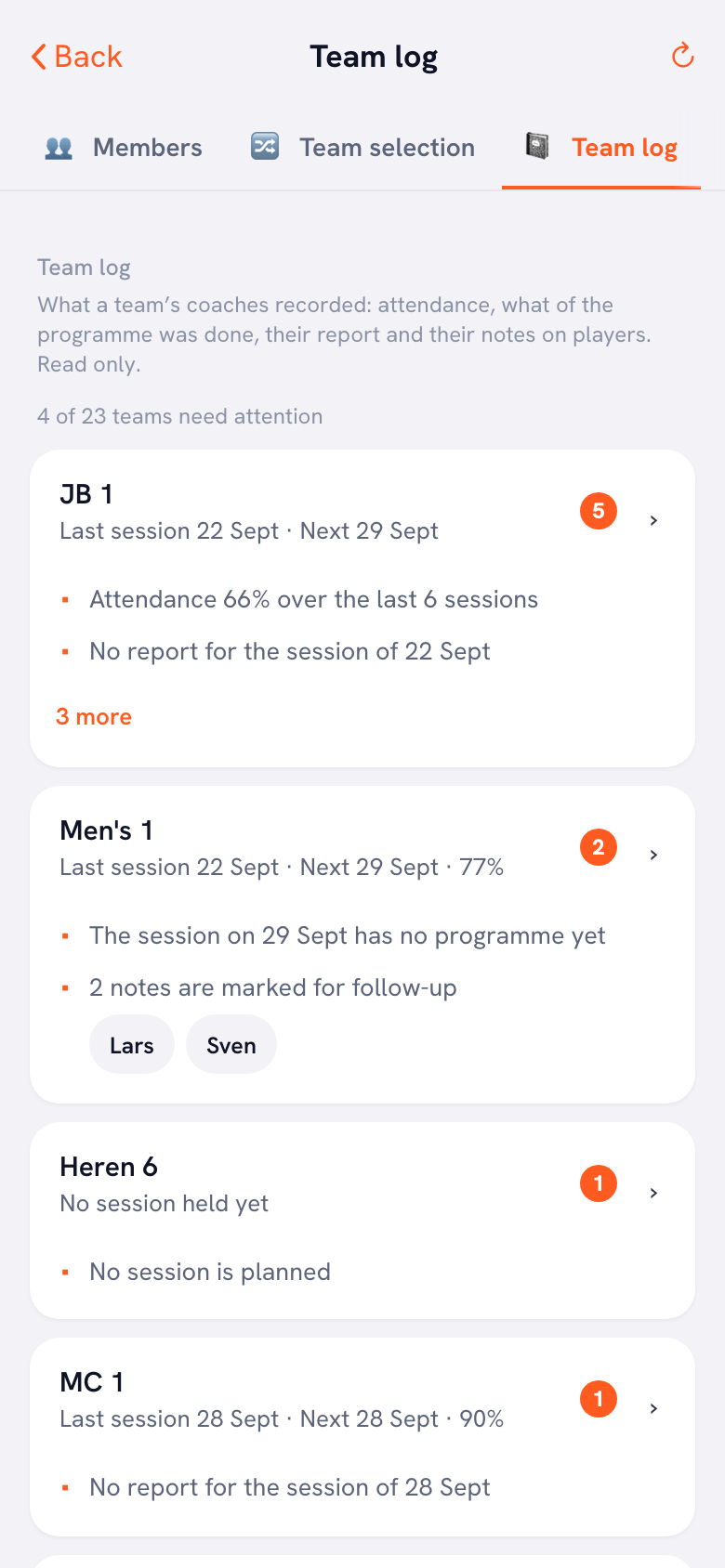
From Profile you open the Club dashboard. At the top of the Team log tab there is a single line: so many of so many teams need attention. Below it are the teams, the one with the most signals first. The block looks at six things: low attendance, players who missed three practices in a row, a missing report, a next practice without a plan, notes the coach has marked Needs follow-up, and a team with no practice scheduled. A missing report or practice plan only counts if that team normally does write one, so the block doesn't turn into a wall of alerts. Where the thresholds sit is explained in the signals block in the club dashboard.
The team log: what is happening in a team
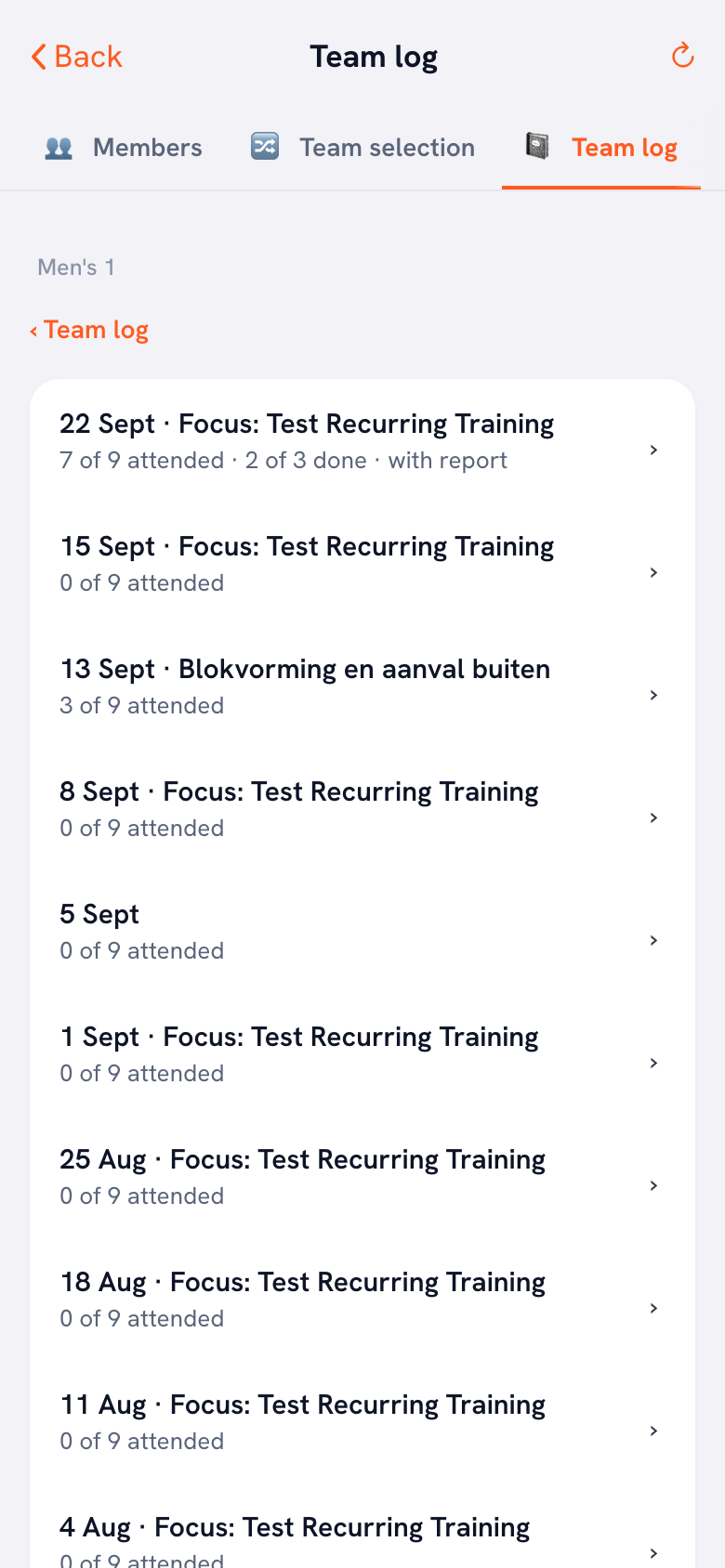
Tap a team and you see its last twelve practices: how many players were there, what got done from the practice plan, the coach's report and their notes on players. With Show older sessions you look further back, and everything is read only. That way you can tell whether low attendance was one bad week or a trend over several weeks, before you call anyone.
The signals block and the team log are visible to the Club manager, a Board member and the Technical manager. That last role exists for exactly this job: they can read along in every team and change nothing. Why that is a separate role is explained in the technical manager as a club role. The treasurer and the confidential adviser do not see the team log.
Member retention in your sports club: what to do when a signal appears
A signal is only worth something if someone acts on it. That works best with four fixed agreements:
- One person looks, at a set time. The technical manager or the youth coordinator goes through the block every week on the same day. A signal that everyone sees is a signal nobody picks up.
- Coach first, then the player. The coach often already knows why someone is staying away: an injury, exams, friction in the group. Ask them first. The conversation with the player or the parents is for whoever knows them best.
- Reach out within a week. A short message now does more than a sit-down at the end of the season.
- Look at the team, not just the player. If attendance drops across a whole team, or the coach stops preparing, the better question is how the coach is doing. A team that loses its coach can lose several players at once. What the coach can do about falling attendance is in improving practice attendance.
After the conversation, write down briefly what was agreed. In Koach the coach does that with a note on the player, which players and parents cannot see. On top of that, put the fixed moments of the year, such as the end-of-season review and team placement, in the volleyball season checklist, so member retention is not only a reaction to signals.
What Koach does not do
- No membership records. Under Members you see the players of every team, but Koach does not track memberships or cancellations and does not replace your membership records. The signals are about practices, not memberships.
- No predictions. Koach contains no AI and no model that calculates who is going to quit. The block counts what coaches have filled in, nothing more.
- No attendance signal without attendance. If a coach doesn't fill in attendance, the block sees no attendance for that team. A practice without a list deliberately marks nobody absent: a gap in the records is not a kid staying away.
- No reasons in the club section. Why a player said they couldn't come stays with the coach. Club leadership sees attendance as a number.
- No automatic "we miss you" message. Koach does not send a separate message on behalf of the club to a player who stays away. That conversation is still a job for people.
Which clubs is this for, and what does it cost?
Koach Club suits a volleyball club with several teams where the coaches already track attendance or are willing to, and where someone wants to take on the role of looking across the teams. If the coaches already track attendance in Koach, you get the signals without adding anything to their workload.
It is less of a fit if you are mainly looking for membership software or want to collect membership fees: Koach does not process payments. How to use club admin software and a coaching app side by side is explained in club admin software alongside your volleyball app. If your club runs several sports, Koach only covers the volleyball teams. And if you have one team, you don't need the club section: attendance per player is also part of the Coach plan.
Club costs €9.99 per month, or €8.33 per month on a yearly plan, for unlimited teams and coaches. Players and parents use the app for free. Club has no free trial: request an intro call on the club page and we will set up your club with you. All prices are on the pricing page; in the App Store and Google Play you see the price in your own currency.
Start with attendance, not with the block. Agree with your coaches that they check off who was there after every practice: first All present, then the exceptions. Only once those lists have a few weeks in them does the signals block have something to count.
Frequently asked questions
What is member retention in a sports club?
Member retention is everything a club does to keep the members it already has, alongside recruiting new ones. In practice it means spotting in time who might quit and doing something about it: calling a player who stops showing up, keeping a team together, taking pressure off a coach. The earliest signs are usually in practice attendance, long before the cancellation arrives.
When should a club step in if a player stops showing up?
A useful rule of thumb is three practices in a row. Missing twice is often illness or school; three in a row is a pattern, and a player who then hears nothing concludes that nobody noticed. Ask the coach what they know first, then have someone who knows the player or the parents get in touch within a week. In Koach Club, a player like that appears by name in the signals block.
Can the club board see why a player is absent?
No. Players and parents can give a reason when they say they can't come, but the team's coaches see it, not club leadership. In the Koach Club team log, the board sees how many players were at each practice, not who was missing or why. The only exception is the signal for three absences in a row: it shows the name, because you can't call someone without one.
Does the signals block work if coaches don't track attendance?
Partly. Two of the six signals need attendance to be filled in: low attendance and three practices missed in a row. Without a list there is nothing to count, and a practice without a list marks nobody absent. The other four keep working: a missing report or practice plan, a note the coach marks Needs follow-up and a team with no practice scheduled. So first agree with your coaches that they check off who was there after every practice.
How much does Koach Club cost, and can you try it first?
Club costs €9.99 per month, or €8.33 per month on a yearly plan, for unlimited teams and coaches; players and parents pay nothing. Club has no free trial. You request an intro call through the form on the club page, and then we set up your club together with you. A coach can start free for 14 days with one team, no credit card needed, and see attendance per player that way.


See sooner which team needs attention
We set up Koach Club together with you. Book an intro call on the club page. Coaching one team yourself? Start your 14-day free trial below.
Get started with KoachOr read first what the volleyball coaching app does.