
Mikasa vs Molten: which volleyball suits your team?
The short answer
Mikasa vs Molten is not a question of better or worse: both match balls meet the FIVB rules. The Mikasa V200W is the ball of the international FIVB competitions, the Molten V5M5000 is used in US college volleyball, among others. Choose the ball your competition requires, and train with it.
Mikasa vs Molten: anyone buying a set of new balls runs into that question sooner or later. This article compares two widely used match balls on the facts: where they are played, what the makers say about them, what the rules require, and how you as a coach or club make a choice that rests on more than taste.
Mikasa and Molten side by side
This is about two balls: the Mikasa V200W and the Molten V5M5000, which Molten sells under the name FLISTATEC. Both brands also make training and youth balls, but the question "Mikasa vs Molten" is almost always about these two match balls. The table lists what the sources at the bottom say.
| What you want to know | Mikasa V200W | Molten V5M5000 |
|---|---|---|
| Where it is played | International competitions of the FIVB and Volleyball World, such as the Volleyball Nations League | Among others the NCAA men's championships in the United States; Molten is a partner of USA Volleyball |
| Status with the FIVB | Official ball, agreement through 2032 | FIVB approved, according to the maker |
| What the maker says about the cover | Synthetic leather with glued panels | Microfiber composite with texture for grip |
| What the maker says about the flight | Not stated on the product page | FLISTATEC: a design that directs the airflow around the ball and reduces turbulence |
| Circumference and weight | 65 to 67 cm, 260 to 280 g | Official size and weight |
Checked on 1 November 2026 on the sites of the FIVB, Volleyball World, Mikasa, Molten USA, USA Volleyball and NORCECA; see the sources at the bottom.
Mikasa has been involved in international volleyball since the 1964 Olympic Games in Tokyo. In 2023 the FIVB and Volleyball World extended their agreement with Mikasa by eight years, through 2032: Mikasa remains the only official ball in their international competitions. The confederation of North and Central America and the Caribbean, NORCECA, has also played with Mikasa since 2023, under an agreement through 2030. According to its own product page, Molten is the official ball of the NCAA men's championships and is used by many US college teams. Together with USA Volleyball, its partner, Molten announced an official outdoor ball for beach and grass in May 2026. Note: the Molten USA product page still calls the V5M5000 the official ball of NORCECA, while NORCECA itself announced the switch to Mikasa.
What the rules require, and what they do not
The FIVB rules do not prescribe a brand. Rule 3.1 of the Official Volleyball Rules 2025-2028 defines the ball: spherical, with a cover of leather or synthetic leather, a circumference of 65 to 67 centimeters, a weight of 260 to 280 grams and an inside pressure of 0.30 to 0.325 kg/cm². Rule 3.2 adds two things: all balls used in one match must have the same characteristics, and international competitions as well as national and league championships are played with FIVB-approved balls, unless the FIVB agrees otherwise.
So which ball is compulsory in your competition is decided by your federation or by the organizer of your competition. Often it is one fixed ball from one brand. Check the regulations or guidelines of your competition, or ask your league secretary: that answer outweighs any comparison.
Why the two balls feel different
Players who switch from one ball to the other often say it feels "different". That is not imagination, but it is not necessarily down to the brand either. Four things determine how a ball feels and flies:
- The pressure. A ball at 0.30 kg/cm² feels softer than a ball at 0.325. Mikasa gives a recommended pressure of 0.300 kg/cm² for the V200W, the bottom of what the rules allow. How to measure and pump is in volleyball air pressure.
- The surface. Texture and material determine the grip when setting and how the ball comes off your forearms.
- Panels and seams. A ball without spin, such as a float, reacts to the seams and the shape of the panels. That is why a float moves differently with one ball than with the other; why a float floats is in the float serve.
- Wear. A ball that has spent a season in the ball cart is smoother and often softer than a new one. Comparing a new Mikasa with an old Molten compares wear, not brands.
Which ball is "softer" or "more stable" therefore differs per player, per ball and per pressure. There is no objective winner, and anyone who names one has rarely measured it.
How to choose as a coach or club
- Required in your competition? Then the choice is made. Train with that ball, the servers too: a float with a different ball is a different float.
- One ball per team. Use the same ball in practice and in matches. A team that passes with one brand on Tuesday and the other on Saturday has to adjust all over again every week.
- Youth: weight first. For children and young teens a lighter ball matters more than the brand; which ball suits which age is in volleyball size by age.
- No requirement? Then test it yourself, with new balls at the same pressure.
If you want to look beyond these two, for example at a training ball or a ball for outdoors, read which volleyball to buy. Sand needs a different ball with a lower pressure: see choosing a beach volleyball.
Test blind, as far as you can. Pump two new balls to exactly the same pressure, have each player do ten passes, ten sets and ten serves with each ball, and only then let them say which one they prefer. Also count what happened: how many passes on target, how many serves in. A preference that does not show up in the count is usually just habit.
Recording the test in your practice report
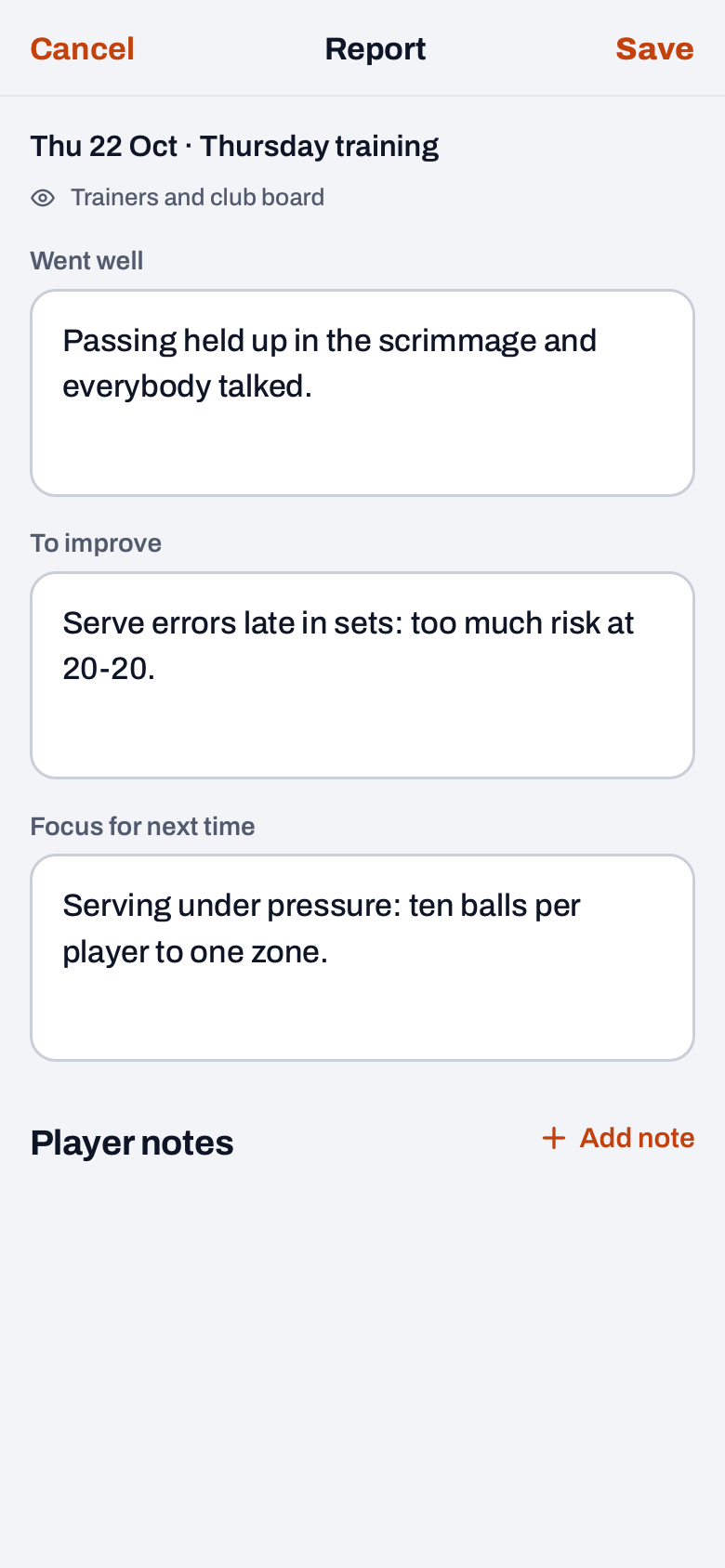
Koach does not choose a ball for you. What does help: giving the test a fixed place, so the verdict does not depend on who remembers most loudly how it went. Add the ball test as a section in the plan of the practice, and afterwards write in the report under Went well and To improve what the count showed. The report is visible to the trainers and the club board. With the Club plan, a club that buys balls for all its teams reads the outcome of every team in the team log.
Then agree who looks after the match balls and brings them. That kind of agreement quickly gets buried in the group chat; why that happens is in why the WhatsApp group breaks down for a volleyball team. What Koach costs after the 14 free days is on the pricing page.
14 days free, no credit card. Put the ball test in the plan of your next practice and record the outcome in the report.
Try Koach with your teamSources: Volleyball World on the extension with Mikasa through 2032, product page of the Mikasa V200W-VNL, NORCECA on its agreement with Mikasa, product page of the Molten FLISTATEC, Molten on the NCAA ball and USA Volleyball on the outdoor ball with Molten, checked on 1 November 2026. Agreements and specifications can change; check them yourself before you choose.
Frequently asked questions
Which ball does the FIVB use?
In the international competitions of the FIVB and Volleyball World, such as the Volleyball Nations League, Mikasa is the only official ball. The agreement was extended in 2023 through 2032. At the moment that is the V200W, which Mikasa also releases in its own VNL edition.
Is a Molten ball allowed in competition?
That depends on your competition. The FIVB rules do not prescribe a brand, but they do require an FIVB-approved ball for championships and balls with the same characteristics within one match. Molten has an FIVB-approved FLISTATEC ball. Whether your competition requires a specific brand is in the regulations of your federation or league.
Which ball is softer, Mikasa or Molten?
That differs per player and depends heavily on pressure and wear. A ball at 0.30 kg/cm² feels softer than the same ball at 0.325, and an old ball feels different from a new one. So only compare new balls at exactly the same pressure before you judge.
Should I train with the same ball as in matches?
Yes, if you can. Servers and passers in particular notice the difference: a float moves differently with one ball than with the other, and the grip when setting differs. A team that practices with a different brand than the one it plays with on Saturday has to adjust all over again every week.


Record your ball test in Koach
14 days free, no credit card. In a week you know which ball your team wants.
Get started with KoachOr read first what the volleyball coaching app does.