
Overhead receive in volleyball: is it legal and when to use it?
The short answer
Yes, an overhead receive in volleyball is legal. On the team's first contact the FIVB rules even let the ball touch several parts of the body in succession, as long as it is one action; only catching or throwing is a fault. It pays off mainly on float serves arriving at shoulder height or higher, not on hard topspin.
An overhead receive in volleyball often raises the same question in the gym: is that even allowed? The answer is yes. This article explains exactly what the rules allow, on which serves receiving overhead works better than a forearm pass, how the technique works and how to teach it to your passers in four steps.
Can you receive a serve overhead?
Yes. The rules make no distinction between a forearm and an overhead reception. What counts are two rules from the FIVB Official Volleyball Rules 2025-2028:
- The ball must not be caught or thrown (Rule 9.2.2). If the ball comes to rest in your hands or you guide it, that is the fault called a catch (Rule 9.3.3).
- On the team's first contact the ball may touch various parts of the body consecutively, provided the contacts occur during one action (Rule 9.2.3.2). On any other contact that is a double contact (Rule 9.3.4).
Serve receive is such a first team contact. A ball that, in an overhead reception, touches one hand first and the other a fraction later is therefore not a fault, as long as it is one movement and the ball rebounds. The referee guidelines of the FIVB Rules of the Game Commission put it even more briefly under Rule 9: the first team contact may be played freely, unless the player catches or throws the ball (point 7.3 of the Refereeing Guidelines and Instructions 2025). The same guidelines say the referee may not judge by the sound of the contact and must allow an overhand finger pass if it is legal under the rules. At lower levels an overhead reception that "sounds" off still gets whistled now and then. That is the referee's judgment, but your players should know the rules are on their side.
Three exceptions to know:
- The libero. If your libero receives the serve overhead while standing in the front zone, a teammate may not attack that ball while it is entirely above the top of the net (Rule 19.3.1.4). In serve receive that rarely comes up, but it exists; the full rule is in can the libero set overhand.
- Beach volleyball. On the sand, separate rules apply: if you play the first ball overhead with your fingers, the contact has to be clean, without a double contact. See the beach volleyball rules.
- Youth and local leagues. Federations and tournaments can set their own rules for youth or recreational leagues. When in doubt, check the regulations of your own competition.
When an overhead receive beats the forearm pass
Receiving overhead is not a style but a choice per ball. The advantage: a ball at shoulder height or higher no longer has to be taken on a platform for which you have to bend your knees deep or step back. You play it where it is, with the precision of a set. The drawback: your hands can absorb less speed than your forearms. So the choice depends on the serve.
| The serve comes | Choice | Why |
|---|---|---|
| Float, flat, at shoulder height or higher | Overhead | With your forearms you have to drop or turn away; overhead you play it directly |
| Jump float, hard at shoulder or head height | Overhead if you are behind it early | A high platform pass on this ball often flies too far |
| Float that drops early, below the chest | Forearms | Overhead you would have to dive under the ball |
| Hard topspin or jump serve | Forearms | Too much speed for the fingers: risk of a catch or a jammed finger |
| Short, high serve into the front zone | Overhead is allowed, forearms are safer | The ball is slow, but you play it while moving forward |
Do not put that choice equally on every passer. Start with the players who are good with their hands: your libero, your setter if they pass, and outside hitters with firm hands. A player who still hesitates on a regular overhead set should certainly not try it in serve receive. How to read a float serve before you choose is in passing a float serve.
How to pass a serve overhead
- Decide early. As soon as you see the ball coming in flat and high, you choose. Switching from platform to hands halfway almost always goes wrong.
- Get behind the ball. Small steps, feet hip-width apart, one foot slightly forward. Turn your shoulders as far as you can toward your setter's target, with your body behind the ball.
- Hands up early. Your hands are already above and in front of your forehead before the ball arrives, fingers spread, thumbs and index fingers together in the shape of a triangular window. If you lift your hands late, the ball lands on your palms.
- Firm hands, short give. On a set your fingers briefly absorb the ball. On a serve there is enough speed already: keep wrists and fingers firmer and let the ball give less. Soft wrists produce a ball that sinks into your hands, and that is the catch the referee does whistle.
- Little power, lots of direction. Extend lightly through your legs and arms toward the target. Aim high enough and not tight to the net: about a meter off the net, between positions 2 and 3, or wherever your usual target is.
- Call it. A player receiving overhead stands taller and often deeper than the passer next to them. Call early, or two players will go for the same ball.
The overhead contact itself is like setting, with firmer hands; its forearm counterpart is in the forearm pass. If you want to see how the basic skills fit together, they are in learning volleyball technique.
Where it goes wrong
- Too late under the ball. The ball gets behind your head and goes backward or over the net. Fix: step in earlier, and rather half a meter too far forward than too far back.
- A half choice. Hands halfway up, halfway down. Agree per type of serve what you do, so the choice has been made before the rally.
- Overhead on a hard ball. Not a technical error but a wrong choice. If a finger stays painful or swollen after such a ball, have it checked by a doctor or a physiotherapist.
- Passing too tight. An overhead reception is precise, and players use that to aim too tight to the net. A high, calm ball on the target is worth more than a fast one that goes just too far.
How to train it in four steps
- Toss. The coach throws a firm ball at forehead height from the other side. The receiver plays it overhead to a target near the net, ten balls per player. Goal: hands up early and firm wrists.
- Float from short range. A server hits floats from six meters off the net. Everything that comes in above the shoulders goes overhead; the rest with the forearms.
- Choice drill. The server alternates high and low, short and deep, from the service line. The passer chooses, and the coach says nothing in advance. Score each pass: on target two points, playable one, error zero.
- Game drill. Serve receive against real serves with an attack behind it, where the receiving team gets a point for every rally won on its own reception. Now what counts is not the technique, but whether the choice wins points.
Have every passer name two serves. After the game drill, ask each passer which two serves they will take overhead from now on, for example the short float and the jump float at shoulder height. That way receiving overhead becomes a fixed agreement instead of a gamble in the rally.
Does it improve your serve receive?
Whether receiving overhead gives your team anything only shows in matches. In Koach you track it in Expert mode: on every opponent serve you rate the reception from 0 to 5 (Error, Back over, 1 option, No quick, Good, Perfect) and tap who received the ball. What those ratings mean and what a good average is, is in the 0 to 5 passing rating. In the player profile you then see, under Stats in Ratings 0-5, the share of good ratings per skill, next to the team's.
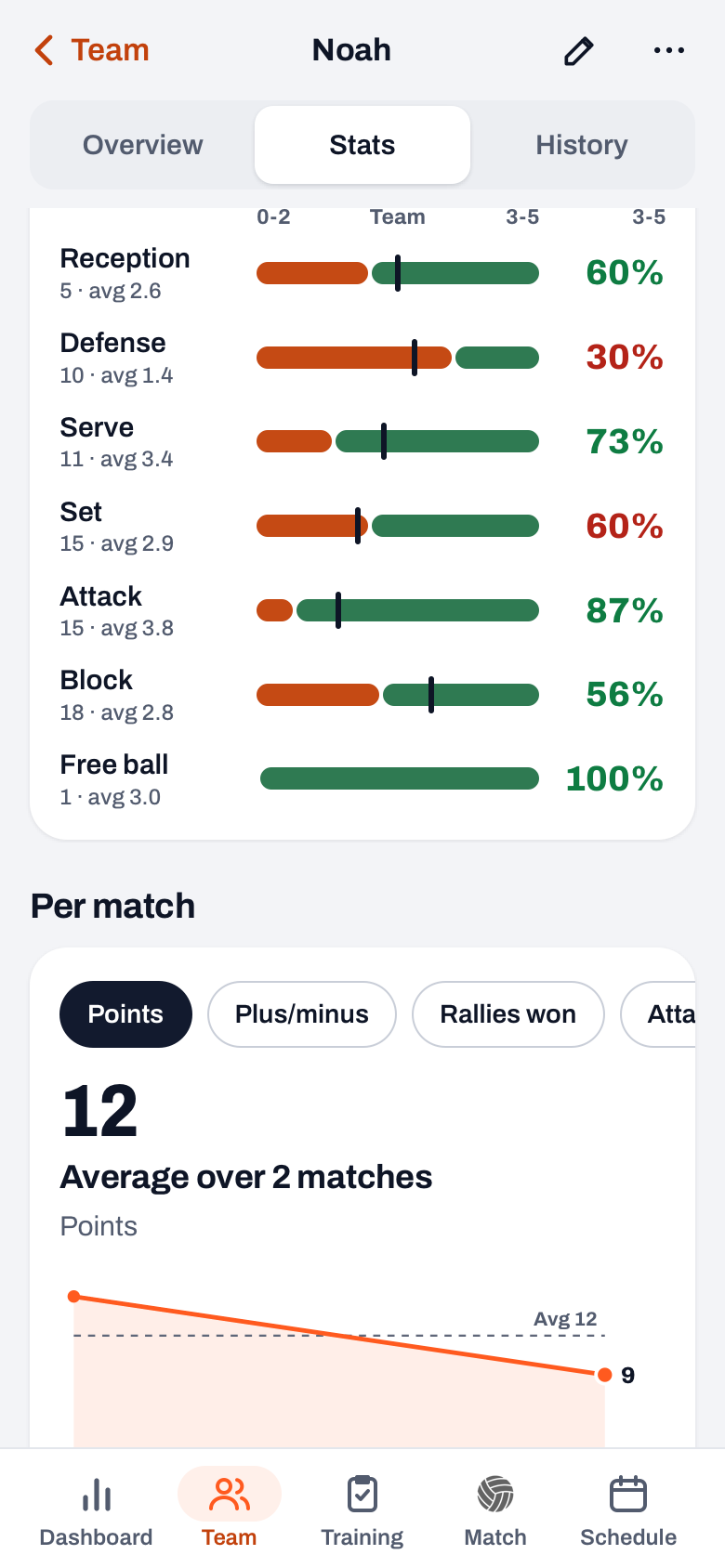
Koach does not record whether a pass was overhead or with the forearms. So compare a player's reception ratings over a few matches before they started receiving overhead with the matches after. What Koach costs after the 14 free days is on the pricing page.
14 days free, no credit card. Rate every reception on Saturday and see after three matches who handles the floats better overhead.
Track your serve receive in KoachFrequently asked questions
Is a double contact on serve receive a fault?
No, not if it happens in one action. On the team's first contact, which includes serve receive, Rule 9.2.3.2 of the FIVB rules lets the ball touch several parts of the body consecutively. Overhead too. What remains a fault is a caught or thrown ball: the ball must rebound and may not come to rest in your hands.
Why do most players still pass the serve with their forearms?
Because the forearm platform can absorb much more speed than the fingers, and because most serves arrive below shoulder height. Against a hard topspin or jump serve, the forearms are also safer for your fingers. Receiving overhead is an addition for high, flat floats, not a replacement for the forearm pass.
Can the libero receive a serve overhead?
Yes. The libero may play overhead anywhere. There is one restriction: if the libero plays the ball with an overhand finger pass while in the front zone, a teammate may not attack that ball while it is entirely above the top of the net. In serve receive the libero is almost always behind the attack line, so it rarely comes up.
Can you receive a serve overhead in beach volleyball?
Yes, but the contact has to be clean. On the sand, the freedom of the team's first contact does not apply to an overhand finger pass: if the ball touches your hands one after the other, it is a double contact. That is why beach players take a serve with their forearms more often, and overhead only when they are fully behind it.

Track every reception from Saturday on
14 days free, no credit card. After three matches you see who handles the floats well.
Get started with KoachOr read first what the volleyball coaching app does.