
Pool volleyball rules: net, ball and games in the water
The short answer
Pool volleyball rules are not official: there is no rulebook, so you agree on them beforehand. Usually you string a net or rope across the pool, play with two to six players per side and use a light ball that does not soak up water. Only play where everyone can stand, with someone supervising who is not playing.
Pool volleyball rules are the agreements you make for volleyball in the water: on vacation, at a camp or as a team outing at a swimming pool. There is no official rulebook, so here you read which agreements work well, how to keep it safe and which games keep a whole group busy.
Which rules apply to pool volleyball?
The FIVB has rulebooks for indoor and for beach volleyball, but there is no official international rulebook for volleyball in the water. So you take over the basics of the regular game, such as three contacts per side and a point on every rally (see all the volleyball rules at a glance), and agree on the rest beforehand. These are agreements that work well in practice; see them as an example, not as fixed rules.
| Item | Agreement that works well |
|---|---|
| Players | Two to six per side, depending on the space. The smaller the pool, the fewer players. |
| Court | The water is the court. If the ball hits the edge or the deck, it is out. |
| Contacts | Three per side at most. For kids and beginners, the first contact may be caught. |
| Serve | From the back of your own half, underhand or with a throw. |
| Point | If the ball lands in the water on your side, or you play it out, the other side gets the point. |
| Net | The ball may touch the net as it goes over. Hanging on or pulling the net is a fault. |
| Scoring | Sets to 15 or 21, or rounds of a fixed number of minutes. |
What is different from playing on land: you hardly jump, you move slowly and you cannot see where other people's feet are. So the game is about placing the ball and playing together, not about hitting hard. On grass or sand other agreements apply; that is covered in grass volleyball.
How do you put a net across a pool?
- A set made for the water. There are nets with posts that stand on the deck on a weighted base, and nets that float on the water. Follow the manufacturer's instructions for the weights and keep the posts out of the walkway.
- A rope. Tie a rope between two fixed points on either side of the pool and hang towels over it if you like, so everyone can see the line. Never tie it to something that can fall over, such as a patio umbrella or a loose chair.
- The height. There is no rule for it. A rule of thumb that works well: the top at about the height of the outstretched hand of an average player standing in the water. Higher makes it a game of lobs, lower a game of hitting.
- Ask first. At a public pool, the pool decides whether you may put up a net and which ball is allowed. Ask beforehand, so you are not left standing at the side holding a net.
Choose a ball that is light and does not soak up water. An indoor ball is not made for that: according to the Molten care instructions, the leather of their volleyballs is glued on, and water and heat can dissolve that glue. A beach volleyball is made for wet weather: the beach rules require a ball made of material that does not absorb moisture. The difference from an indoor ball is in choosing a beach volleyball. For kids, a soft inflatable ball works better: it does not hurt and is easy to catch.
Playing safely in the water
Volleyball in the water is only fun if nobody has to worry. Agree on these points before the first ball goes over the net:
- Play where everyone can stand. Choose the shallow end, with water that does not come above the chest of the smallest player. In deep water you are busy swimming, not playing the ball.
- Someone supervises and does not play. Even if there is a lifeguard. According to the World Health Organization, children are at greater risk around water without active supervision by an adult. With a youth team, a coach or parent watches only the water, not the score.
- Know who can swim. With a youth team, ask the parents beforehand. Anyone who is not a good swimmer plays in the shallowest part or joins in from the side as referee or scorekeeper.
- No diving or jumping for the ball. Not from the edge and not in shallow water. Under water you cannot see where the others are, and a jump into shallow water can end on the bottom.
- No running on the deck. A wet edge is slippery. Whoever fetches a ball from the side walks.
- No alcohol at an adult outing. Drink after the game, not before or during it. Anyone who has been drinking stays out of the water.
- Outdoors: sun and cold. Put on sunscreen, drink water and take a break in the shade. Anyone who gets cold gets out and dries off.
If someone hits their head on the edge or feels dizzy after a collision, stop playing. If symptoms persist, go to a doctor or the emergency room.
Appoint one watcher before the game. Give that person a whistle: one blast means everyone stops and looks. That works better than shouting across a crowded pool, and the watcher does not have to keep score as well.
Five games for a team outing or camp
- Keep it up in a circle. The whole group in a circle in the water. How many times can you keep the ball up together before it touches the water? Harder: everyone has to touch the ball once before the count counts. Good as a warm-up.
- Catch volley. Three against three over the rope. Every contact may be caught and thrown again, and the third ball has to go over the net. For kids and for groups where not everyone plays volleyball.
- Three touches required. A point only counts if your team has played the ball three times before it went over the net. That way everyone has to take part and the strongest player cannot win on their own.
- King of the pool. Two against two. The team on the king side stays as long as it wins; the challengers serve, and whoever loses joins the back of the line. A rally is one point, so the line moves quickly.
- Two balls at once. Four against four with two balls in play at the same time. If a ball lands in the water, that is a point and that ball goes back into play. Chaos, laughter and lots of ball contacts; play it in rounds of three minutes.
If you are organizing a whole camp, with practices, sleeping and meals, read organizing a volleyball training camp.
Organizing the team outing without an endless group chat
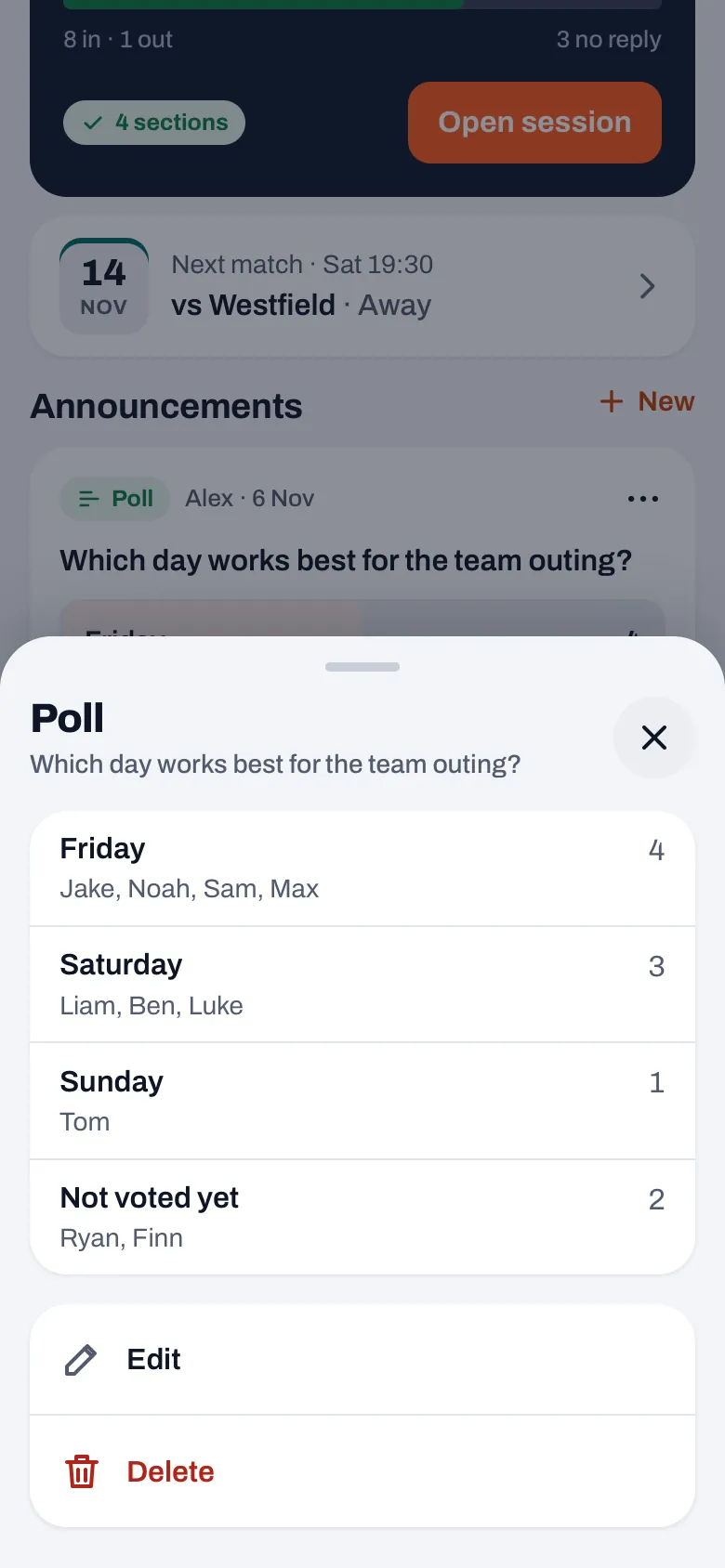
The game is the easy part; finding the date takes more time. In Koach you add a poll on the dashboard under Announcements, for example which day works best for the team outing. Since version 3.1 the coach sees in the poll who voted for each option and who has not voted yet; how that works is in seeing who voted in a poll. Once the day is set, add the outing to the schedule as a separate event, see a separate event in the team schedule. With a task in the announcements you ask who brings the ball and the net; whoever does it taps I’ll do it.
14 days free, no credit card. Pick the date of your team outing with a poll instead of dozens of messages.
Try Koach with your teamWhat Koach costs after the trial is on the pricing page.
Frequently asked questions
How high should the net be for pool volleyball?
There is no rule for it, because there is no official rulebook. A rule of thumb that works well: the top at about the height of the outstretched hand of an average player standing in the water. If it hangs higher, it becomes a game of lobs; if it hangs lower, players mostly hit. For kids, hang it lower.
What ball do you use for volleyball in the pool?
A light ball that does not soak up water, such as a beach volleyball or, for kids, a soft inflatable ball. An indoor ball is not made for water: with glued balls, water can affect the glue under the leather, after which panels come loose. At a public pool, ask beforehand which balls you may use.
How many players do you need for pool volleyball?
Two to six per side, depending on the space in the pool. In a small pool, two or three per side works best, because otherwise players bump into each other. With a large group, play short rounds and have those waiting on the side act as referee or scorekeeper.
Is pool volleyball suitable for kids?
Yes, as long as everyone can stand in the water, an adult who is not playing supervises, and the kids can swim. Let young kids catch and throw the ball, use a soft inflatable ball and keep the rounds short, so nobody gets cold.


Plan your team outing in Koach
14 days free, no credit card. Poll, schedule and tasks in one place.
Get started with KoachOr read first what the volleyball coaching app does.