
Reading per-player statistics after the match
The match report is ready before the shoes are off: points per player, the breakdown, the errors. Now for the hardest skill: reading it — because numbers don't lie, but they love to exaggerate.
The first look: ratios, not totals
Don't start with who scored the most — you usually already know. Look at the ratios: an opposite should carry the volume (lots of attack), a middle blocker ideally chips in via blocks, a setter who scores does it through serves and the clever second-ball attack. The report confirms whether everyone's production fits their role — the deviations are your talking points.
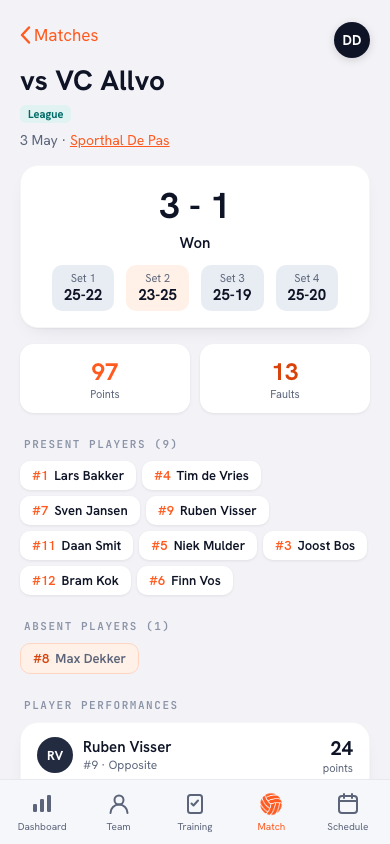
The second look: the error column
Reading points without errors is bookkeeping with one column. 25 points with 1 error is a world-class performance; 28 points with 8 errors is a gamble that happened to pay off today. Look above all at the ratio per role: from an opposite you accept risk, from a libero and setter barely any. More depth in error load per player.
The third look: what isn't there
The report shows scoring actions — not the pass that made every attack possible, not the defense that saved three rallies. The libero with zero points may have been the best player on the court. So never use the numbers as a complete appraisal: combine them with what you saw and capture that in notes. Numbers plus observation is the whole story; numbers alone is half of it.
From report to action
- Compliment with evidence: "17 points and only 2 errors — that's the balance we're after" works better than "well played".
- Question before judgment: when a report disappoints, first ask "how did it feel?" — the answer often explains more than the columns.
- Check the trend: one weak report is a day; open the growth overview before drawing conclusions.
Read the report yourself first, share it second. Whoever dumps the numbers into the group chat unseen hands the interpretation to the loudest player. The coach who reads first sets the frame: what do we celebrate, what do we learn?
Frequently asked questions
What's a good number of points per player per match?
Entirely role-dependent: an opposite in a four-set match easily reaches 15–25, a middle blocker 8–15, a setter 2–6. Compare players with their own average, not with each other.
My best player has poor numbers — now what?
Context first: was he on his own position, was the pass in order, was he playing injured? One bad report is noise. Three in a row is a conversation — including the question what he sees himself.
How do I discuss the report of a bench player with few minutes?
Not on absolute numbers — four points in a single set can be excellent. Convert to production per set and name what he showed in his minutes; that keeps the comparison fair.


Try it yourself in Koach
Less admin, more coaching — starting at your next practice.
Get started with Koach